A useful schematic is the upper critical solution temperature form of a binodal: a dome in temperature versus chromatin concentration. Below the dome, an intermediate overall concentration separates into a dilute phase and a chromatin-rich phase; above it the liquid is homogeneous. At a fixed temperature, the two intersections of a horizontal tie line give the compositions of the coexisting phases, not the concentrations of two different initial samples.
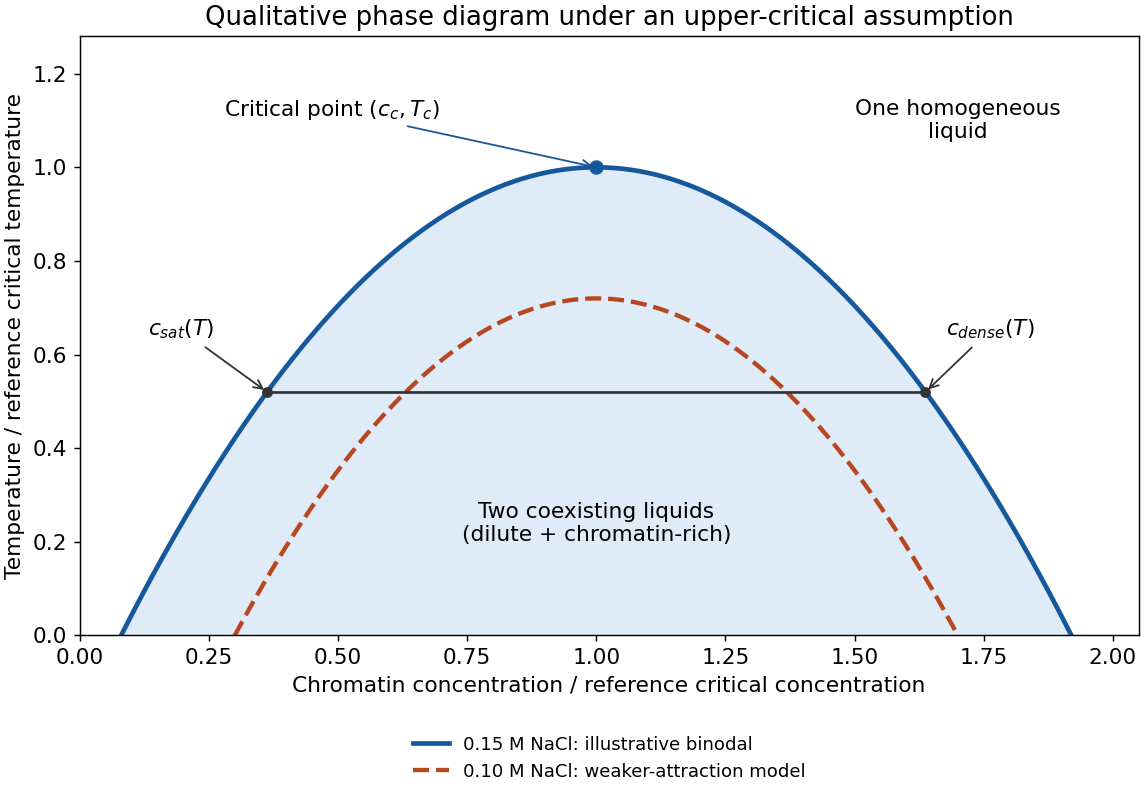
Schematic upper-critical-solution-temperature model for chromatin demixing and weaker attraction at lower salt
. Details. 
The diagram is a model, not measured phase-boundary data. The stated observation at one salt concentration does not by itself establish whether heating suppresses or promotes demixing. A lower critical solution temperature system would instead demix on heating, and would need the corresponding inverted geometry. The following answers make the usual enthalpically favourable-demixing assumption explicit.
The saturation concentration is the dilute-phase coexistence concentration at the specified temperature and solution conditions. On increasing the overall concentration through this boundary, a macroscopic condensed phase can first coexist with the dilute phase. The other branch gives the dense-phase concentration .
At the thermodynamic critical point, the two branches meet: their concentration difference vanishes. Its coordinates define the critical concentration and critical temperature . In the upper-critical model, admits no two-liquid coexistence. Thus is a temperature-dependent branch, whereas is the concentration at the endpoint.
Between coexistence concentrations, the lever rule gives the dense-phase volume fraction , assuming consistent concentration and volume definitions. Increasing total chromatin then primarily changes phase amounts rather than allowing the dilute phase to increase without bound.
At fixed volume and temperature, equilibrium minimizes the Helmholtz free energy . Mixing increases translational entropy, whereas favourable contacts between chromatin segments can lower the interaction contribution to internal energy. At low enough temperature, favourable contacts can compensate the entropy lost on concentrating the arrays; at higher temperature, the mixing contribution can dominate. This gives the upper-critical dome assumed in (a).
A simple illustrative Flory–Huggins solution theory writes the dimensionless mixing free energy per site asHere is an effective polymer size, not automatically the number 12, and represents an effective energetic incompatibility of polymer and solvent. The common-tangent construction determines coexisting compositions. Solving givesSince decreases on heating, the coexistence interval narrows and closes at . For fixed pressure the corresponding potential is Gibbs free energy, with the enthalpic term in ; enthalpy and internal energy should not be interchanged without stating the mechanical constraint. Hydration, ion release or temperature-dependent effective interactions can change this simple temperature trend.
In the regime where salt promotes chromatin condensation by screening repulsion between DNA-rich surfaces, reducing salt from 0.15 M to 0.1 M weakens the effective attraction. In the schematic upper-critical model this means a lower critical temperature and a smaller coexistence region; at a fixed suitable temperature the dilute-phase saturation concentration rises. The second curve is therefore drawn inside and below the first. The magnitude of the shift is not specified by the question.
This direction has a microscopic basis: reducing ionic strength increases the range of electrostatic repulsion between negatively charged DNA segments. Modelling of interacting arrays supports a role for screening and nucleosome contacts in stabilizing chromatin-rich phases.[ref]
Nucleosome plasticity is a critical element of chromatin liquid-liquid phase separation and multivalent nucleosome interactions by Stephen E. Farr and others. Salt-dependent coexistence and the role of nucleosome breathing
In the idealized limit of unscreened DNA-DNA repulsion, the ordinary condensed phase can disappear, rather than simply acquiring an arbitrarily small positive critical temperature. However, zero added NaCl is not literally zero counterions: charged chromatin requires charge compensation, and buffer ions and counterions associated with the preparation remain. Salt also screens attractive interactions, and very high salt can alter nucleosome stability. The proposed shift applies to the stated low-salt screening regime, not a universal monotonic law at every salt concentration.
Chromatin is a composite of charged DNA, folded histone cores, flexible histone tails and associated proteins. These parts differ in charge, hydrophobicity, flexibility, interaction partners and chemical modifications. It is therefore not a chemically uniform chain with one identical contact energy at every position.
Diversity also occurs along a chromosome: nucleosome occupancy, linker DNA length, histone variants, histone acetylation and other histone modifications change the local interaction pattern. Positively charged tails can contact DNA or neighbouring nucleosome surfaces; an acetylated lysine has different electrostatic properties and can recruit a modification-reading protein. The number, arrangement and lifetime of contacts matter as well as their average strength. A coarse-grained interaction parameter can summarize one preparation but should not be mistaken for a universal chemical constant of all chromatin.
The structural implication is a spectrum of arrangements, not a universal regular fibre. Local nucleosome packing, irregular accessible chains, compact domains and interactions between differently modified regions can coexist, and their balance depends on preparation and cellular context. Nucleosome breathing changes the sites available for intermolecular contacts and hence the connectivity of an array assembly; it is not merely a uniform change in the size of a rigid bead.[ref]
Nucleosome plasticity is a critical element of chromatin liquid-liquid phase separation and multivalent nucleosome interactions by Stephen E. Farr and others. Comparison of breathing and artificially constrained nucleosomes
Reconstituted-array experiments separate contributions that are difficult to disentangle in nuclei. Fluorescent arrays, microscopy, droplet fusion and molecular exchange measurements test condensation and dynamics; changing tails, linker organization or acetylation tests the interaction mechanism. Bryan A. Gibson and colleagues found that histone H1 and nucleosome spacing modulate condensation, while acetylation and reader proteins can produce different condensed states.[ref]
Organization of Chromatin by Intrinsic and Regulated Phase Separation by Bryan A. Gibson and others. Reconstituted arrays and regulation of condensate properties
In cells, combine imaging with contact maps and accessibility assays. Hi-C can reveal preferential contacts and chromatin compartments, but does not establish liquid behaviour. Fluorescence recovery after photobleaching measures recovery kinetics, but recovery alone does not prove equilibrium liquid-liquid demixing. Conversely, an in-vitro droplet is not proof that every nuclear domain forms by the same mechanism. The strongest case combines material behaviour with controlled molecular perturbations and measurements of the resulting organization.
Physicochemical diversity provides ways to regulate the same DNA without changing its sequence. Histone modifications, variants and recruited proteins can alter local contacts, accessibility and the partitioning of regulatory factors. This can couple chromatin organization to transcription, DNA replication and DNA repair, while allowing distinct genomic regions to behave differently in one nucleus.
For example, changing histone acetylation can weaken some intrinsic contacts while favouring binding of specific acetylation readers. A local state can therefore change both how strongly a region associates with itself and which partners it recruits. Reversible, multivalent interactions allow organization to respond to signals without requiring an irreversible solid assembly.
These mechanisms also allow memory: feedback between a chromatin-associated mark, its reader and modifying machinery can help restore a local state after replication. Such epigenetic inheritance still needs evidence for maintenance and re-establishment; a stable-looking condensed region alone does not establish it. Likewise, correlations between compaction and reduced transcription do not prove that condensation is always the cause of repression. Perturbations must separate altered material properties from direct effects on transcriptional machinery.
Articles by others on the same topic
There are currently no matching articles.