Let be displacements from equilibrium, with positive directions chosen alike. Hooke's law and Newton's second law giveFor a normal mode , the determinant condition isSolving the quadratic for givesThe angular frequencies are the positive square roots. Positive masses and spring constants make the stiffness quadratic form positive definite, ensuring both squared frequencies are positive. Distinct spring constants do not require equal masses or any symmetry approximation.
Put and . The mass-normalized stiffness matrix isIts symmetric eigenvector has eigenvalue , while its antisymmetric eigenvector has eigenvalue . ThusThe symmetric frequency does not depend on the middle spring constant because that spring has no extension in an in-phase normal mode. The antisymmetric motion stretches the middle spring and has the higher frequency for .
With the same positive displacement convention for both masses, the first eigenvector equation is . At the symmetric frequency it reduces to , while at the antisymmetric frequency it becomes . HenceIn both normal modes the displacement magnitudes are equal. For the first, the masses move in phase and their separation stays unchanged; for the second they move in opposite phase, alternately approaching and separating. A negative signed amplitude ratio records a phase difference of , not a negative displacement magnitude. The left panel of the later figure plots these signed normal mode shapes with the fixed wall values included.
Both masses in the source's absorber diagram are free: there is no additional spring attaching to a wall. Let their displacements be and . The equations areFor a periodic particular response , , the amplitude equations are and . Their solution isAt , and : the spring force on the larger mass cancels the applied force at every instant. This is antiresonance, a frequency-selective cancellation, rather than dissipation of energy.
There is a nearby undamped resonance at . For it lies close to the cancellation setting. More quantitatively, write . ThenFor , the amplitude relative to the unconnected mass's amplitude is approximately . A light absorber therefore needs very accurate tuning and loses suppression when the driving frequency changes. Its own travel can also become large, limiting linearity and available stroke.
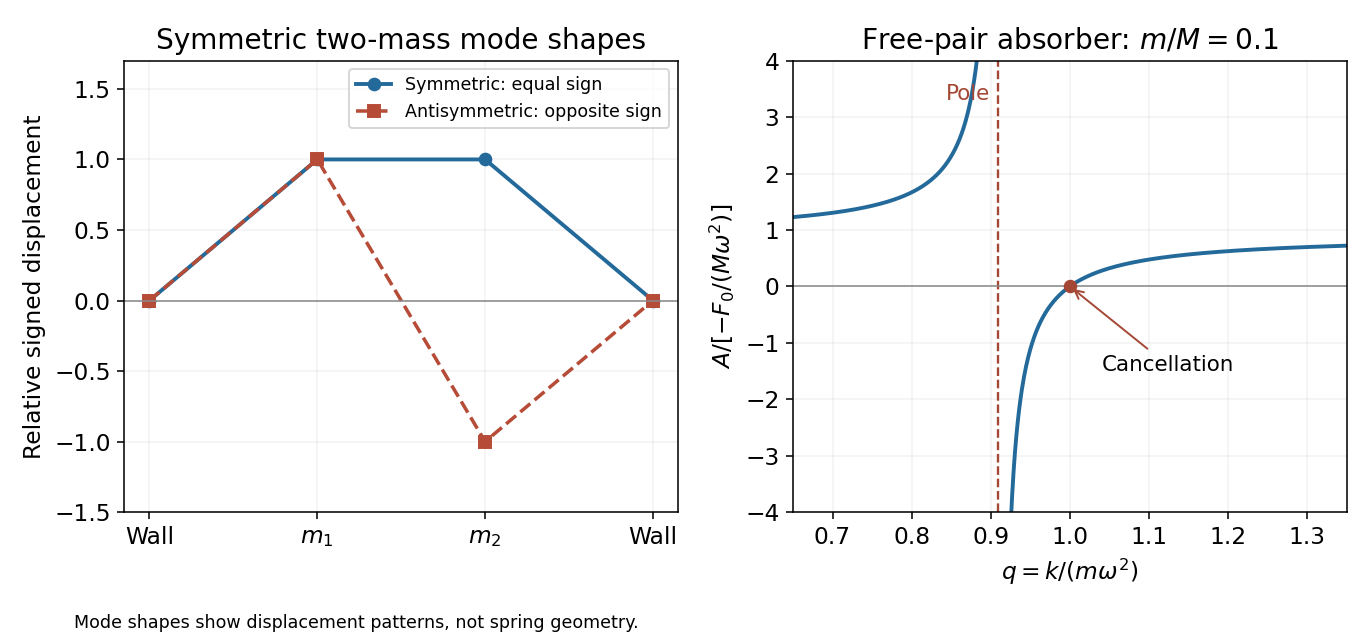

Without damping, resonance growth and persistent free oscillations remain; special initial conditions select the displayed periodic particular response. The free pair also has rigid-translation motion. These limitations prevent interpreting the cancellation as broadband damping or as a unique attracting late-time state.
Articles by others on the same topic
There are currently no matching articles.