For a stationary film of uniform thickness, thermal conduction gives , so . The cooling boundary condition determines :Consequently the surface temperature isThis is the quasistatic temperature of a conductively cooled film, with a weak-cooling expansion when .
Let the thickness and longitudinal scales be , with . Incompressibility gives transverse speed of order , and film evolution has the kinematic time scale . For the temperature variation scale , longitudinal diffusion divided by transverse diffusion is . Each advective term, and the time derivative on that evolution scale, divided by transverse diffusion isThus and make the leading thermal profile locally linear and quasistatic. Retaining the weak-cooling condition gives the same surface-temperature approximation with the local . For any independently imposed faster time variation one would also require its thermal relaxation ratio to be small.
Define the positive surface-tension gradient coefficientThe weak-cooling approximation gives , so the Marangoni stress is . The Young–Laplace equation gives the leading liquid pressure , with constant ambient pressure. In lubrication theory, and . The no-slip boundary condition at the wall and the tangential surface condition giveHence the volume flux isConservation of mass gives the thermocapillary thin-film equationThe replacement of surface tension by in the capillary term needs . For comparable capillary and thermocapillary fluxes,so the fractional tension change is only . Both the tension correction to and the differentiated-tension contribution are then higher-order. Weak cooling alone would not justify that replacement if were allowed to grow without bound.
The capillary term smooths the film: a crest has negative curvature and higher liquid pressure, causing flow away from it. The thermal term has the opposite effect. A thicker region has a colder surface and therefore higher surface tension; Marangoni stress pulls surface fluid toward that region, reinforcing the thickness disturbance. These mechanisms give fourth-order damping and second-order growth respectively.
Use , , and . The two dimensionless flux-divergence coefficients are and . Setting both equal to one gives the balanced scales for a thermocapillary film:These choices yield . The predicted must be small for the assumed long-wave approximation.
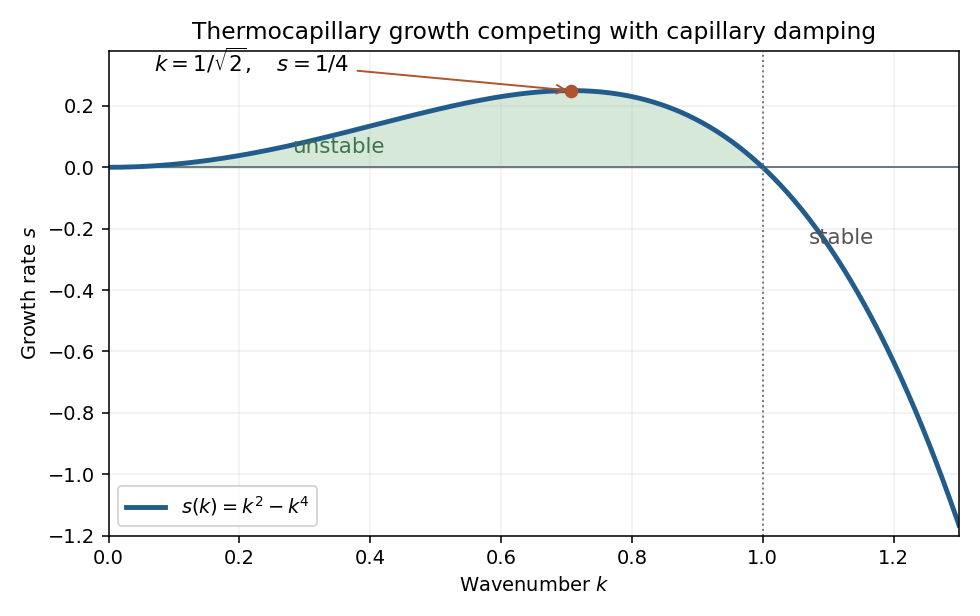
Linearize about using a normal mode of amplitude . The resulting equation is , so the dispersion relation isModes with grow, while modes decay. Differentiating gives the most unstable wavenumbersThe physical fastest wavenumber is .

For a positive steady film with zero volume flux, . Divide by and integrate once:Choosing the thickness scale so that when sets . Multiply by and integrate to obtain the zero-flux thermocapillary film profiles relationThus the stated potential is and the integration constant is the corresponding first integral.
Articles by others on the same topic
There are currently no matching articles.