Take and , with unit-weight antisymmetrization. The Clifford algebra first givesExpand the two antisymmetrized gamma matrices using :Anticommuting past the next contracted factor givesSubtracting the remaining gives the gamma-matrix vector sandwichIn particular it vanishes in four dimensions. The result is independent of the choice of Lorentz signature when all indices are contracted consistently. Defining the bivector without its factor would multiply by four.
Choose the charge conjugation matrix so that and , and write . Since the components are odd Grassmann variables,Thus a symmetric matrix gives zero, whereas a nonzero antisymmetric matrix can give a nonzero bilinear. The four-dimensional Majorana bilinear vanishing criterion follows by transposing an antisymmetrized product and reversing its factors:For , the symmetry types are respectively antisymmetric, symmetric, symmetric and antisymmetric. These are the same-spinor selection rules of the Majorana spinor; they would be reversed for a commuting spinor. The vanishing choices are (a) and (c).
The matrix is symmetric. Its contraction with two identical odd Grassmann variables is antisymmetric under their exchange, soThis is the vector case of the four-dimensional Majorana bilinear vanishing criterion.
The matrix is antisymmetric, so the scalar Majorana spinor bilinear is not identically zero. For example, choose two independent odd Grassmann variables at a pair of indices with . Their contribution is , which is nonzero as a Grassmann polynomial. This is why a Majorana mass term is possible.
Four-dimensional Hodge duality identifies with a nonzero convention-dependent multiple of . Every is symmetric by the four-dimensional Majorana bilinear vanishing criterion; taking this linear combination preserves symmetry. HenceThe phase in the duality formula depends on the definition of and orientation, but does not affect the vanishing result.
The three-gamma matrix is antisymmetric, and for three distinct indices it is nonzero. A pair of nonzero Grassmann components therefore produces a nonzero term exactly as in the scalar case. Consequently this three-form bilinear is not identically zero. Equivalently it is dual to the axial-vector Majorana spinor bilinear, which is allowed; it must not be confused with the vanishing vector in part (a).
Here a supersymmetry-preserving combination means a real combination of Hermitian Majorana spinor supercharges, in a positive-norm unitary representation of the ordinary Super-Poincaré algebra. This reality qualification is essential. Let be normalized and in the charge domains, and define the real symmetric matrixFor real , the Hermitian operator satisfiesTherefore is a positive semidefinite matrix, andThe reverse implication uses positivity: diagonalize , so a zero quadratic form has zero component in every positive-eigenvalue direction. This converts the problem into nullity of real N=1 supercharges, not just a condition on the determinant of an operator-valued expression.
In the equivalent Weyl spinor form, . After a fixed invertible change of real charge basis, is the realification of the Hermitian two-by-two matrixup to the harmless spatial-sign convention. A complex Hermitian matrix has the same eigenvalues in its realification, each repeated twice. The Pauli matrix multiplication law gives , so these eigenvalues are and , each twice. Positivity forces . If one nonzero real annihilates the state, has a kernel: either , with exactly two zero eigenvalues, or , with four. ThusFor a momentum eigenstate these are the null-momentum and zero-momentum cases; the expectation-matrix proof also covers states not assumed to have definite momentum. There are no massive states preserving a real charge in this unextended algebra.
If “linear combination” instead allows arbitrary complex coefficients, the unrestricted claim is false. In a massive fermionic Fock space with two lowering operators and a spin-half Clifford vacuum spectator, takeThen . The three vectors , and are linearly independent, by their occupation numbers and spectator spin labels. The complex annihilator is therefore only one-dimensional. Such a lowering operator is not a Hermitian generator of preserved real supersymmetry. The boxed conclusion applies to the physical real-charge interpretation; it also assumes no domain-wall charge in N=1 supersymmetry.
In a massive four-dimensional N=1 supersymmetry representation, the two normalized raising supercharges transform as a spin-half doublet. Start with a Clifford vacuum of superspin . At occupation levels zero, one and two, the ordinary spins areThe two-creation state has a spin-singlet oscillator factor because the creation operators anticommute. Thus the massive N=1 vector multiplet containsThere are four bosonic polarizations, , and four fermionic polarizations, , as required by boson-fermion degeneracy in a supermultiplet.
In the massless limit the helicity multiplicities become , two copies each of , and two zero-helicity states. They separate into the four irreducible helicity pairsWith the lower-helicity convention for superhelicity, a pair has labels , respectively. A midpoint convention shifts each label by ; the explicit helicity pairs remove any naming ambiguity.
Pairing under the CPT theorem, the first and last pairs form a massless vector multiplet, and the middle two form a massless chiral multiplet. This is the massless limit of a massive N=1 vector multiplet. The longitudinal vector polarization supplies one of the chiral multiplet's two real scalar modes; the original spin-zero state supplies the other. Simply discarding the longitudinal polarization would lose a physical degree of freedom and give the wrong decomposition.
A scalar superfield transformation is a pullback under a supertranslation. Since that transformation mixes and , an odd-coordinate derivative acquires an extra spacetime-derivative term under the coordinate Jacobian. It therefore does not transform as a spinor superfield merely by differentiating the scalar transformation law. This is partial derivatives and superfield covariance.
For explicit signs, split the Majorana spinor coordinates into and use left Grassmann derivatives. Choose the differential generatorsFor example, , which is nonzero. Commuting the even supersymmetry variation through consequently gives the unwanted translation term.
Replace the ordinary odd-coordinate derivatives by the supersymmetric covariant derivativesThe graded product rule cancels the mixed coordinate/derivative terms, giving . Thus and transform as spinor superfields. Their own mixed algebra is , with equal-chirality anticommutators zero. This covariant differentiation is also what makes a chiral superfield constraint supersymmetry invariant. Negating every barred derivative is another convention, but changes the displayed mixed-algebra sign.
In the ordinary local two-derivative matter class, the general ungauged supersymmetric action for a chiral superfield isThe Kähler potential is real, and the superpotential is a holomorphic function. Adding to changes the action only by a boundary term: full superspace integration of a chiral or antichiral function vanishes modulo that term. This is a Kähler transformation. A positive Kähler metric is required for a nonsingular positive-norm kinetic term, not just for derivative counting.
To see the differential order, the bosonic component Lagrangian in mostly-plus signature containsThe auxiliary field equation is algebraic: on a purely bosonic configuration. It gives the scalar potential . The scalar equations have at most two spacetime derivatives, the fermion equations from the sigma-model kinetic term have one, and the remaining interaction terms do not raise this order. The fermionic corrections to the auxiliary equation are still algebraic.
For four-dimensional renormalizability, assign engineering dimensions , , and . Hence, up to a Kähler transformation and a constant field normalization, the restrictions areA mixed higher-degree term in or a term of degree above three in introduces a negative-mass-dimension coupling. The constant has no local effect in global supersymmetry, as in the constant superpotential in global supersymmetry.
The boxed general-action statement uses the conventional two-derivative matter interpretation. It is not a classification of all derivative-dependent effective superfield actions by the order of their bosonic equations alone. For example, a scalar Lagrangian quartic in first derivatives still yields a second-order Euler–Lagrange equation, and supersymmetric derivative-dependent interactions can contain such terms. Their auxiliary and fermionic equations require separate checking. This distinction is explicit in the original construction of supersymmetric derivative-dependent scalar actions. Such actions are outside the ordinary class used for the renormalizable answer here.
Use the supertranslation-invariant superspace coframeIt is a basis because the change from is triangular with identity diagonal blocks. Under a rigid supertranslation, , and . Therefore , and .
Writing wedge products explicitly, the three-form isBoth factors are supertranslation invariant. Under a Lorentz transformation, and the bilinear in transform as vectors, so their contraction is invariant. Thus is invariant under the Super-Poincaré group.
The Maurer-Cartan equation is . Since the other factor is closed,The required four-dimensional Fierz rearrangement identity, which may be stated without proof, isDifferentials of odd Grassmann variables commute in the graded exterior algebra. Thus the coefficient of the product of four factors is the fully symmetric spinor-index part appearing in this identity. It vanishes, provingThis is the closed three-form on four-dimensional superspace; it should not be confused with the different closed four-form used for a membrane coupling in Question 10.
Spontaneous supersymmetry breaking preserves the action and conserved supercharges, but the vacuum fails to be invariant. This differs from explicit breaking, which changes the symmetry of the action itself. In global four-dimensional N=1 supersymmetry, summing diagonal entries of the Super-Poincaré algebra writes the Hamiltonian as a sum of positive charge anticommutators. Its expectation is a sum of squared norms. Consequently a zero-energy vacuum is supersymmetric, whereas an existing vacuum with broken global supersymmetry has positive energy density. The energy zero is fixed by the algebra. Neither this positivity statement nor the particle-multiplet mass relations should be transferred without qualification to supergravity.
For supersymmetric quantum mechanics, let , , and let fermion parity anticommute with both charges. On a positive-energy eigenspace, is an odd involution: its square is one, it preserves energy, and it reverses parity. Thus every positive-energy bosonic state has a fermionic partner and conversely. Their contributions cancel in the Witten indexFor a discrete spectrum with a well-defined trace, this proves independence of . Continuous changes of parameters also preserve the index if the trace stays well defined and no state escapes to infinity or crosses an unregulated continuum threshold. A nonzero index guarantees an unbroken supersymmetric ground state; a zero index is inconclusive. For example, de Rham supersymmetric quantum mechanics on a circle has a bosonic constant zero-form and a fermionic constant one-form, both normalizable zero modes, so it is unbroken with index zero.
A more explicit one-dimensional family illustrates how normalizability determines the answer. DefinePositivity of these Hamiltonian operators shows that a zero mode must solve or . Thus the only candidates areFor , the Gaussian minus-sector wavefunction is normalizable and its reciprocal is not, giving an unbroken model with when the minus sector is assigned even parity. For , , the exponent tends to opposite infinities at the two ends, so neither candidate is normalizable. Both partner potentials grow quartically; their spectra are discrete and their lowest energies cannot be zero. The lowest states are therefore paired at positive energy, , and supersymmetry is spontaneously broken. This is supersymmetric factorization and zero-mode normalizability. In quantum mechanics the paired ground states illustrate the charge algebra; a relativistic massless-particle conclusion requires field-theoretic hypotheses.
In relativistic global field theory, Goldstone's theorem has a fermionic version. If a conserved supercurrent charge does not annihilate the vacuum, its Ward identity has a nonzero vacuum contact term. Fourier transforming, the divergence of the current correlator cannot tend to zero smoothly at zero momentum. Its spectral representation therefore contains a massless fermionic pole: the Goldstino, with spin one-half. This statement assumes a Poincaré-invariant vacuum and the usual local unitary field-theory conditions. It does not require a bosonic Goldstone particle for the fermionic symmetry. In supergravity the Goldstino can instead supply the longitudinal polarization of a massive gravitino.
For canonical chiral superfields , elimination of their auxiliary fields givesA supersymmetric vacuum solves every . At a stationary broken vacuum,The same matrix is the chiral-fermion mass matrix, so the nonzero vector is a zero mode. This derives the Goldstino zero mode from vacuum stationarity. The transformation independently identifies that direction through its inhomogeneous shift.
For one canonical chiral field, , , has everywhere, a massless fermion and a classically flat scalar direction. It is flat F-term breaking with a linear superpotential, rather than an isolated vacuum. In contrast, a nonconstant polynomial of positive degree has a complex root and hence a supersymmetric vacuum; in particular a generic quadratic or cubic single-field superpotential cannot remove all such roots. This argument assumes canonical nonsingular kinetic terms and does not claim that every runaway or nonpolynomial model has a vacuum.
A renormalizable three-field O'Raifeartaigh model gives a less degenerate illustration:The auxiliary equations require , then , leaving . They cannot vanish simultaneously. For real positive with , the potential obeysTherefore its global tree-level minimum has , arbitrary , and energy . The massless is the Goldstino, while is a pseudomodulus. At , the scalar mass-squared spectrum is , and the fermion masses are . This exhibits both the stability condition and the loss of ordinary supermultiplet mass degeneracy in a broken vacuum. Quantum corrections can lift the pseudomodulus and must be analysed rather than assumed away; the noncompact classical valley also prevents an unqualified finite-volume Witten index trace argument. The index, the vacuum equations and the Goldstino theorem consequently answer complementary questions.
Ordinary electromagnetism uses a one-form gauge potential, its gauge transformation and its curvature. On superspace the corresponding object is a superspace gauge connection, with both vector and spinor components. Write . Its graded commutator contains the flat-frame torsion plus supercurvature. The conventional constraints set the two undotted-spinor curvatures, the two dotted-spinor curvatures and the conventional mixed spinor curvature to zero; the mixed derivative algebra then determines the vector connection. The remaining independent gauge curvature is packaged into a chiral field-strength superfield. A real vector superfield is a prepotential solving these constraints, rather than four unrelated ordinary gauge potentials.
Use the left-derivative conventions of Question 5, with and . An Abelian supergauge transformation has a chiral parameter , and one consistent normalization isThe parameter is chiral so that the transformed matter is still a chiral superfield; its complex components remove more of the prepotential than an ordinary real gauge parameter. In Wess-Zumino gauge, one convenient expansion isIts components are the gauge potential , the gaugino and the real auxiliary field . Wess-Zumino gauge removes the extra scalar and spinor components of a general real superfield. Supersymmetry transformations usually leave that gauge slice and require a compensating supergauge transformation. For a residual chiral parameter with real lowest component , the expansion gives and ; thus is the ordinary Maxwell gauge parameter.
The Abelian field strength is the Abelian field-strength chiral projectionThree barred derivatives vanish because there are only two anticommuting dotted components, so . Gauge invariance follows directly: by antichirality, while the mixed derivative algebra gives for chiral . In chiral coordinates its component structure iswhere fixes the tensor normalization. Overall gaugino phase choices do not change the gauge-invariant field strength or its Bianchi constraint.
Reality of and the derivative algebra imply the superspace Yang-Mills Bianchi identityIndeed, the two sides are the same differential operator on , because . This is the superspace counterpart of , and its components contain . It is a defining curvature constraint, not the Maxwell equations. Varying the pure gauge action additionally sets the common real superfield to zero; matter supplies a current instead.
The Supersymmetric Yang-Mills action and minimal matter coupling areThe chiral phase factors cancel in . The component matter derivative is , which transforms covariantly under the residual gauge transformation just derived. The same superspace term generates the associated matter–gaugino Yukawa coupling and auxiliary coupling, so minimal coupling is not only replacing an ordinary derivative in the scalar action. The gauge action contains , the gaugino kinetic term and . Rescaling the vector multiplet to canonical kinetic normalization gives the physical coupling . The holomorphic superpotential must be gauge invariant; a single field of nonzero continuous Abelian charge admits no nonconstant polynomial superpotential without additional fields. For several fields, invariance requires . A Fayet–Iliopoulos term is additionally possible for an Abelian factor, shifting the algebraic equation.
For a non-Abelian gauge group, and are Lie-algebra-valued, and multiplication cannot be reordered. For matter in a specified representation, setThe same matter quadratic form remains invariant. Its curvature isAt first order in an Abelian , this reduces to , fixing the factor . In the chiral gauge frame, and as an operator. The gauge-covariant Bianchi identity is , where is the conjugate curvature expressed in that same frame. It follows from the graded Jacobi identity of the covariant derivatives. Taking a trace of makes the chiral gauge action invariant. Its bosonic curvature becomes the ordinary Yang-Mills curvature, and the gaugino transforms in the Adjoint representation. A constant Fayet–Iliopoulos coefficient cannot be inserted for a simple non-Abelian group, since it would need an invariant linear functional annihilating every Lie bracket. These constructions connect the constrained superspace connection, its prepotential and its component gauge multiplet.
A canonical Wess–Zumino model with a cubic superpotential already supplies a microscopic membrane-like object. Choose positive real andThere are two isolated supersymmetric vacua, . A planar domain wall has a static scalar profile depending on the transverse coordinate , with one vacuum at either end. Its energy per unit area isChoosing gives . The real increasing solution saturates the bound:The tension follows either from integrating or from . This is a supersymmetric domain wall, and the first-order equation also implies the second-order scalar equation. Its thickness is of order .
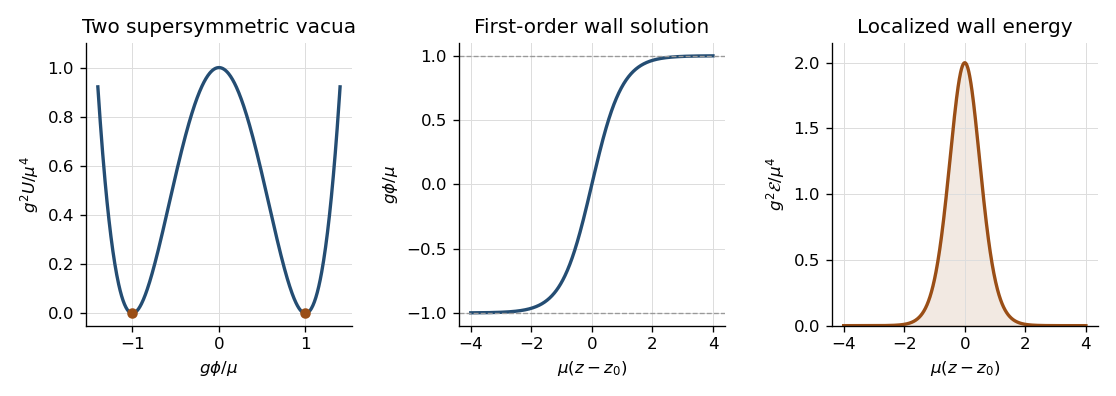

The wall breaks transverse translations: changing gives a normalizable scalar zero mode proportional to . It also preserves only half the four real supercharges. In the chiral-fermion transformation, and the derivative term combine into a rank-half condition on the constant supersymmetry parameter, for example in a compatible Weyl convention. The orthogonal two real parameters are broken and generate localized fermion zero modes. One such profile satisfies , giving . The scalar and a three-dimensional Majorana fermion therefore form the low-energy wall multiplet. The domain-wall charge in N=1 supersymmetry is a boundary/tensor charge contributing to the extended algebra; the preserved combinations saturate . This avoids falsely applying the unextended particle-algebra argument of Question 3 to a wall with nonzero tension.
Promote the translation collective coordinate to a slowly varying worldvolume field . At wavelengths long compared with the wall thickness, its leading relativistic geometric action is the Dirac membrane actionIt is invariant under worldvolume reparametrizations and the target Poincaré group. In static gauge , , the matrix determinant lemma givesDirectly substituting the leading collective-coordinate profile into the scalar kinetic term gives the same coefficient, since . Target Lorentz symmetry fixes the leading first-derivative nonlinear completion to the invariant area; finite-thickness physics can add higher-curvature terms. The area action is therefore a long-wavelength effective field theory, not an exact replacement for the microscopic wall at arbitrary momenta. Its embedding equation is .
For the four-dimensional supermembrane, extend the embedding to with a four-real-component Majorana spinor. Pull back the invariant coframe of Question 7:Replacing by makes the area term invariant under rigid target supersymmetry, but does not yet give the appropriate fermionic gauge symmetry. Add a Wess-Zumino brane coupling to a superspace three-form potential . In one orientation and matching normalization,The supermembrane closed four-form uses the distinct four-dimensional Fierz identity . Differentiating reduces its coefficient to this symmetric tensor, so . A local potential therefore exists. Since the curvature is supertranslation invariant, the potential can vary by an exact form; its pullback integral is invariant modulo boundary terms. This is why the three-form of Question 7 is not itself the membrane field strength: integrating a membrane potential requires three-form degree and hence four-form curvature.
The required additional local fermionic gauge invariance is kappa symmetry. Define the worldvolume gamma matrices andWith mostly-plus target signature, a local orthonormal worldvolume frame gives , so and . Thus are rank-two kappa symmetry projectors. The embedding variation gives . The area variation is consequently proportional to . Contracting the displayed with the fermionic variation and using gives the opposite Wess-Zumino contribution with an extra . Their sum is proportional toFor the boxed kappa variation, , so it vanishes by . Reversing membrane orientation reverses the Wess-Zumino sign and the matching projector. The cancellation fixes the relative charge magnitude to the tension; rigid supersymmetry alone would not fix it.
Worldvolume reparametrizations remove three of the four embedding scalars, leaving one transverse mode. Kappa symmetry removes half the four real embedding spinor components, leaving a two-component three-dimensional Majorana field, whose first-order equation has one on-shell fermionic polarization. The physical worldvolume modes are one scalar and one Majorana fermion, matching the wall zero modes. Without kappa symmetry the fermionic degrees would be doubled. A planar configuration preserves the target supersymmetries that can be compensated by the kappa projector, reproducing the wall's half-supersymmetry condition. This is the four-dimensional effective domain-wall interpretation of a supermembrane, rather than the eleven-dimensional M2-brane particle-content problem.
Articles by others on the same topic
There are currently no matching articles.