Work with canonically normalized real components of the scalar field; a complex representation can first be written in terms of its real and imaginary components. At a vacuum expectation value , expansion of the scalar potential givesThe linear term vanishes by stationarity. Thus the scalar mass matrix is the Hessian matrix of the scalar potential. Invariance under each Lie algebra generator gives the identity . Differentiating this identity with respect to and evaluating at the stationary point removes the term containing , leavingThe kernel of the map is precisely the Lie algebra of the stabilizer subgroup H. Consequently its restriction to a complementary space of broken Lie algebra generators is injective: a linear combination that annihilates would belong both to the stabilizer algebra and its complement, and hence would vanish. There are therefore independent Goldstone directions in the scalar mass matrix, tangent to the vacuum manifold. There are symmetry-protected massless scalars.
This Goldstone theorem guarantees at least that many zero quadratic masses. The claim that these are all the massless scalars additionally requires nonzero curvature transverse to the vacuum orbit. For example, , with , has an ordinary spherical vacuum manifold but its entire Hessian matrix vanishes there. These accidental massless radial modes beyond Goldstone modes are not excluded by the hypotheses. For the indicated orthogonal group breaking, the protected number is
For the Higgs doublet, put and wherever . If , thenThis explicitly exhibits the three angular coordinates as an SU(2) transformation of a real radial field. In particular, the polar coordinates for the electroweak Higgs doublet can locally be chosen in the formAt the vacuum the three variations generated by , , and acting on are independent over the reals. They span the three broken directions; the remaining generator annihilates the vacuum. This proves that the exponential supplies local angular coordinates. An inverse local gauge transformation, applied also to the gauge fields, removes these three fields in unitary gauge. They supply the longitudinal polarizations of the massive W bosons and Z boson through the Higgs mechanism. The parameterization is local about a nonzero vacuum, rather than a coordinate system through every possible zero of the Higgs doublet.
Use the metric and define the charged W bosons and neutral gauge fields bywhere , , and . Direct substitution into the gauge-covariant kinetic term givesand henceThe electroweak doublet gauge-boson mass matrix in the basis isIts normalized zero direction is and its massive direction is . Thus the scalar-vector terms in physical fields arewith the tree-level electroweak gauge-boson massesThese are also charge eigenstates. The unbroken U(1) gauge symmetry has generator ; on the Higgs doublet, . Since , the combinations have charges , while Z, the photon, and H are neutral. The photon disappears from the displayed scalar-vector terms because . The photon is massless and has no direct tree-level coupling to the remaining radial scalar in this sector. This does not remove its interactions with charged W bosons, or exclude a scalar-to-photon interaction generated by loops.
Finally, retain the printed normalization of the Higgs field potential:The kinetic term is , so the Higgs radial mass for a half-normalized quartic potential is . The extra factor of two familiar from a potential with prefactor , rather than , does not apply here.
The derivative convention uses hypercharge Y with . For each lepton family , the left-handed fields form an SU(2) doublet , with . Their weak isospin values are and their electric charges are . The right-handed charged lepton is an SU(2) singlet, with , and charge . The minimal model used here has no right-handed neutrino. A sterile right-handed neutrino, if added as a singlet with , would have no charged weak current interaction. Antiparticles carry the conjugate representations and opposite electric charges.
Expanding supplies . The off-diagonal entries of are and . With the chiral projector , one has . Thus the two W boson interactions areFor quarks, separate rotations diagonalize the up-type and down-type mass terms. If their left-handed rotations are and , the charged interaction contains the CKM matrix :There is an implicit sum over color charge. This quark mixing permits transitions between different families, rather than just the paired fields in a single doublet.
Let and . At momenta much smaller than , neglect derivatives in the heavy W boson equation. Its mass and source terms can be completed to a square:This explicitly performs integrating out a charged vector boson. The resulting Fermi interaction isThe omitted terms contain derivatives and are relatively suppressed by momentum squared divided by .
For the leptonic pion decay, Lorentz covariance restricts a vacuum-to-spin-zero current matrix element to a constant times . In the rest frame, rotations eliminate the spatial components. Under parity, the temporal vector current is even, whereas the vacuum is even and the pion is odd, so its temporal matrix element equals its negative and vanishes. The temporal axial current is odd and is allowed. This proves the vacuum-to-pseudoscalar current selection rule, rather than merely assuming an axial current. Define the pion decay constant byThen the vector-minus-axial charged weak current has matrix element , up to an irrelevant overall phase convention. Consequently the scattering amplitude for the decay can be writtenUse , the momentum-space Dirac equation , and for a massless neutrino. Since , the neutrino contribution vanishes, leavingThe fermion spin sum is, using the supplied gamma matrix trace identities,Here , , and . The mass term in the trace vanishes; anticommuting reduces the remaining trace to twice . It follows thatUsing two-body decay phase space, with final momentum magnitude , gives the leptonic pseudoscalar decay widthThus the requested factor is already present in the squared amplitude, and the phase space supplies one more threshold factor.
The physical explanation is helicity suppression. In the pion rest frame the two momenta are opposite. The massless antineutrino has positive helicity; zero total angular momentum would require the electron to have positive helicity too. The charged weak current instead creates a left-chiral electron, whose helicity is negative when its mass vanishes. A nonzero electron mass admits the required opposite helicity with an amplitude proportional to . The decay amplitude vanishes for , and the rate is suppressed by .
Start with the Dirac equation . The equation for the Dirac adjoint is . Transpose it and multiply by the charge-conjugation matrix C to obtainFor this to be the original Dirac equation multiplied by minus one, the necessary matrix identity isUsing , the charge conjugation of the Dirac adjoint follows directly:The final step uses and .
Let , , and . For anticommuting fields, or normal-ordered operator bilinears, the minus sign in the transformed Dirac adjoint cancels the minus sign from interchanging the two fields. The charge conjugation of fermion bilinears is thereforeThe matrix identity just proved gives . Also , obtained by transposing its four gamma matrices and reversing their order. Henceso and , where . Since the external vector V is odd under charge conjugation, becomes and is generally not invariant.
For parity symmetry in quantum field theory, write . The given spinor transformation gives , , and , with arguments evaluated at the reflected point. The contracted interaction again becomes . Each of parity and charge conjugation interchanges the two chiral contractions; applying both restores . This particular neutral current interaction is CP invariant, although neither P nor C is separately a symmetry. This conclusion uses the stipulated C-odd vector transformation; it is not a claim that all interactions of the Standard Model preserve CP symmetry.
For time reversal of a Dirac field, the gamma matrix adjoint and transpose identities giveWith , anticommutation of with every gamma matrix yieldsEquivalently, . Since time reversal is an antiunitary operator, the factor i in must also be conjugated. ThusUsing the stated transformations of the field and its Dirac adjoint, the transformed bilinear consequently isThe external vector has the same component signs. Their contraction is unchanged, proving time reversal of a real neutral chiral vector interaction. A real coupling is understood; an antiunitary operator also conjugates coefficients, and relative complex weak phases need not satisfy this invariance.
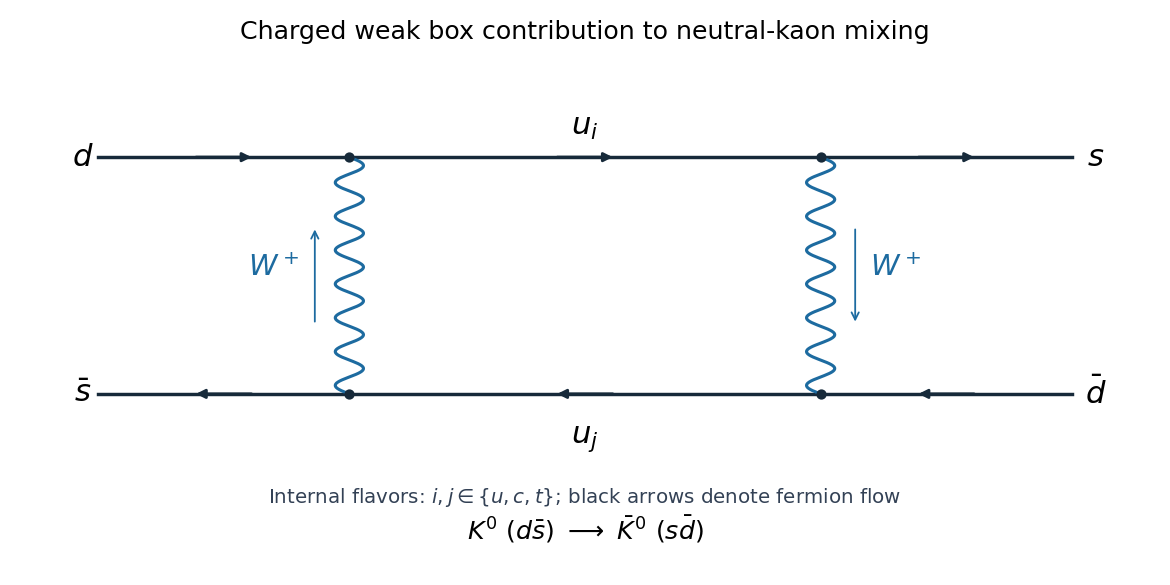
A charged weak box contribution to kaon mixing is shown below. The incoming and outgoing connect through two charged W bosons and two internal up-type quarks. The black arrows are fermion flow, so the lower line's arrows oppose the momentum of the corresponding antiquark. The blue arrows specify the direction of positive charge carried by the charged propagators. Each vertex is a charged weak current vertex, with the appropriate CKM matrix element; the internal flavors are summed over .

Use precisely the printed exchange-positive CP convention for neutral kaon mixing. In the flavor basis, CP symmetry acts by . Write the restricted effective matrix asThen , so CP invariance of this mixing operator is exactly . Therefore CP noninvariance in this neutral-kaon mixing block means . Violation elsewhere in a larger Hamiltonian would not, by itself, prove an inequality for this particular block.
For neutral-kaon mass matrix diagonalization, choose correlated roots , , and eigenvalues . The vectors and are the corresponding eigenvectors, as direct multiplication verifies. Taking orthonormal flavor states and writing the printed CP eigenstates as and , one findswhere the kaon CP mixing parameter isOverall phases have been absorbed. The kaon mixing square-root branch convention must be chosen continuously so that in the CP-conserving limit for the eigenstate labeled plus. These formulas are exact in the nondegenerate case with ; the requested small admixtures follow if . Smallness is an additional weak-CP-violation assumption, not a consequence of alone. A Hermitian mass operator has ; the same algebra also applies to the effective non-Hermitian operator that includes decays, where the two eigenstates need not be orthogonal. At a fully degenerate , a CP eigenbasis can simply be chosen.
Put and neglect electron and final-quark masses compared with . First fix a final color charge; its multiplicity will be restored for the inclusive rate. The photon-exchange scattering amplitude is, up to an overall phase,Averaging over the two spins of each incident particle and summing final spins givesBy the gamma matrix trace identities, the first trace is , and likewise for the second. Contracting the two tensors cancels the terms proportional to , givingIn the centre-of-mass frame all four energies are . The first pair of scalar products equals each, and the second pair equals each. Hence .
For clarity, the printed flux hint has a factor-of-four inconsistency: when , the prefactor multiplying the spin-averaged amplitude is , not . Alternatively, is correct if . Use this massless two-body scattering flux normalization, keeping the spin average separate.
To obtain the two-body Lorentz-invariant phase space directly, integrate the momentum-conserving spatial delta function, leaving . The remaining radial integral is , so . The relativistic scattering cross-section is consequentlySince , the integrated electron-positron annihilation into a quark pair result, for this fixed color, isThe first two printed formulas are thus color-stripped. Distinct final colors are orthogonal states and must be summed, producing . At leading order each accessible quark flavor contributes independently. Away from thresholds and narrow resonances, quark-hadron duality relates the inclusive parton rate to the observed inclusive electron-positron annihilation into hadrons, givingThis formula concerns the photon channel, assumes is large compared with the relevant quark masses and the strong-interaction scale, and does not include Z boson exchange.
Beyond leading order, an exactly exclusive pair of colored quarks is not an observable asymptotic state because of confinement and hadronization. Moreover its virtual corrections have infrared divergences; real soft or collinear gluon emission cannot be excluded if a finite rate is wanted. The inclusive sum includes both the corrected two-parton channel and channels such as , with their degenerate soft and collinear limits. Real and virtual infrared divergences then cancel for an infrared-safe observable. A specified jet observable can also be meaningful if it defines an infrared-safe observable; a bare two-quark final state is not.
A convenient inclusive calculation uses the optical theorem. For the electromagnetic hadronic current , defineThe hadronic electromagnetic-current spectral density is obtained from its discontinuity. In this convention the hadronic R ratio is , where at this order. Cutting the forward amplitude sums all allowed hadronic intermediate states, so perturbative Quantum chromodynamics applied to this inclusive quantity implements the required sum of real and virtual contributions.
Finally, write , , , and . The given truncated correction isDifferentiate with respect to , using the stated one-loop beta function and . The derivative of cancels the explicit logarithmic derivative at order . Keeping the residual derivative of the truncated expression givesThus the principle of minimal sensitivity, applied to this expression with nonzero coupling and , selects the one-loop stationary scale for the hadronic annihilation correctionThis is a prescription based on the residual order- scale dependence of an order- approximation. At strictly order , the derivative already vanishes for every renormalization scale; the prescription does not assert exact scale dependence of the observable. It is useful only while the selected running coupling remains perturbative. If or , the stated derivative imposes no unique scale.
Articles by others on the same topic
There are currently no matching articles.