Buoyancy and the convective criterion. Consider a small fluid parcel displaced outward by . Assume that sound waves keep its pressure equal to the ambient pressure, while heat exchange is slow enough that its displacement is an adiabatic process. Composition is uniform, so the parcel and its surroundings have the same mean molecular weight. For an ideal gas, , and an adiabatic parcel obeys . If is the pressure change on moving outward, thenThe density excess of the parcel at its new location is thereforeIf , this excess is negative: the outward-displaced parcel is lighter and accelerates farther outward. A downward displacement similarly continues downward. Conversely, a smaller gradient gives a restoring buoyancy force. The Schwarzschild criterion is thus stability for and instability for , where the adiabatic temperature gradient is . For a monatomic gas,A composition gradient would require the additional density effect in the Ledoux criterion; it is absent in this calculation.
Opacity and pressure. The supplied opacity is characteristic of a cool hydrogen-rich stellar atmosphere dominated by negative hydrogen ion opacity. Mostly neutral hydrogen can attach electrons supplied by partially ionized metals; bound-free and free-free absorption involving the resulting ions produces a steep positive temperature dependence. The weak density dependence and strong temperature sensitivity can be represented by local power-law fits. At fixed composition the given pressure form is equivalent to , because . This is an approximate fit over the relevant cool-atmosphere regime, not an exact opacity law at all temperatures; molecular opacity or hydrogen ionization eventually changes the regime.
For a geometrically thin atmosphere take the surface gravity of a star to be constant, . Combining with gives hydrostatic equilibrium in optical depth,The grey atmosphere relation gives . With negligible external pressure, , integration yieldsAn imposed nonzero external pressure would add ; the boundary assumption is what fixes the integration constant here.
The factor in parentheses is . HenceThe grey-atmosphere convection onset with eighth-power temperature opacity occurs when this reaches , soThe radiative continuation below this boundary would be unstable. Efficient convection instead keeps the deeper star approximately adiabatic.
Matching to the convective interior. Write . Eliminating density using the ideal gas law givesat fixed composition. Since is a fixed number, the matching temperature is proportional to , while the matching pressure satisfies . ConsequentlyThe polytropic mass-radius relation for index gives . Raising the matching relation to the ninth power and using therefore givesFinally the Stefan–Boltzmann law yields the Hayashi relation with eighth-power temperature opacity,Composition and the opacity normalization are fixed in this comparison. The entropy coefficient is spatially constant in each convective model, but need not be the same for stars with different masses or radii.
Thermal energy versus electrostatic repulsion. The mean translational kinetic energy of one nonrelativistic thermal proton isUsing the center-to-center touching separation , the Coulomb barrier estimate isThus . Using rather than as the rough interaction distance doubles the estimate but leaves the conclusion unchanged. Typical solar thermal energies are far below the classical barrier. The two essential ideas are the high-energy tail of the thermal distribution and quantum tunnelling through the Coulomb barrier: neither a mean-energy estimate nor a sharp classical cutoff describes the reacting population.
For two equal-mass protons, let be their relative speed. In the center-of-mass frame each has speed , so their total collision energy isHere is the reduced mass, not the stellar mean molecular weight.
In the low-energy, nonresonant approximation, the geometrical quantum-wave factor in a collision cross-section is proportional to the squared de Broglie wavelength, hence to . The slowly varying short-range reaction probability is absorbed into ; for proton–proton fusion it also includes the small weak-reaction probability. The rapidly varying exponential is the quantum tunnelling probability. For a Coulomb potential , its leading semiclassical exponent isThe integral follows from ; its dimensionless integral is . A finite nuclear radius modifies the short-distance factor absorbed into . In this convention : it is a penetration-energy scale, distinct from the classical contact energy .
Thermal averaging and pair counting. Each proton samples collision partners with number density and collision flux , so its collision rate is . Multiplying by the number of protons counts each identical pair twice. The thermonuclear reaction rate is thereforeThe relative speed of two independent thermal protons has a Maxwell-Boltzmann velocity distribution with reduced mass . Changing variables with gives the normalized energy densitySubstituting and the collision cross-section causes the energy powers to cancel:
The Gamow peak and its Gaussian width. Set . It diverges at either endpoint and has its unique minimum whereThus the energy called in this question is the Gamow peak energy,In the stellar tunnelling regime ,This establishes the requested hierarchy in its physical regime; it is not an inequality valid at arbitrary temperature.
At the minimum, and . HenceThe Gaussian standard deviation is , small compared with when . Extending the lower endpoint to relative to the peak then givesCombining this with the thermal prefactor yields the Gaussian approximation to a nonresonant thermonuclear rate,At fixed reactant density and fixed , comparison with the requested temperature form givesThe constant here has dimensions of temperature; it is not inverse temperature. Resonances, plasma screening or variation of would require corrections to this particular approximation.
Mechanical balance and equipotentials. Let be the Newtonian gravitational potential and the cylindrical distance from the rotation axis. For rigid angular velocity , a fluid element at rest in the rotating frame has no Coriolis acceleration. The centrifugal acceleration is , so hydrostatic equilibrium becomesUsing the Poisson equation for gravity and gives
On any regular connected equipotential surface, every tangent displacement satisfies and therefore . Locally , with . This makes a function of as well. Equivalently, taking the curl of the hydrostatic equation gives . Thus and are constant on each surface. The last conclusion follows from the modified Poisson equation; it does not constrain the magnitude of the first derivative to be constant there.
For uniform composition, an equation of state determines uniquely at fixed in the usual stellar regime. For the gas-plus-radiation equation, the derivative with respect to is positive. Hence , and the opacity and radiative conductivity are also functions of .
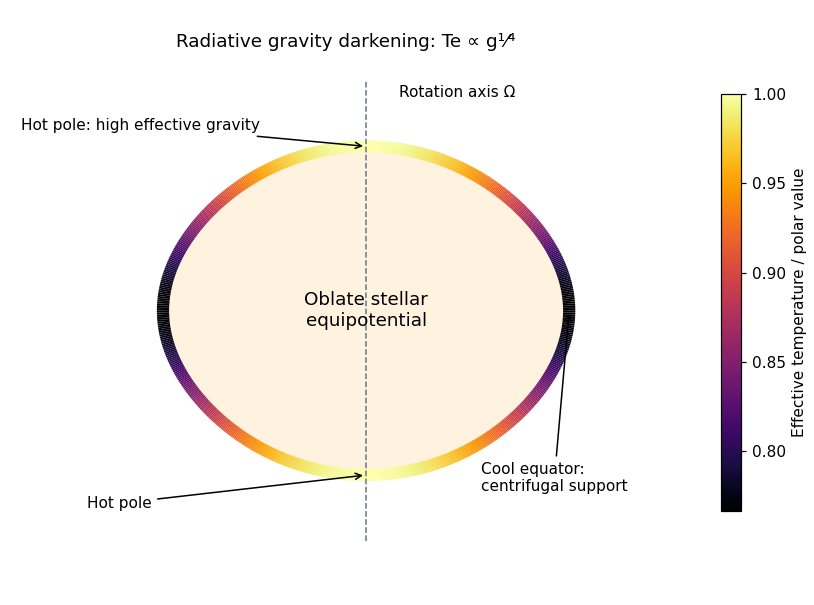
Surface flux and the requested sketch. Define , positive for the outward radiative flux. ThenOn an outer equipotential surface, is constant and the outward normal is parallel to . Its effective gravity is , so . The Stefan–Boltzmann law gives the radiative gravity-darkening law,A rapidly rotating star is oblate. Centrifugal support reduces the effective gravity near the equator, which is therefore cooler and dimmer; the poles are hotter. The original sketch below uses a subcritical Roche model of a uniformly rotating star to show this geometry and the corresponding temperature variation. The material temperature on an interior equipotential is not the same quantity as the emergent effective temperature defined by surface flux.

Why purely local radiative balance fails. Differentiating the flux givesOn one equipotential, and the proposed source are all constant, but generally varies with latitude. Unless or there is another special cancellation, no single value of can match this flux divergence at all points on the surface. This is the radiative-equilibrium obstruction in a rotating barotropic star. Slow stellar meridional circulation can transport heat to compensate; it is distinct from abandoning hydrostatic balance at leading order.
Integrated energy balance with circulation. The steady continuity equation is . Combining the entropy–enthalpy relation with hydrostatic balance givesIntegrate the energy equation over and apply the divergence theorem:Uniform composition makes constant on the enclosing equipotential, and is constant there by definition. Pull out of the last integral; the remaining net mass flux is zero by steady continuity. Thus the equipotential luminosity conservation with stellar circulation isThis does not require pointwise on : inward and outward circulation may cancel in the net mass flux.
Finally, is constant on and the divergence theorem applied to the effective potential givesTherefore . Since ,The mass is the mass enclosed by this surface, not necessarily the total stellar mass. The denominator is positive for the regular hydrostatic surfaces used here; near loss of centrifugal confinement the assumed stellar model must be reconsidered. The derivation uses slow circulation, retaining hydrostatic/equipotential thermodynamics to leading order while allowing a nonzero advective heat flux.
Orbital angular momentum carried by the wind. Use a circular orbit of separation , and write and . The donor's distance from the center of mass is . With spins neglected, its specific orbital angular momentum is , while the circular-binary orbital angular momentum isA fast spherically symmetric stellar wind has no net extra angular momentum in the donor's rest frame and escapes with mean specific orbital angular momentum . Thus Jeans-mode mass loss givesInitially take negligible wind capture by the companion, so , and the total mass derivative is . Logarithmic differentiation of givesCombining the two expressions yields , so is constant. Kepler's third law then gives . HenceThese are secular relations for slow changes of the orbit through nearly circular states. A wind being fast compared with orbital speed does not mean its mass-loss timescale is shorter than an orbital period; impulsive removal would require a different orbital calculation.
Whether wind drives contact. Ignore nuclear expansion on the stated short evolutionary timescale. With and , wind alone givesBecause , the ratio increases precisely whenThis is wind-driven Roche-lobe overflow: the escaping wind makes the donor expand relative to its lobe and drives a separate transfer stream. It is not the slow-wind capture mechanism called Wind Roche-lobe overflow. If the inequality is reversed, the donor recedes inside its expanding lobe and detaches; wind loss alone does not maintain a Roche-lobe transfer stream. At equality it gives no leading-order change of overfill, so additional evolution or higher-order changes decide the outcome.
Contact rate and its stability. Now let the transfer stream be accreted conservatively by star 2 while the separate wind still escapes at rate . Denote the stream rate by . ThenOnly the wind removes orbital angular momentum; internal transfer redistributes it. Using the same wind-loss law and differentiating givesSubstitute this into the donor and lobe radius derivatives. The overfill evolves asMaintaining contact sets the left side to zero and gives the contact transfer rate with Jeans-mode wind loss,When the wind-drive condition holds, its numerator is positive. If , the denominator is also positive and the stream rate is positive; increasing transfer reduces overfill and can balance the wind driver.
If instead , positive transfer increases overfill, which drives still more transfer. The formal contact formula would demand a negative stream rate and is not a physical steady solution. The system develops unstable, runaway mass transfer on the timescale appropriate to the assumed donor response. For a giant with an adiabatically responding envelope, this can lead to a common envelope and rapid orbital evolution, rather than the stable contact sequence; the eventual outcome requires physics beyond these radius laws. At , transfer gives no linear restoring effect, and a nonzero wind driver cannot be balanced by a finite rate within this approximation.
Articles by others on the same topic
There are currently no matching articles.