The three identifications areThey match the same lower-dimensional theory, including its moduli of a string compactification, charged states and extended branes. Different weakly coupled descriptions occupy different limits of its moduli space.
For the M-theory circle duality, write and let be the eleven-dimensional Planck length. The standard length dictionary isThe circle radius is the type IIA superstring theory coupling modulus. The eleven-dimensional metric supplies the ten-dimensional metric, dilaton and Ramond–Ramond potential through Kaluza-Klein theory; the three-form supplies and the Neveu–Schwarz two-form by . Thus the field content also agrees with type IIA supergravity.
The M2-brane and M5-brane tensions are and . Wrapping one spatial direction multiplies the effective brane tension by . Consequently:
- A wrapped M2-brane gives the fundamental string, since ; an unwrapped M2-brane gives the D2-brane.
- A wrapped M5-brane gives the D4-brane, with tension ; an unwrapped M5-brane gives the NS5-brane, with tension .
- Momentum gives units of D0-brane charge. The Kaluza-Klein monopole with the M-circle as its fibre gives the D6-brane.
These tension and charge relations explain why increasing reveals an eleventh dimension. The simple circle dictionary describes massless type IIA supergravity; a D8-brane involves its massive extension and Romans mass.
For the M-theory torus duality, the complex structure of the torus is the IIB axion-dilatonIts area supplies the remaining radius modulus. In a common nine-dimensional mass normalization, an M2-brane wrapped on the entire torus has mass , identified with ; hence is inversely related to the torus area in that normalization. Radii quoted in different string or Einstein metrics also include their Weyl rescaling. A rectangular torus with cycle radii has . Equivalently, first reduce to IIA and use T-duality:where in this formula use the corresponding string metrics. Shrinking the torus area at fixed decompactifies the IIB circle. The torus mapping class group becomes IIB S-duality.
An M2-brane wrapped on a primitive one-cycle gives a (p,q) string, whose tension is the membrane tension times the cycle length before conversion to the IIB metric. Momentum on the torus matches winding of these strings on the IIB circle. An M5-brane wrapped on the whole torus gives an unwrapped D3-brane; an unwrapped M2-brane gives a D3-brane wrapped on the IIB circle. An M5-brane wrapped on one torus cycle gives a (p,q) five-brane wrapped on the IIB circle. The unwrapped M5-brane is the magnetic dual of the IIB circle's Kaluza-Klein mode, represented by its Kaluza-Klein monopole five-brane. These identifications match effective spatial dimensions as well as electric and magnetic charges.
For the M-theory K3 duality, the common noncompact spacetime has seven dimensions and sixteen supersymmetry generators. A Ricci flat K3 surface has a positive three-plane in its second real cohomology, equipped with the K3 intersection lattice of signature . The unit-volume moduli space of Ricci-flat K3 metrics has local formwith a discrete lattice identification and one additional positive volume modulus. This is the heterotic Narain moduli space on , together with the seven-dimensional coupling: its torus metric has six parameters, its antisymmetric tensor three, and its sixteen gauge Wilson lines forty-eight, giving before the dilaton.
The coupling–volume relation can be checked dimensionally rather than guessed. A wrapped M5-brane gives a heterotic fundamental string with tension , so its squared string length is proportional to . The seven-dimensional gravitational coupling is proportional to . Their dimensionless ratio givesThus the large-volume M-description corresponds to strong heterotic coupling. Overall constants depend on the normalization of the lower-dimensional coupling.
There are twenty-two gauge fields from reducing on the twenty-two harmonic two-forms of K3, matching the heterotic sixteen gauge vectors plus three metric and three two-form vectors. The remaining seven-dimensional three-form is dual to the heterotic two-form. A wrapped M2-brane gives an electrically charged particle in the shared charge lattice, matching heterotic momentum, winding and gauge charges; an M5-brane on a two-cycle gives its magnetic three-brane. An M5-brane wrapping all of K3 gives the heterotic string, while an unwrapped M2-brane corresponds to a heterotic NS5-brane wrapped on . At suitable collapsing two-cycles, charged membrane states become massless and yield ADE gauge enhancement. The geometry accounts for both generic abelian charges and nonabelian enhancement. There is no extra K3 two-form modulus in the M-description: its fundamental potential is a three-form, and .
On a bosonic configuration, the target-space supersymmetry transformation changes the fermionic coordinate by , where is a background Killing spinor. A kappa symmetry convention isThe configuration preserves a supersymmetry if this change can be cancelled by a local kappa symmetry transformation. Multiplying by proves necessity ofConversely, if this holds, choosing cancels the variation. Reversing the brane orientation reverses the corresponding kappa symmetry projector.
The preserved parameters must solve this equation everywhere on the brane and satisfy the background Killing spinor equations. Thus the fraction of all thirty-two eleven-dimensional supersymmetries isOne traceless constant kappa symmetry projector in flat space preserves sixteen parameters. Further independent commuting projectors often halve that number again, but a position-dependent projector requires a common global solution; its pointwise rank alone does not determine the answer. To quote a fraction of the background supersymmetry, divide instead by the number of its Killing spinors.
For the supermembrane, let be the embedding in eleven-dimensional superspace. Define the pulled-back supervielbein, the induced worldvolume metric, and induced gamma matrices byFor a chosen orientation,The Clifford algebra shows that ; in an orthonormal membrane frame this reduces to . Its trace is zero, so its two eigenspaces each have real dimension sixteen.
The full supermembrane action in an on-shell eleven-dimensional supergravity superspace isHere is the super-three-form and denotes the pullback of a differential form. Its bosonic restriction is the ordinary supergravity potential, but its fermionic components are retained in this action. The magnitude of its Wess-Zumino brane coupling equals the membrane tension; the sign fixes the orientation and the matching sign of . In flat superspace one may take , with the super-three-form chosen to obey the standard supergravity superspace constraints. Thus this is a fermionic, kappa symmetry-invariant action, rather than merely its bosonic truncation.
To construct an ordinary calibration, first take a flux-free static background with a unit covariantly constant spinor . In a compatible orientation and mostly-plus Clifford algebra, the membrane spinor calibration form isFor an oriented orthonormal spatial pair , . The matrix on the right is the static membrane , a Hermitian involution, so this value is at most one, with equality precisely when . Parallel transport of the spinor and gamma matrices gives , hence .
A calibration is a closed differential form whose value on each oriented unit tangent plane is at most one; its comass is at most one. A calibrated submanifold saturates the bound, . For any homologous competitor with the same boundary, Stokes theorem givesThis proves that calibration implies volume minimization, and in particular that the membrane's spatial surface is a minimal surface. The closure condition is indispensable. A general flux-coupled Killing spinor need not produce a closed ordinary calibration; the corresponding generalized calibration bounds the full brane energy including its potential coupling. The flux-free construction above is the ordinary volume-minimizing case.
For the flux-coupled membrane, the standard spinor bilinears give a Killing vector and a two-form satisfying , in matching supergravity conventions. In a stationary gauge , Cartan's magic formula givesThis closed charge form provides the membrane generalized calibration; its potential term is what changes the volume bound into an energy bound.
For bosonic embedding coordinates , the supermembrane action truncates toThe first term is its induced worldvolume volume and the second is its Wess-Zumino brane coupling. A membrane of the opposite orientation reverses .
The M2-brane supergravity solution admits the harmonic functionwith arbitrary centre positions in eight transverse dimensions. Away from the sources, the Laplacian of each term is zero. The unrestricted positions describe static separated membranes carrying aligned charges, so their separations have no potential. Physically, their gravitational attraction is cancelled by their four-form charge repulsion. This is the M2-brane probe no-force identity, which can also be checked directly without relying only on the existence of the multicentre solution.
Keep the field-strength ordering printed in the paper and use . If , a gauge vanishing at infinity isThe last equality uses the sign acquired by moving a one-form past a three-form. For this convention the parallel probe has . In static gauge, at a fixed transverse position, its induced worldvolume metric is , hence andUsing the opposite convention for , and orientation together yields the same cancellation. Changing only the probe charge produces an anti-membrane, with nonconstant potential . Thus the orientation cannot be dropped from the argument.
The cancellation also survives an expansion for slow transverse motion. With ,There is no static potential and no position dependence in the leading kinetic coefficient.
Near an isolated positive membrane charge, write with and . The regular membrane near-horizon limit removes the asymptotically flat constant and givesSet . ThenThus the Anti-de Sitter spacetime radius is half the sphere radius. In orthonormal units the four-form has magnitude along the AdS volume form, the Freund-Rubin compactification flux.
The full asymptotically flat solution has spinors subject to one oriented membrane projector, leaving sixteen real parameters. In the throat, the Killing spinor equation separates into the standard AdS and sphere equations with correlated signs fixed by the flux. There are four real AdS solutions and eight real solutions for the required signs, soThis is maximal supersymmetry of AdS4 times S7: the additional sixteen spinors need not extend through the asymptotically flat region. A multicentre geometry therefore remains globally sixteen-supersymmetric even though each regular local throat has this enhancement. The classical supergravity description is controlled when is large compared with the eleven-dimensional Planck length; singular harmonic multipoles not representing regular positive membrane centres do not automatically have the same throat.
Use static gauge for a D3-brane in flat space and let be one physical transverse displacement. Put and , so the fields entering the DBI action are dimensionless. With no magnetic field, writing givesIntroduce the dimensionless electric displacement in DBI theory, . Its Hamiltonian density obeys the DBI Hamiltonian bound for an electric spike:The electric bound is saturated when . On that locus the constitutive relation also gives . With the Gauss law constraint in gauge theory away from charges, the electric BPS equations for a one-scalar D3-brane are thereforeThe magnetic version is , . More generally, one constant charge angle gives the aligned dyonic branch , with harmonic. A single aligned electric, magnetic or dyonic spike preserves eight of the D3 vacuum's sixteen supersymmetry generators. Thus “one-half BPS” here means one-half of the linearly realized worldvolume supersymmetry; the string–D3 configuration preserves one-quarter of the thirty-two spacetime supersymmetries.
The electric BIon is the single-centre harmonic solutionThe sign fixes its electric charge and spike orientation. The scalar is an actual transverse coordinate, so as describes a long narrow spike emerging from an asymptotically planar D3-brane. It carries fundamental strings ending on the brane. A magnetic BIon similarly represents D1-branes, and an aligned dyonic BIon represents a (p,q) string.
The string-tension interpretation of BIon energy follows explicitly. With , the energy above the planar-brane vacuum outside a small radius isIts divergence is the energy of a semi-infinite string, with the correct finite tension. For a magnetic spike, instead, and the same calculation gives the D1-brane tension . The solution solves the full nonlinear DBI action, not just its weak-field expansion.
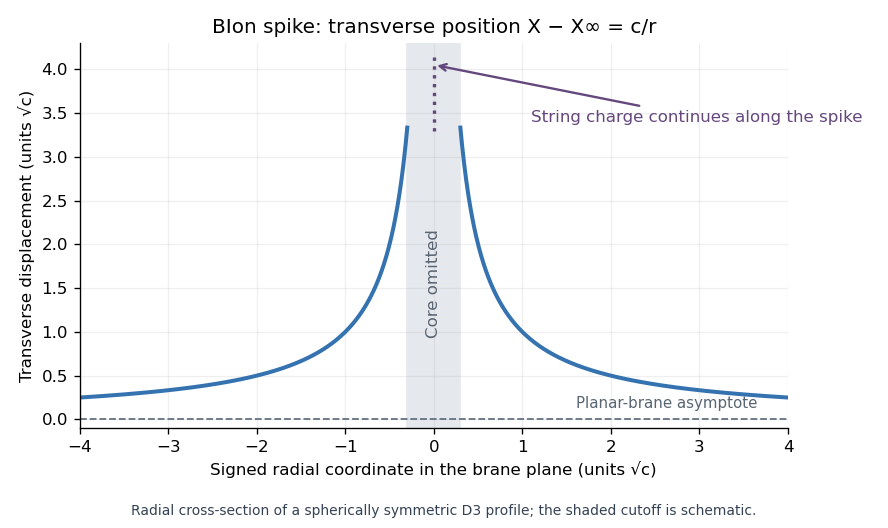

The validity of the abelian BIon approximation concerns its derivative expansion, string loops and gravitational backreaction. Large field strengths are included by the DBI action, but rapidly varying field strengths and embedding curvature require corrections. Far outside the singular core these corrections can be small. The transition region has ; an electric throat can be parametrically controlled with while keeping gravitational backreaction small with . For a magnetic throat the corresponding conditions are and . The weak-coupling and large-charge windows allow both requirements. The ideal tip is not uniformly controlled by the single abelian effective action, so one should not infer exact microscopic core physics solely from its formal singularity.
Less supersymmetry survives when independent, compatible geometric or charge projectors must hold simultaneously. A useful purely geometric family is a D3-brane whose spatial worldvolume is a special Lagrangian submanifold of . In a graph , the conditions areThe first condition makes symmetric, so locally . Pulling back gives . Hence the phase-zero special Lagrangian graph equation iswhere is the sum of the pairwise products of the three Hessian eigenvalues. The positive real branch fixes the orientation. These curved D3 geometries minimize volume by their calibration and generically preserve four spacetime supersymmetries, one-quarter of the D3 worldvolume supersymmetry. Special flat graphs can preserve more.
The generic count follows from the common tangent-plane projectors. With complex coordinate pairs , the phase-preserving rotations require and . Multiplication by turns these into two independent commuting involution conditions with eigenvalue . Each halves the sixteen-dimensional planar D3 eigenspace, leaving . This is an intersection of compatible kappa symmetry projectors, rather than a count based on the rank of a single projector at one point.
Charge-carrying examples include compatible networks of differently oriented (p,q) strings ending on D3-branes. At each string junction, charge vectors add to zero and tension vectors balance; their directions and charge phases must also give common kappa symmetry projectors. They can impose further independent conditions beyond the planar D3 projector. Geometrically, several transverse scalar profiles describe the corresponding spikes and intersections. Merely replacing one electric spike by an aligned dyonic spike does not lower its preserved fraction; additional independent conditions are what reduce the common Killing spinor space.
Articles by others on the same topic
There are currently no matching articles.