Put . At a nonzero equilibrium point the two equations form the homogeneous linear systemIts determinant must vanish, giving . ThusEach positive real polynomial root gives an antipodal equilibrium point pair; a negative polynomial root does not describe a real equilibrium point. A direction is specified by , , where , . This is the polar form of the cubic confinement model. The origin is always an equilibrium point.
The origin's eigenvalues are . A simple zero eigenvalue occurs on , except at . The symmetry of an odd function makes the generic steady bifurcation a pitchfork bifurcation. At a point on this circle with , vary . Expanding the radius equation gives . In a signed, unit-eigenvector centre manifold coordinate, the cubic coefficient therefore has sign .
On the lower semicircle the transverse eigenvalue is negative: the pitchfork bifurcation is supercritical for and subcritical for . On the upper semicircle it is supercritical for and subcritical for in the centre manifold direction, but its transverse eigenvalue is positive, so the bifurcating equilibrium points are not fully attracting. At the cubic vanishes. The radius equation instead gives , a nonzero quintic degeneracy with amplitude proportional to : these are degenerate pitchforks in the cubic confinement model.
A Hopf bifurcation occurs at , , with frequency . To determine its direction, first note that the divergence is . The Bendixson-Dulac criterion excludes every nonconstant periodic orbit for , since this divergence is negative except possibly at the origin. We can also calculate a nonzero saturation coefficient. Set , and . At the linear orbits are ellipses of constant . Direct differentiation givesOn a linear ellipse, write , . The angular speed is constant; the averages of and vanish, while . Averaging the cubic terms, or removing their oscillatory parts by a periodic change of coordinates in its normal form, gives for The cubic coefficient is strictly negative. Hence a small attracting limit cycle exists for , andFinally have a nonzero nilpotent matrix as their linearization with two zero eigenvalues. They are reflection-symmetric double-zero bifurcations where the Hopf bifurcation and steady thresholds meet; an ordinary nonzero-frequency Hopf bifurcation calculation does not apply there. These, the two degenerate pitchfork bifurcation points, and the generic pitchfork bifurcation/Hopf bifurcation loci above exhaust the origin's local loss-of-hyperbolicity possibilities.
The trace and determinant of the origin's linearization are and . Thus its open region of linear asymptotic stability isFor this means below the lower semicircle; for all negative lie in the open stable region. The origin is a saddle equilibrium inside the unit circle and a source outside it with positive .
For nonzero equilibrium points, put . Existence requires and . An equivalent region isInside the circle exactly one radius polynomial root is positive, giving two equilibrium points. Outside it, with and , both polynomial roots are positive, giving four. On with , the two radii coalesce in a saddle-node bifurcation at each antipodal point. On the circle a zero radius is the origin and is excluded from the nontrivial count. These distinctions are shown in the parameter sketch.
At the linearization has one simple zero and one negative eigenvalue, while the cubic centre manifold coefficient vanishes. The quintic coefficient is negative. It is a codimension-two bifurcation with a reflection-symmetric degenerate pitchfork bifurcation: a wedge of coexistence between an attracting origin and an attracting antipodal pair opens between a subcritical pitchfork bifurcation and the nearby saddle-node bifurcation curve. The intervening smaller-radius pair consists of saddles. Indeed at a nonzero equilibrium point, direct differentiation of the polar coordinates equations givesThe smaller-radius branch has negative determinant, while in the coexistence wedge the larger-radius branch has positive determinant and negative trace.
At critical boundaries the linear stability analysis test alone is inconclusive. The origin is nonlinearly attracting at a supercritical lower pitchfork bifurcation, at its stabilizing quintic endpoint, and at the supercritical Hopf bifurcation threshold, although decay is no longer exponential. It is unstable at the subcritical lower pitchfork bifurcation. The double-zero point is also attracting: the positive function hasnear the origin away from zero. Here and prove the bound. The other double-zero point has an unstable quartic potential, as the blow-up below shows. The shading records the open linear stability analysis regions; these boundary remarks distinguish nonlinear from exponential stability.
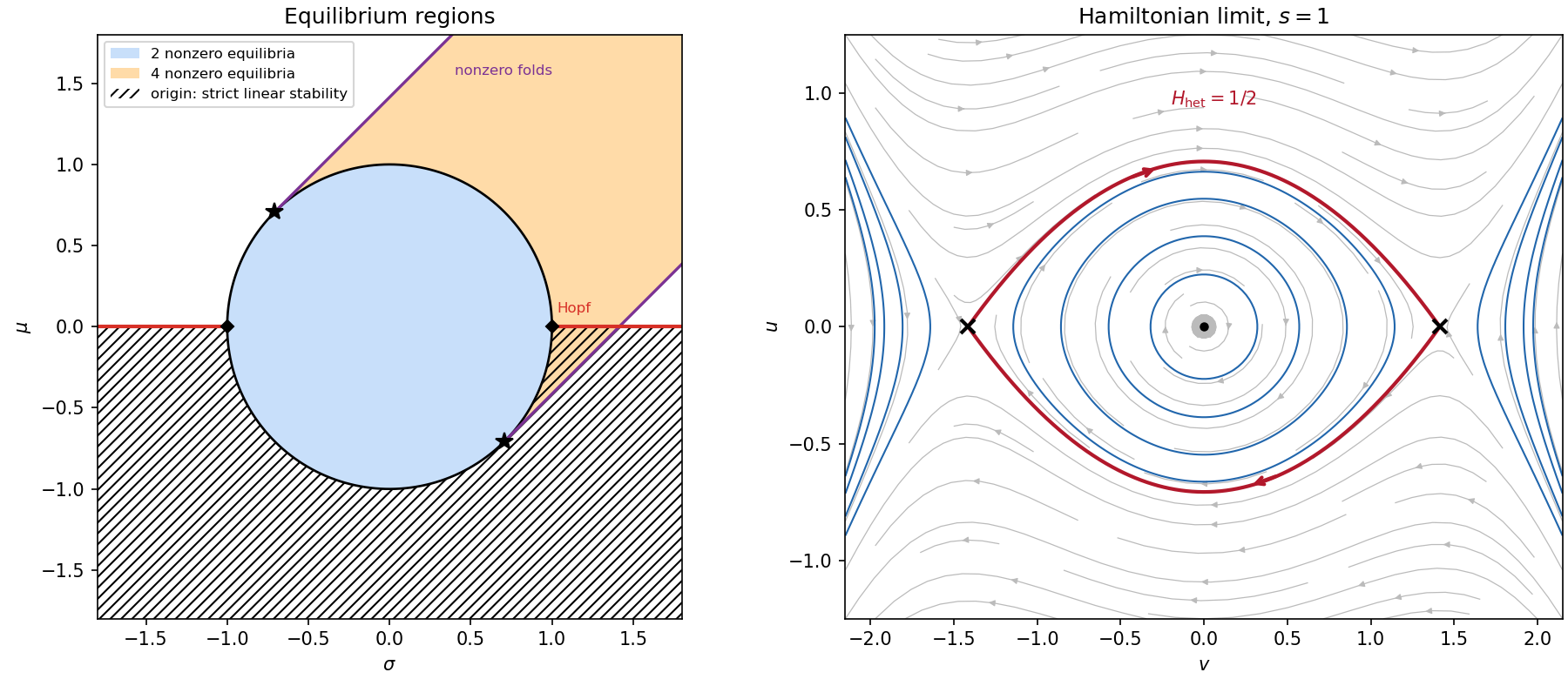
Origin stability, nonzero-equilibrium counts and the Hamiltonian separatrix of the cubic confinement model
. Details. 
At the origin's matrix is : it has a double zero eigenvalue and one eigenvector. Trace and determinant vary independently with and there, so two parameters are needed. The symmetry of an odd function removes quadratic terms, giving a reflection-symmetric cubic double-zero normal form. The quadratic nonlinearity required for a generic Bogdanov–Takens bifurcation vanishes.
Use a prime for differentiation with respect to the rescaled time. Direct substitution, with all rescaled variables written without tildes, givesAt , the equations are , . Fordifferentiation gives . This is the Hamiltonian blow-up of a reflection-symmetric double-zero point.
For , the equilibrium points are a centre equilibrium at and saddles at . The centre equilibrium has eigenvalues ; at either saddle equilibrium they are . Levels contain closed inner ovals around the centre equilibrium. The saddle equilibrium level hasThese two branches form a heteroclinic cycle connecting the saddles. The branch with runs from the lower saddle equilibrium to the upper one because ; the other runs back. Outside the potential well, trajectories are open. The right panel of the preceding figure uses the coordinates to display the well and these directed connections.
The rescaling resolves the small, nearby nonzero saddles while retaining the weak non-Hamiltonian terms. It allows the global stable manifold/unstable manifold connection to be studied as a perturbation of the explicit heteroclinic cycle, rather than searched for only in the original variables.
Differentiate the first integral using the first-order perturbation from part (c):On the positive unperturbed connecting branch, , soIntegrating the energy change from one saddle equilibrium to the other therefore givesThis is the heteroclinic Melnikov integral for a quartic Hamiltonian. It measures the first-order energy mismatch, equivalently the transverse splitting between the outgoing unstable manifold and the incoming stable manifold. A nonzero value means that the heteroclinic orbit has broken. A simple zero supplies the leading connection condition; smooth perturbation then shifts the curve by higher-order terms. The central inversion symmetry makes the two connections have the same condition, so both can be restored on one parameter curve.
For fixed , . The coefficient is affine in , has a unique simple zero, and changes sign across it. No explicit evaluation is necessary. Energy drift on the nearby closed Hamiltonian levels can similarly determine a periodic orbit and its stability; the cycle born at the supercritical Hopf bifurcation grows towards the separatrix and can terminate at this global bifurcation through a heteroclinic orbit. Translating the resulting balance curve back with , places it near the original double-zero point.
Articles by others on the same topic
There are currently no matching articles.