Use metric and the hypercharge convention . Then the Higgs doublet has and transforms under electroweak gauge invariance asThe covariant derivative sign consistent with the requested expression isA convention that instead calls the doublet hypercharge one puts in the charge generator and derivative; the physical coupling is the same. Here and the matrix-valued connection transforms as , making transform like .
In unitary gauge, the upper component of the derivative comes from the off-diagonal Pauli matrices:The lower component isWriting , , inversion of the neutral rotation gives and . Since , the coefficient of the photon vanishes, whereas . ThusThe zero photon coupling expresses the neutrality of the surviving radial Higgs boson.
The scalar Lagrangian density is . Adding gives the complete bosonic electroweak Lagrangian density. Its scalar and vector mass terms, after electroweak symmetry breaking, are obtained directly asIndeed, the shifted quartic Higgs potential normalization gives . Comparing with a canonically normalized real scalar mass term, a complex vector mass term and a real vector mass term yieldsThe extra factor one half in this paper's Higgs potential is why is , rather than in another common convention. The tree-level electroweak gauge-boson masses give : measure the two vector masses and take their ratio. Beyond tree level this extraction requires a specified renormalization convention and radiative corrections.
Expanding the vector terms gives the cubic and quartic Higgs couplings to electroweak gauge bosons:The four elementary Feynman diagrams and their all-incoming Feynman rules are shown below. Differentiating with respect to two identical fields supplies a factor two; differentiating with respect to two identical Higgs fields supplies another factor two in the quartic rules.
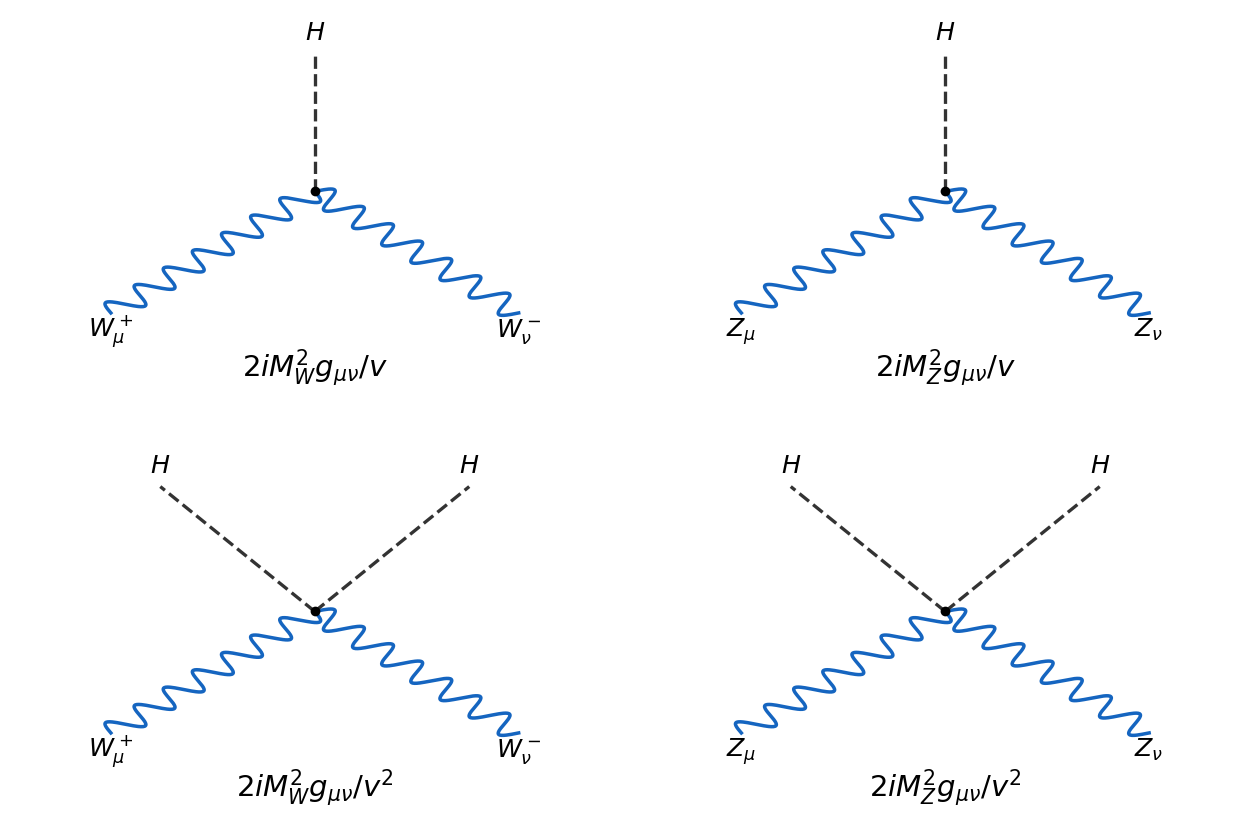
Tree-level Higgs vertices with charged and neutral electroweak gauge bosons
. Details. There are no elementary , , or vertices in this tree-level Lagrangian density. Loop-induced photon interactions are a different order. The scalar self-interactions, if included, have rules and .
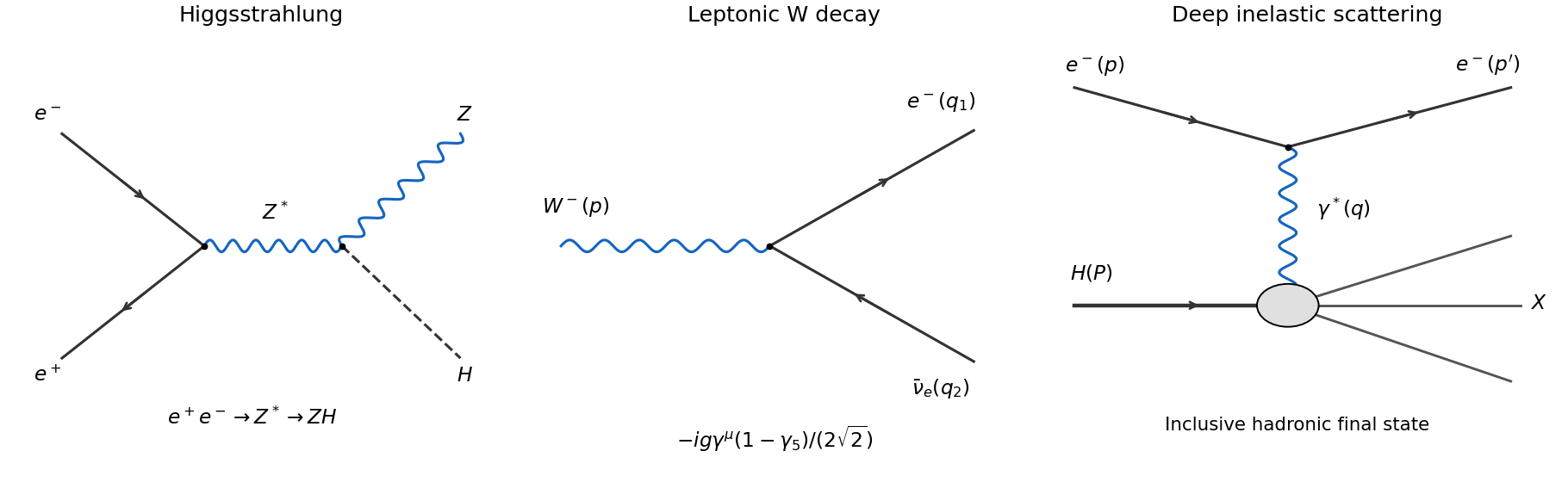
The prime LEP2 search used the Higgs boson coupling to Z bosons through Higgsstrahlung, , shown in the first panel of the process figure in Question 3. This identifies an associated-production interaction, rather than an on-shell decay of a single into a heavier Higgs. The channel's historical role is documented in the LEP2 Higgs-search account.
For the free charged W boson, take , with the conjugate field carrying . In the action, multiplying the two field strengths gives . ThereforeTo invert it, separate the transverse and longitudinal projectors , . The operator is , soSince the quadratic action kernel is , its Proca propagator isFor all momentum components small relative to , the low-momentum limit is , with corrections of relative order or . This local limit leads to the Fermi interaction, with for the charged-current normalization used here.
The CPT theorem is a structural consequence of relativistic quantum field theory. In flat spacetime, assume a positive physical state space, the positive-energy spectrum condition, Lorentz invariance, microcausality, the usual Spin-statistics theorem, and a Hermitian dynamics. For ordinary field theories these are realized by a local Hermitian Lorentz-scalar Lagrangian density. There is then an antiunitary operator implementing the combined charge conjugation, parity symmetry in quantum field theory and time-reversal symmetry, with a CPT-invariant vacuum. The combined symmetry is required even when the three separate symmetries fail.
Under the combined spacetime transformation, . A complex scalar field can be taken to transform into its adjoint at ; a Hermitian vector field transforms into minus itself at . A derivative contributes a minus sign through differentiation of its reflected argument. For a Dirac field the transformation supplied in the paper may be writtenField phases are conventional and do not affect the physical conclusions. Crucially, antiunitarity means and conjugates every numerical coefficient. The reversal of time is compatible with positive energies because this conjugation changes to while leaving the Hamiltonian invariant. Treating time reversal as a unitary change of coordinates would instead give incorrect signs.
One can see explicitly how the CPT transformation of Dirac bilinears works. Let be a Hermitian fermion bilinear, with . The colons indicate normal ordering so that the graded reordering below has no vacuum contact term. Using the reflected fields and conjugating , then interchanging the two fermion factors, givesThe last step uses the Dirac-Hermiticity condition and . The identities for the gamma matrices then giveThe pseudoscalar's sign is particularly instructive: its explicit must also be conjugated. The minus sign from exchanging fermions is equally essential. These signs depend on the number of free vector indices, rather than on a field's separate parity assignment.
This supplies a local Lagrangian argument for CPT invariance. Hermitian local field combinations with vector indices transform with sign , including the appropriate reordered derivative terms. A Lorentz scalar contracts those indices in pairs or with four-index invariant tensors, giving a positive total sign. For charged terms, the reflected conjugate fields and conjugated coefficients exchange a term with its Hermitian-conjugate partner. ThusThe integration variable has unit absolute Jacobian. The general field-index argument is discussed in Srednicki's treatment of discrete symmetries, section 40.
For example, the scalar mass term is even. The Dirac electromagnetic current and vector potential are both odd, making their contracted interaction even. The Hermitian Dirac kinetic term is also even: reflection and reordering interchange the two derivative placements, while antiunitarity conjugates its . A complex Yukawa coupling and its Hermitian conjugate are exchanged rather than requiring the coupling itself to be real. Hence CP violation in the CKM matrix is compatible with exact CPT. Renormalizability is not necessary: local Hermitian higher-dimensional Lorentz-scalar operators satisfy the same argument.
The axiomatic form of the CPT theorem does not start by assuming a polynomial Lagrangian density. The positive-energy spectrum condition provides analytic continuations of Wightman functions, and complexified Lorentz transformations relate configurations to their total spacetime inversions. At suitable spacelike configurations, microcausality permits reversal of the order of field operators with the signs dictated by the Spin-statistics theorem. Uniqueness of analytic continuation extends this relation to the correlators generally, from which the Hilbert-space antiunitary operator is obtained. This explains why locality and positive energy are genuine hypotheses, not incidental features of a particular interaction. The elementary argument above displays the mechanism for the scalar, spinor and vector fields relevant to the Standard Model; it is not a substitute for all the analytic steps of the axiomatic proof.
For one-particle states, CPT reverses additive charges and spin projections. The spatial momentum is unchanged by the combination: parity symmetry in quantum field theory and time reversal each reverse it. Thus, up to phases,Since the energy-momentum spectrum is preserved, the CPT constraints on particle properties give equal particle-antiparticle masses, equal spin magnitudes, and opposite conserved additive charges. Relating the corresponding two-point functions also fixes equal pole positions, so unstable conjugate particles have equal total decay widths, hence equal lifetimes. Magnetic moments at the same chosen spin orientation have opposite signs. These are precise experimental tests of CPT, not tests that every individual discrete symmetry is respected.
For scattering, CPT interchanges incoming and outgoing boundary conditions. The antiunitary operator identity relates to the amplitude with transformed incoming and transformed outgoing. Thus the reversed process with antiparticles and reversed spins has the same transition probability. This is not, in general, equality with the forward CP-conjugate process. In particular, CP violation can make corresponding partial decay widths different while their complete sums remain equal. With CPT preserved, genuine CP violation requires corresponding time-reversal symmetry violation.
Finally, a proposed CPT violation requires revisiting at least one assumption: for example, a nonlocal interaction, a preferred spacetime direction violating Lorentz invariance, or loss of unitary Hermitian dynamics. A generic curved background need not possess the global spacetime inversion used here. Those observations delimit the theorem; they do not weaken its prediction for the ordinary local Standard Model in Minkowski spacetime.
The middle panel shows the Feynman diagram for the leptonic W boson decay. With the charged-current Lagrangian density sign in the question, its vertex Feynman rule isAn overall field-phase convention can change the overall amplitude sign but cannot change the decay width. With the standard Dirac field current ordering, the amplitude isThe unusual order of barred fields in the printed description should be interpreted as this physical weak charged current matrix element.


For massless final fermions, the fermion spin sums are and . The massive-vector spin average divides by three. Thuswith the chiral traceAnticommuting through the two following gamma matrices and using gives its symmetric partIts remaining part is an antisymmetric epsilon tensor from the gamma matrix trace identities; it vanishes against the symmetric polarization tensor . Direct contraction gives andHenceNo additional averaging over hypothetical right-handed neutrino states is appropriate: the chiral projector already enforces the physical helicity coupling.
On shell, , and , so and . The squared matrix element reduces to . In the parent rest frame, integrate the spatial momentum delta first in two-body Lorentz-invariant phase space. The remaining radial integral isConsequently the massless leptonic W decay width isLepton universality gives in the same massless approximation. The muon and tau lepton masses produce small corrections if retained.
With an identity CKM matrix, the allowed quark channels are and . The corresponding third-generation channel is closed by the top threshold. Each open channel has three orthogonal matching-color final states, so the color multiplicity in a decay width gives . There is no initial color average because the W boson is colorless. The tree-level W branching fractions are therefore:
| Final channel | Partial width | Branching fraction, rounded |
|---|---|---|
The rounded percentages sum to 99% because of rounding. The exact fractions sum to one, with total leptonic fraction and hadronic fraction . The total decay width isAs an illustrative numerical estimate, taking and gives , each open quark width and . These are tree-level model estimates with the stated illustrative inputs, not a fit to a measured width. Strong radiative corrections increase the inclusive quark widths.
The produced quark and antiquark radiate gluons, generating a parton shower. As their virtualities fall towards the strong-interaction scale, perturbation theory gives way to hadronization: confinement converts the colored partons into color-neutral hadrons, typically seen as two particle jets, with additional radiation sometimes producing resolved extra jets. Unstable hadrons subsequently decay; the primary quarks are not observed as free particles.
Including the CKM matrix, the charged current couples an accessible up-type flavour to every kinematically accessible down-type flavour . ThereforeThe sums over remain by row unitarity, so the massless tree-level total remains . Quark mixing redistributes the hadronic branching fractions; it does not create a new total color factor. If a family is above threshold, only its accessible channels enter, and the unitarity sum must not be applied to an incomplete set of final flavours.
For completeness, CKM parameter counting starts with real degrees of freedom of an unitary matrix. This follows by counting real entries and independent Hermitian constraints in . The real-orthogonal subclass has mixing angles; the remaining parameters can be viewed as phases. Rephasing each up-type and down-type mass eigenfield changes by . Of the phases, the common phase does nothing, so are removable. ThusFor three generic nondegenerate families this is three angles and one CP-violating phase. Degenerate masses can allow additional changes of basis and reduce the count.
The last panel of the preceding process figure shows deep inelastic scattering through a virtual photon. The blob represents the electromagnetic hadronic tensor response, with all final hadronic states included. With charges factored into and the hadronic current as in the question, a suitable scattering amplitude, up to an irrelevant overall phase, isThe electron fermion spin sum, before averaging the two initial spin states, gives the following normalization of the leptonic tensor:The initial electron spin average is a separate factor . Equivalently one can absorb it into a tensor , but the prefactor in the requested formula uses the unaveraged trace . The massless Dirac equations imply , the relevant Ward identity.
In the target rest frame the incident flux is . This remains valid for a massive target because the electron is massless: the general flux reduces to that expression. The outgoing electron contributes , and the inclusive final-state sum is . Including the electron spin average therefore givesThe implicit hadron spin average in must not be inserted a second time.
For an unpolarized target, Lorentz invariance permits tensor structures formed from , and the metric. Hermiticity relates the two index orders. The electromagnetic response is parity even, excluding the pseudotensor . A possible ordinary antisymmetric term is excluded by current conservation. The symmetric part initially has four structures, , , and . Imposing both current-conservation conditions leaves the transverse decomposition of an unpolarized hadronic tensor:For example, contracting into the first structure gives in the printed parametrization, and contracting into either parenthesis gives or . Since the two independent deep-inelastic structure functions are not generally linked by symmetry, transversality requiresThere are only two invariant variables once is fixed; they may be chosen as and Bjorken x .
Now make the leading massless collinear parton approximation. In the hard parton calculation, use a lightlike collinear reference for , neglecting target-mass effects of relative order as well as quark masses. Literally combining a massive with an exactly massless constituent momentum would be inconsistent. The exact rest-frame flux derived above does not require this approximation; it is the following partonic response that does.
Let and . Strip the quark charge out of the current, since its square is already the factor in the parton convolution. Averaging the initial quark spin and summing the final spin gives the spin-averaged electromagnetic parton tensorThe spatial momentum delta fixes . The remaining one-particle Lorentz-invariant phase space, together with in the definition, suppliesSince and , the full parton response isTerms with a free index vanish when contracted with the conserved leptonic tensor. Thus the part of contributing to the cross-section iswhere denotes equality in that contraction, rather than an equality of the full tensors. The omitted terms are necessary for the full hadronic tensor to be transverse; the wording about contributing terms in the PDF is important here.
To prove the delta identity with the correct Jacobian, set . On physical support and . Factoring gives the positive-energy on-shell delta function identityThis is restricted to the positive-energy branch; the other root must not be included. Using the spatial momentum constraint and in the leading hard approximation,The Dirac delta function change of variable therefore gives the parton on-shell delta identityHere . This is the actual printed identity: the converted TeX's final is a transcription error. If target mass is formally retained in the delta argument, it becomes , so the stated simple root and Jacobian no longer apply.
Let . The parton integral collapses at , givingThe transverse decomposition of an unpolarized hadronic tensor, in the same contraction, is . Comparing the two independent structures yieldsThis derives the Callan-Gross relation from the spin-one-half trace and on-shell constraint. Antiquarks give the same symmetric response and therefore the sum . The result applies at leading order in the massless parton model; target masses, intrinsic transverse momentum and Quantum chromodynamics radiative effects can generate a nonzero longitudinal deep-inelastic structure function and modify the relation.
Articles by others on the same topic
There are currently no matching articles.