The three handle attachments give : there are no one-handles or three-handles. Use the capped core disks of handles as the homology basis, ordered by the framing labels . The surgery linking matrix gives the intersection form. Orient the three components so that the outer components have linking number and the middle component has linking number with each outer component. There are six crossings between the outer components, and two crossings between the middle component and each outer component; counting their signs gives these linking numbers. Reversing a component changes the corresponding row and column signs and does not change the invariants.
Thus the intersection form isAn exact matrix congruence diagonalizes this intersection form toConsequently its signature is , and .
The long exact sequence in relative homology and Poincare-Lefschetz duality identifywith the intersection form matrix, and identify with its cokernel, since . The Smith normal form has first invariant factor , because the entries have greatest common divisor , and second invariant factor , because the upper-left two-by-two matrix minor has determinant . The last invariant factor is . Hence
Use generators for the three one-handles in the generalized Heegaard diagram. Read a downward crossing of the cut from a left-hand hole to its right-hand partner as the corresponding generator. Traverse the attaching curve around the left-hand hole, starting at its outgoing downward strand, and then traverse the attaching curve around the left-hand hole in the same way. Their cut-crossing words areThese are the two relators imposed by the two handle attachments. The remaining boundary is a torus; no third relator should be added. The fundamental group presentation is thereforeThe exponent-sum vectors are and . Thus the abelianization is , with all mapping to its positive generator .
Apply the Fox derivatives and then this abelianization. The resulting Alexander matrix isFor example, the three occurrences of in contribute to the first entry. Every row sums to zero, as the Fox calculus identity predicts.
The cellular boundary in degree one for the infinite cyclic cover is . Its kernel is freely generated by . Expressing the two relation boundaries in this basis gives the two-by-two matrix obtained by deleting column of . Its determinant is the order of the Alexander module of a space. Equivalently, all three maximal matrix minors of agree up to sign. The Alexander polynomial iswhere allows multiplication by a unit in the Laurent polynomial ring. Its value at is .
Number the seven crossings from top to bottom. Orient the strand entering the top-left arch downward. With the usual positive braid crossing convention, the crossing signs areTo make the diagram calculation reproducible, its oriented Gauss code isSubscripts record overpassing and underpassing. In this convention a positive trefoil knot has knot signature .
Label the seven Wirtinger generators successively between undercrossings, beginning just before the encounter . The Alexander matrix, with rows ordered by crossing number, isAt a positive crossing the Fox derivative entries at the overpassing, incoming and outgoing arcs are ; at a negative crossing a unit multiple of the row has entries . Deleting the last row and column gives determinant . Hence a symmetric normalization of the Alexander polynomial of a knot isIn particular, in this displayed normalization; multiplying by gives normalization and does not change any conclusion.
The Seifert algorithm produces four Seifert circles and seven bands. Its connected Seifert surface has Euler characteristic , and so genus . Conversely, the Alexander breadth bound on Seifert genus gives . ThereforeFor the knot signature, use the alternating diagram signature formula: for a reduced alternating knot diagram,where counts circles in the all- bracket smoothing and counts positive crossings. Here the all- smoothing has four circles, the all- smoothing has five, and . ThusThe opposite global knot signature convention gives instead.
For the slice genus, the Levine-Tristram signature bound on the slice genus at gives . There is also an explicit unknotting crossing: switch crossing . A type III Reidemeister move across the triangle formed by crossings makes crossing a removable kink. Next cancel pairs and by type II Reidemeister moves; crossings and then become removable kinks. This leaves the unknot. One crossing change gives a genus-one knot cobordism to the unknot: its movie consists of two oriented band moves, and capping the final unknot by a disk in gives a surface of genus one. Consequently
All homology and cohomology in this solution use coefficients, so no orientation hypothesis is necessary. The Poincare-Lefschetz duality degrees are complementary:The starred notation in the question must be understood with this degree reversal.
Turn the handle decomposition upside down. An absolute -handle becomes a relative -handle based on . The absolute cellular boundary coefficient counts intersections of an attaching sphere with a belt sphere. In the reversed handle decomposition, the same intersections are counted in the opposite order. Over the two incidence matrices are transposes, with no sign ambiguity. Thus the absolute chain complex is the complementary-degree dual of the relative chain complex. Taking homology and using the universal coefficient theorem for cohomology over a field proves the displayed isomorphism. This is mod-two handle duality.
To obtain a perfect pairing from the assumed closed case, form the double of a manifold from two copies of . The fold map is a retraction, so the inclusion of either copy induces an injection on homology. If in , its image in is nonzero. Closed-manifold mod-two Poincare duality supplies a class with intersection against that image. Cut a representative of along the boundary and retain its part in the first copy; it defines . Equivalently, apply the quotient map and excision. Intersections with a representative of in the interior are unchanged, so . This proves nondegeneracy in the first variable. Mod-two handle duality gives equal finite dimensions for the two spaces, hence nondegeneracy in the second variable as well.
For the three-dimensional conclusion, setThe long exact sequence in relative homology says , where . The closed-surface intersection pairing on is nondegenerate. A collar calculation gives the adjoint identityIndeed, push slightly into the collar: intersections with the relative surface representing correspond to its boundary intersections with . By the absolute-relative perfect pairing already proved, is orthogonal to every precisely when . Therefore .
For any finite-dimensional space with a perfect pairing, . Hence the half-lives-half-dies theorem givesBut has dimension one. It cannot be the entire boundary of a compact three-manifold, because the displayed dimension would be . This excludes nonorientable three-manifolds as well as orientable ones.
A closed connected three-manifold has a handle decomposition with one zero-handle and one three-handle. To arrange this, cancel the zero-handles along a spanning tree of connecting one-handles; perform the corresponding construction in the dual handle decomposition to consolidate the three-handles. This does not require the three-manifold to be orientable.
If there are one-handles and two-handles, the Euler characteristic isMod-two Poincare duality pairs the Betti numbers of a closed odd-dimensional manifold, giving . Thus . The one-handles give generators of a group of the fundamental group, the attaching circles of the two-handles give relators, and the three-handle does not change the fundamental group. Therefore admits a balanced presentation.
Now letbe any finite group presentation. Start with a four-dimensional zero-handle and one-handles. Its fundamental group is the free group on the . Represent the finitely many relators by disjoint embedded circles in its three-dimensional boundary; a small perturbation makes the circles disjoint. Choose framings of an embedded sphere and attach two-handles. The resulting compact connected oriented four-manifold has by the Seifert-van Kampen theorem.
The map is surjective. One way to see this is to turn the handle decomposition upside down: the relative handles based on have indices , and so add no fundamental group generators. Also is connected, since surgery on embedded circles in a connected three-manifold preserves connectedness.
Take the double of a manifoldIt is a closed connected smooth oriented four-manifold. The Seifert-van Kampen theorem givesBoth maps from are the same surjection, under the natural identification of the two copies. The pushout identifies the two copies of every element of and imposes no new relations: the fold homomorphism is inverse to either inclusion. ThusThis is four-manifold realization of finitely presented groups.
Replace the open knot complement by the compact knot exterior ; they have the same homotopy type. The abelianizationsends an oriented meridian of a knot to . The connected covering space corresponding to its kernel is the infinite cyclic cover of a knot exterior . Choose a generator of its deck transformation group. Thenis the Alexander module of a knot over . It is a finitely presented torsion module, and its order, equivalently the greatest common divisor of the appropriate maximal matrix minors of an Alexander matrix, is the Alexander polynomial of a knot, up to a unit .
For a fibered knot, the infinite cyclic cover of a knot exterior is . Write the mapping torus with the gluing convention in the question. The deck transformationhas exactly that quotient: and are identified. Choose . Its action on is . If one instead chooses the generator projecting in the positive circle direction, its action is ; this replaces by and produces an associate for a knot.
Choose an integral basis for and let be the matrix of . The Alexander module of a knot has the finite free module presentationThere are no further relations: using and the invertibility of , every Laurent combination reduces uniquely to an integral combination of the chosen basis elements. Taking the order of this square presentation gives the monodromy formulaFor a disk fiber both sides are , using the empty determinant convention.
Choose an oriented Seifert surface of genus and an integral basis of . Push in the positive normal direction to . The Seifert matrix isIt represents the Seifert form. Its skew-symmetrization is the integral intersection form of . The relation to the Alexander polynomial of a knot isThis follows from the presentation of the Alexander module of a knot obtained by cutting the knot exterior along and stacking the resulting copies; a proof is not needed here.
The printed genus inequality is false. The useful consequence of the determinant relation is the Alexander breadth bound on Seifert genus:Here the breadth of a Laurent polynomial is its largest exponent minus its smallest exponent, so it is unchanged by multiplying by . Indeed, for a minimal-genus Seifert surface, the matrix has size and each entry of has degree at most one. Its nonzero determinant is an ordinary polynomial of degree at most ; its breadth is no larger than that degree. Equivalently, the highest exponent of a symmetrically normalized Alexander polynomial of a knot is at most . An unnormalized degree is not invariant under Laurent units.
For a counterexample to the printed inequality and the requested example, take the untwisted Whitehead double of a trefoil knot. The picture specifies the two-strand tangle in the zero Seifert framing; the two exterior caps form a Whitehead double clasp. The inset identifies the trefoil knot used as companion.
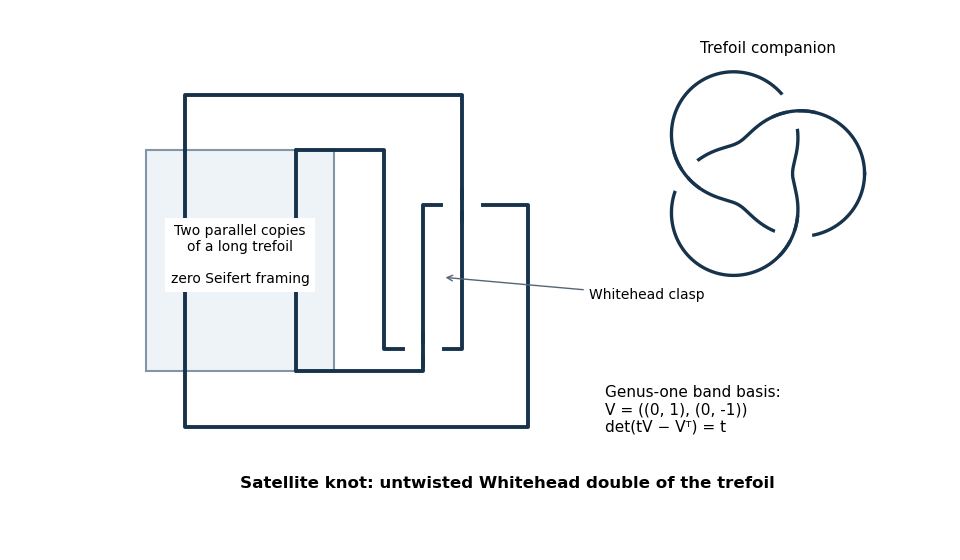
Untwisted Whitehead double: zero-framed trefoil tangle and Whitehead clasp
. Details. 
Its usual genus-one Seifert surface is a zero-framed annulus following the trefoil knot, joined by the clasp band. Choose the annulus core and a curve traversing the clasp band as the basis of its first homology. Zero annulus twisting gives the first self-linking number . The clasp contributes a Hopf band with self-linking number in the positive-clasp convention used here. Plumbing the bands contributes one linking in one push-off direction and none in the other. Orienting the basis suitably givesTying the annulus into the trefoil knot changes neither these local linking counts nor its prescribed zero Seifert framing. ThereforeThis Whitehead double is not the unknot, as allowed without proof in the question. Its Seifert genus is consequently at least one and at most one, hence exactly one. Thus while every normalized constant Alexander polynomial of a knot has degree zero: a direct counterexample to the printed inequality.
Orient as the boundary of . Push the interior of an oriented Seifert surface slightly into , and let be the double branched covering of over this pushed-in surface. Its boundary is the two-fold branched cover of a knot. Define the knot signature byThe signature of a possibly degenerate intersection form means the number of positive eigenvalues minus the number of negative eigenvalues; its radical contributes zero.
Here is why the definition is independent of . Given two choices , glue their branched covers along the common boundary to obtainThis is the double branched covering of over the closed oriented surface obtained by gluing the pushed-in to . Every closed oriented surface in admits a Seifert hypersurface: its complement has an integral meridional class, represent it by a map to the circle, and take a regular value. Near the surface choose the angular map in its trivial normal disk bundle. The closure of a suitable regular fiber is a compact oriented three-manifold bounding the surface. Its trivial normal framing can be chosen to match this construction.
Push the interior of this Seifert hypersurface into . The double branched covering of over the resulting properly embedded three-manifold has boundary . The existence of the cover follows from the meridian homomorphism to ; smoothness near the branch set is the local map . By the hypothesis about boundaries of five-manifolds, . Novikov additivity for gluing along an entire closed three-dimensional boundary givesThus the knot signature is independent of the Seifert surface. An isotopy of the knot carries the construction to an equivalent one, so it is also a knot invariant.
To calculate its intersection form, express as a disk with bands. The double branched covering of over the pushed-in disk is again . Each band lifts to a two-handle. The capped lifted cores give a basis of corresponding to the band-core basis of . The framing of the th lifted attaching circle is . For distinct bands, the two sheets contribute the two push-off linkings and , so the mutual linking number is . HenceA different integral basis changes this matrix by matrix congruence and leaves its signature unchanged.
In Figure 7 the upper knot is a connected sum of knots , while the lower one is , where is the positive trefoil knot. Both knot groups have the same presentationTo see this, the Seifert-van Kampen theorem expresses the knot group of a connected sum of knots as the amalgamated free product of the two summand knot groups, amalgamating their meridians of a knot. A trefoil knot has presentation with a meridian. Reflection gives the same abstract group for the mirror. If it reverses the chosen meridian, send both generators to their inverses; the inverse braid relation is again the same relation. Thus the meridian amalgamation yields the displayed group presentation in both cases.
A band basis for the positive trefoil knot giveswhose symmetrization is negative definite. Therefore and . Boundary-connected-summing Seifert surfaces makes the Seifert matrix block diagonal, so the knot signature is additive under connected sum of knots. ConsequentlyThe upper knot and lower knot are therefore not isotopic, even though their knot groups are isomorphic. With the opposite global knot signature convention the first value is , and the distinction is unchanged.
There are two common normalizations. I will define both explicitly, because the numerical conclusion in the question uses the unreduced one.
Set . The reduced Kauffman bracket of a nonempty link diagram iswhere runs over all bracket smoothings, count - and -smoothings, and is the number of resulting circles. Locally,Fix the usual Kauffman bracket convention in which the -smoothing at a positive braid crossing is its oriented smoothing; reflecting a crossing exchanges and . The unknot has reduced bracket , and adjoining another circle multiplies the bracket by . The unreduced Kauffman bracket uses instead and assigns the empty diagram . Thus for a nonempty diagram
For completeness, the bracket calculations for all three Reidemeister moves can be carried out in the Temperley-Lieb diagram algebra. Let be the identity two-strand tangle, and let be the cap-cup tangle. Composition gives . The two crossings correspond toConsequentlywhich proves invariance under the second Reidemeister move. On three strands, the cap-cup diagrams satisfy , , and . Expand the two sides of the third move. Their difference isThus the third Reidemeister move also preserves either bracket normalization. Reflected forms of these moves follow by replacing with .
A positive curl contributes , and a negative curl contributes . The writhe of a link diagram changes by or in exactly these cases. Therefore the corrected bracketis invariant under the first Reidemeister move as well; the second and third moves leave the writhe of a link diagram unchanged. Substituting defines a Jones polynomial. For multiple components half-integer powers of may occur. The reduced version has , and the Unreduced Jones polynomial is
At , switching a crossing does not change the bracket: both smoothing coefficients are . It changes the writhe of a link diagram by , so the correction factor is unchanged. Hence either Jones polynomial at is unchanged by a crossing change. By switching crossings, any -component link can be made an unlink. Its crossing-free diagram has circles and zero writhe of a link diagram, givingThus the printed conclusion holds for the unreduced normalization. For the reduced Jones polynomial, the correct conclusion is ; the unknot alone already rules out in that convention.
Articles by others on the same topic
There are currently no matching articles.