Use units , metric , and . Treat the complex scalar field and its adjoint as independent variables when varying the action. Their canonical momenta areCanonical quantization in the Heisenberg picture imposes, at the same time ,All other independent equal-time commutators vanish: in particular , together with the same-type field and momentum commutators. The Legendre transform gives the Hamiltonian densityThe Euler-Lagrange equations are . The positive- and negative-frequency plane waves form a complete basis of solutions of the Klein-Gordon equation. Since the field is complex, their operator coefficients are independent rather than being adjoints of each other. Define the Lorentz-invariant phase space measure . A convenient expansion isThe minus sign is a phase convention: replacing by produces the usual plus-sign expansion without changing its commutators or number operator. The normalization is fixed by the canonical commutation relations. For example,when . The cross commutators vanish and the other canonical relation follows by taking adjoints with the operator order reversed. Conversely these mode commutators can be obtained by Fourier inversion of the equal-time relations. This is canonical quantization of a complex scalar field.
Substitution into the spatial integral for makes the diagonal terms proportional to and . Terms creating or annihilating a pair have and a coefficient , so they cancel. The result before vacuum subtraction isCommuting past leaves a divergent field-independent vacuum energy. The displayed zero-vacuum-energy form must therefore be understood as a normal-ordered Hamiltonian:A regulator can be introduced before subtracting the constant. This is the normal-ordered Hamiltonian of a free complex scalar field; the unrenormalized Hamiltonian is not literally equal to this expression without that convention.
The scalar-field vacuum is annihilated by both annihilation operators. Their adjoints create two species of spin-zero bosons with the same positive energy and mass , becauseRepeated creation operators give the bosonic Fock space. The negative-frequency part does not create a negative-energy physical state; it creates the antiparticle of positive energy. The charge distinguishes the two species.
For the global phase transformation , , Noether theorem gives . Its divergence isWith vanishing boundary flux, the integral of is a conserved charge. Substituting the modes gives, before charge normal ordering, . The pair terms cancel because their frequency difference is zero when their spatial momenta sum to zero. Taking the vacuum charge to vanish gives the complex scalar charge operatorThe mode commutators imply and , soThus the particle carries charge , the antiparticle carries charge , and a state with occupation numbers has charge . Also and , agreeing with the phase transformation and charge conservation.
Continue with metric signature . The Pauli matrices obey . Block multiplication in the chiral gamma-matrix representation givesandHence , the required Clifford algebra. Multiplying the Dirac equation by yieldsThe antisymmetric part of drops out because partial derivatives commute. Therefore every component of the Dirac spinor satisfies the Klein-Gordon equation. The converse is not true: four arbitrary scalar solutions need not obey the first-order Dirac equation.
The Lorentz group consists of real invertible matrices preserving the Minkowski metric: . Writing gives , so there are six continuous parameters: three spatial rotation angles and three boost rapidities. The proper orthochronous Lorentz group is the connected component with determinant that preserves time orientation. Parity and time reversal are additional discrete operations and are not encoded by the six real parameters in an exponential near the identity.
For the real-generator convention used here, vector generators can be writtenTake and use the same parameters in the spinor representation. The Lorentz-spinor generators from a Clifford algebra areTo verify the Lorentz algebra, first commute a generator with one gamma matrix:For example, this follows by moving through each product using the Clifford anticommutator. Applying the commutator derivation rule to then givesNo extra factor of belongs in these generators with this commutator convention. Hermitian-generator conventions shift the factors of into the brackets and the exponential instead.
The same gamma commutator provesIndeed, to first order , exactly the infinitesimal vector action defined above. Exponentiating proves the finite relation. The spinor field transforms as with ; combining this relation with preserves the Dirac equation. A rotation gives , so the spinor matrices give the double-cover spin representation, rather than a single-valued ordinary representation of the Lorentz group itself.
For a boost in direction , is Hermitian, with eigenvalues . A real rapidity therefore produces eigenvalues in , whose moduli are not one. The finite-component spinor representation is not unitary for boosts, although the rotation matrices are unitary. The Lorentz group is noncompact; this does not forbid the unitary infinite-dimensional action on the physical Hilbert space of states.
Nevertheless, since ,This Dirac spinor pseudo-unitarity implies , and consequentlyThe Dirac adjoint is precisely the adjoint needed to form this Lorentz scalar; ordinary alone is not a scalar.
Let . It anticommutes with every gamma matrix and commutes with every , so . Thus the axial current transforms as a four-vector under proper Lorentz transformations:Under parity it is an axial vector, acquiring the additional pseudovector sign. Contracting two axial currents cancels that sign and uses the invariant metric. Therefore is compatible with Lorentz invariance, including parity invariance of this contraction. Lorentz invariance of the interaction does not require the axial current to be conserved.
For fields with a first-derivative Lagrangian density, suppose an infinitesimal global transformation at fixed coordinates is and , with constant infinitesimal . Noether theorem gives the on shell conserved currentThis follows by varying the Lagrangian, integrating the terms with by parts, and setting the Euler-Lagrange expressions to zero. If spatial boundary flux vanishes, is a conserved Noether charge. Spacetime symmetries are covered by including the induced field variation at fixed coordinates and the corresponding total derivative .
An example of a theory with a Lorentz four-vector is the source-free Maxwell field with electromagnetic four-potential . Under an Abelian gauge transformation,The change in is , so the Maxwell Lagrangian is gauge-invariant. For define and . With signature ,The minus sign in gives the positive electric kinetic term and positive physical field energy; reversing it would reverse the Hamiltonian's sign for the physical modes. The normalization accounts for antisymmetry and yields the conventional equations. Varying gives .
For time translation at fixed coordinates take . Since is constant, , and hence . Thus . The momentum derivative isNoether theorem therefore gives the canonical stress-energy tensor's time-translation currentHere was used. The canonical momentum of vanishes, while that of the lower spatial component is : acts as a multiplier for Gauss law, not a propagating degree of freedom. The density above is not manifestly gauge-invariant, but its charge agrees with the physical energy on the constraint surface and with appropriate boundary conditions.
The gauge-covariant time translation instead has . It is time translation combined with a gauge transformation of parameter . Directly,using the definition of , equivalently its Bianchi identity. The total derivative in is unchanged. The improved current isIt is the gauge-invariant Maxwell stress-energy tensor. In particular,The spatial current is the Poynting vector , so conservation gives . This is the familiar positive local electromagnetic field energy density, expressed entirely in measurable fields.
To compare the currents,The last term vanishes on the source-free Maxwell equations, leaving a stress-energy tensor improvement generated by a stress-energy superpotential. At the charge level,when the surface term vanishes and Gauss law holds. Thus the symmetries yield the same conserved energy under these conditions while the second supplies a gauge-invariant local density. Boundary terms would have to be retained if those boundary conditions were not imposed.
Take the muon mass to be , and use the quantum electrodynamics convention with . Let be the incoming muon and antimuon momenta and the outgoing photon momenta, so . External particles are on shell: and . The two tree-level Feynman diagrams are the two orders in which the photon legs attach to the muon line. There is no three-photon QED vertex, and therefore no single-photon annihilation diagram into two photons at this order.
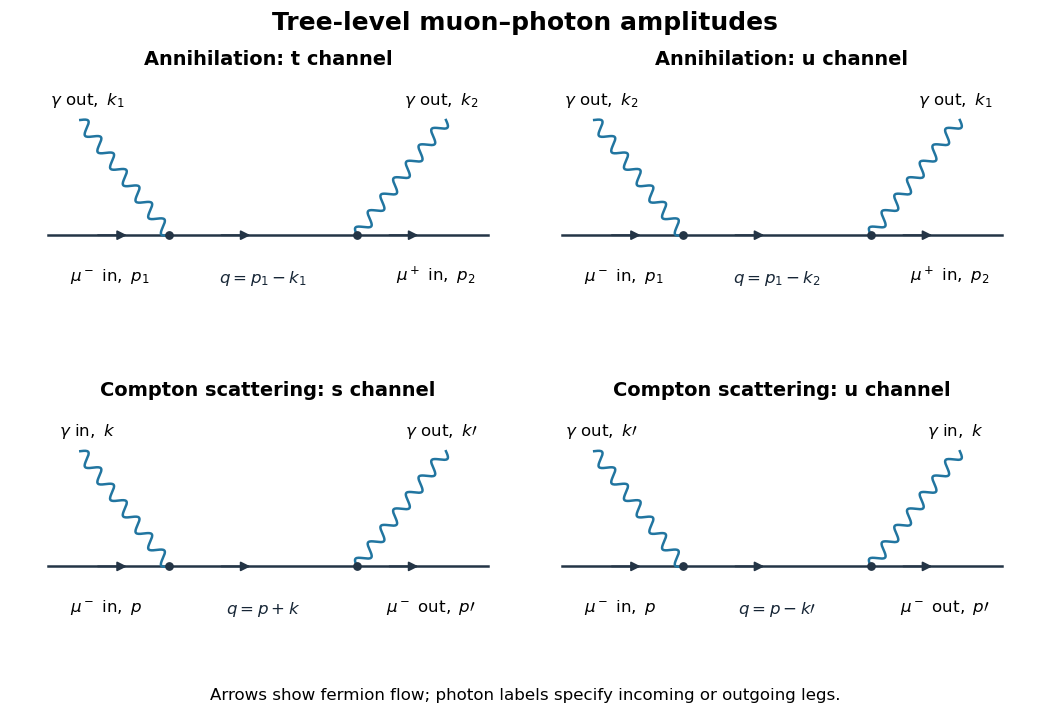

The QED Feynman rules needed here are the vertex , the Dirac propagatoran incoming muon spinor , an incoming antimuon adjoint , and an outgoing photon polarization . At a vertex enforce four-momentum conservation. Spinor products are ordered along the fermion line; exchanging the external photons introduces no relative minus sign. Define and .
With the convention that a diagram contributes , the two muon-antimuon annihilation amplitudes areTheir denominators are respectively and , where , . A different consistent overall amplitude-phase convention has no physical effect.
A physical photon polarization vector obeys , and represents an equivalence class . For a real null momentum, adding preserves transversality. One can additionally choose transverse spatial vectors with and ; there are two independent physical polarizations. The equivalence class removes the unphysical longitudinal direction, rather than imposing four independent physical polarization states.
The invariance of the total amplitude is a two-photon fermion Ward identity. Replace by and put , . The external Dirac equations giveAway from propagator poles, ; the identity extends with the common Feynman prescription. ThereforeThe two terms in the bracket then give and , which cancel. Exchanging photon labels proves the second Ward identity. Thus the sum is unchanged under for either photon. Neither diagram is generally gauge-invariant separately. Physically, longitudinal pure-gauge polarization does not couple to the observable scattering amplitude; only the two transverse photon degrees of freedom contribute.
For Compton scattering write the incoming momenta as and outgoing momenta as , with . The outgoing muon contributes , the incoming photon contributes without conjugation, and the outgoing photon contributes . The two tree-level Compton amplitudes areThese are the lower two diagrams. Their intermediate muon momenta are and , with denominators and . The first attaches the incoming photon before the outgoing photon along fermion flow; the second reverses that attachment order. Both contribute at order in the amplitude.
Compton scattering has one incoming and one outgoing muon and one photon on each side; annihilation has an incoming particle-antiparticle pair and two outgoing photons. Accordingly the external spinors/polarizations and physical Mandelstam channels differ, although both arise from the same two-vertex QED matrix element. Crossing symmetry relates them by continuing and one outgoing photon momentum , with the corresponding external wavefunction replacements. The annihilation channel becomes the Compton channel and the other channel becomes its channel. Identical final photons require a factor in an annihilation phase-space integral over an otherwise double-counted full final-state region; there is no analogous final-state identical-particle factor for the muon-photon Compton final state. Gauge cancellation holds for the summed Compton amplitude as well.
Articles by others on the same topic
There are currently no matching articles.