Use natural units and the Minkowski metric . For the real scalar field, choose . The conjugate momentum is . Under an active translation , the density changes by . The Noether theorem therefore gives the canonical stress-energy tensorIts divergence is , which vanishes on the Klein-Gordon equation. With vanishing flux at spatial infinity, the charges are conserved. In particular,The minus sign is required because and . These are the four-momentum of a free real scalar field.
For canonical quantization, impose , with both equal-time field-field commutators zero. Inverting the mode expansion givesThe equal-time canonical commutation relation then yieldsFor example, the two mixed field-momentum terms in the first commutator have coefficients and ; the delta function sets their sum to one.
Insert the mode expansion into the quadratic energy. Spatial integration supplies . In the and terms, the coefficient is proportional to . The remaining terms giveHere is the divergent zero-point energy, formally . Thus the vacuum-free energy formula requires normal ordering, or equivalently subtraction of this constant. In a finite box with a cutoff this is the ordinary sum , so the subtraction is explicit before passing to the continuum.
Likewise, use the Hermitian momentum expression . Terms containing two annihilators or two creators vanish by antisymmetry under , leaving the symmetric number-operator expression. Its vacuum term is zero with an inversion-symmetric regulator. Therefore the normal-ordered free scalar four-momentum isThe creation operator commutators follow directly from :Starting from a vacuum annihilated by every , each creation adds a particle of mass , energy and momentum . The real scalar field has one spin-zero species: its antiparticle is the same species. Products of creation operators commute, so multiparticle states are invariant under exchange of their labels. In a normalized discrete mode, exists for every ; there is no exclusion restriction. These are bosonic statistics from commuting creation operators and prove Bose-Einstein statistics. For completeness, the single-mode thermal sum gives , the Bose-Einstein distribution at zero chemical potential.
Variation with respect to the Dirac adjoint, the Dirac field, and the real scalar field respectively givesThe derivative in the adjoint equation acts to the left; its sign follows by integrating by parts. The Yukawa interaction supplies a spacetime-dependent effective fermion mass and a scalar source.
Use and the convention . The momentum-space Feynman rules are: a scalar internal line contributes ; an oriented fermion line contributes ; and each scalar-fermion vertex contributes times the identity in spinor space. Impose four-momentum conservation at each vertex. Incoming and outgoing fermions supply and , while incoming and outgoing antifermions supply and ; scalar external legs supply one. Loop momenta are integrated with , a closed fermion loop contributes a minus sign, and graph symmetry factors are included. Relative signs between distinct contractions of identical external fermions follow from their anticommutation relations. These specify the Feynman rules also beyond the tree approximation.
Label incoming momenta and outgoing momenta , with all external particles on shell. Write the Mandelstam variables as , , , and abbreviate . Spin indices on are implicit. The six required tree-level Feynman diagrams are:
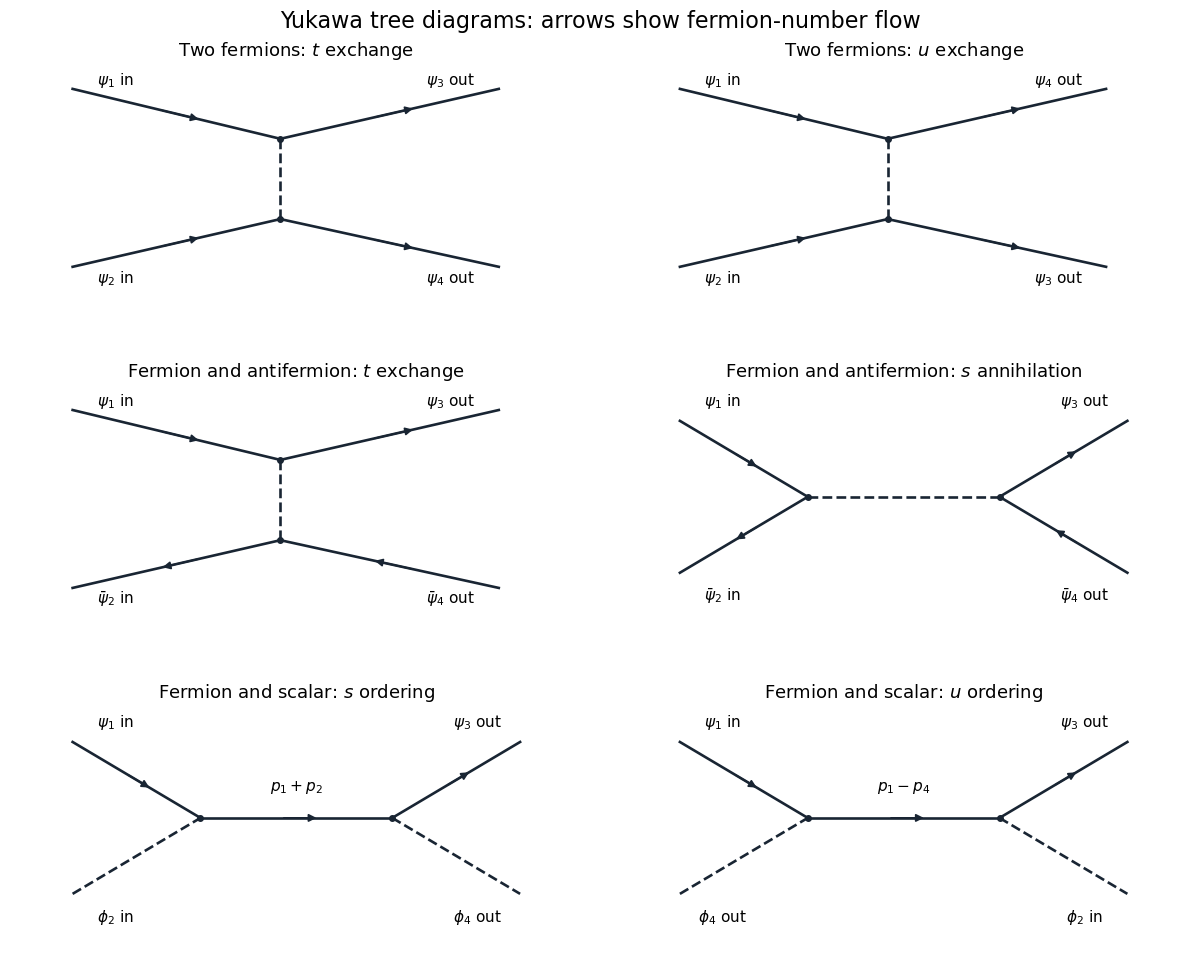
The six Yukawa tree diagrams for fermion, antifermion and scalar scattering, with momentum labels and fermion-number arrows
. Details. 
For two incoming fermions, the two diagrams exchange a scalar in the and channels. With external state ordering and , the result isEach scalar-exchange contraction has two factors and one scalar Feynman propagator. Exchanging the final fermions reverses the sign, as required by their identical-particle statistics.
For a fermion and antifermion, there is -channel scalar exchange and -channel annihilation. Take both initial and final states ordered as fermion creator followed by antifermion creator. ThenThe relative minus is not optional. One way to track it is the antifermion sign of a normal-ordered bilinear: the antifermion scattering part of is , whereas its annihilation part is . Thus the exchange contraction has the opposite fermionic sign to the annihilation contraction before multiplying by . A different overall phase convention for external states changes the common sign of this amplitude, but cannot change the relative sign.
For fermion-scalar scattering, the fermion can absorb the incoming scalar before emitting the outgoing one, or emit first and absorb afterwards. The internal momenta are and respectively, givingBoth orderings have the same sign: there is only one open fermion line and no exchange of identical external fermions. There is no scalar-exchange diagram because this Yukawa interaction has no three-scalar vertex. These amplitudes describe tree scattering in Yukawa theory.
The conjugate complex scalar field has the opposite charge. Thus the derivative on in the kinetic term must mean , while the derivative on is . This is the conjugate gauge covariant derivative. Applying the same plus-charge differential operator to both fields would not give the stated gauge-invariant theory. For example, take , and ; the literal plus-charge kinetic product changes from to . The opposite-charge interpretation removes this term.
For an arbitrary real function , takeThen and the conjugate derivative transforms oppositely. Also because mixed derivatives commute. The kinetic contraction and are unchanged, proving local U(1) gauge symmetry.
Expanding the covariant kinetic term identifies the interactions:The first term gives the scalar electrodynamics three-point vertex, and the second gives the seagull vertex. For scalar charge flow from an incoming particle of momentum to an outgoing one of momentum , the factors areThe factor two in the second rule comes from the two identical photon fields. Equivalently, with all momenta incoming, the three-point rule is for a leg of momentum and a leg of momentum . An antiparticle line has the opposite charge-flow sign. The vertices are shown with dashed scalar lines and wavy photon lines:
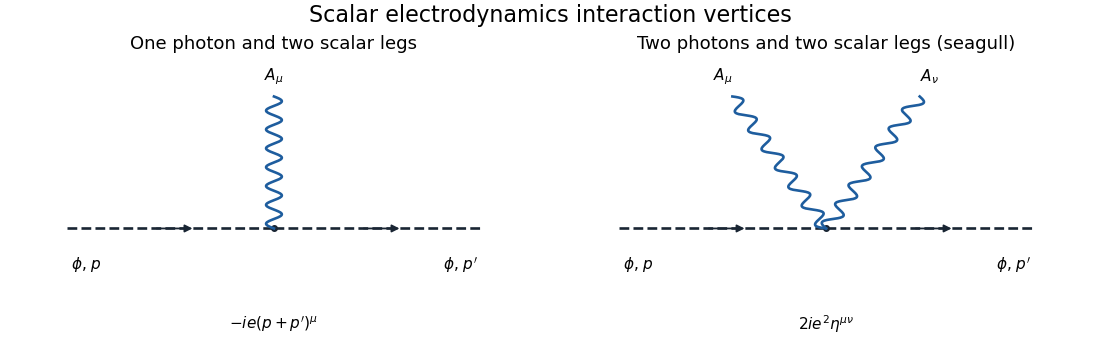
The one-photon scalar vertex and the two-photon seagull vertex in scalar electrodynamics, including their momentum-space factors
. Details. 
For particle-antiparticle scattering, use incoming and outgoing , with particle momenta. At order , there are exactly two tree-level Feynman diagrams: -channel photon exchange and -channel annihilation. The seagull vertex has only two scalar legs and cannot alone provide four external scalar legs.
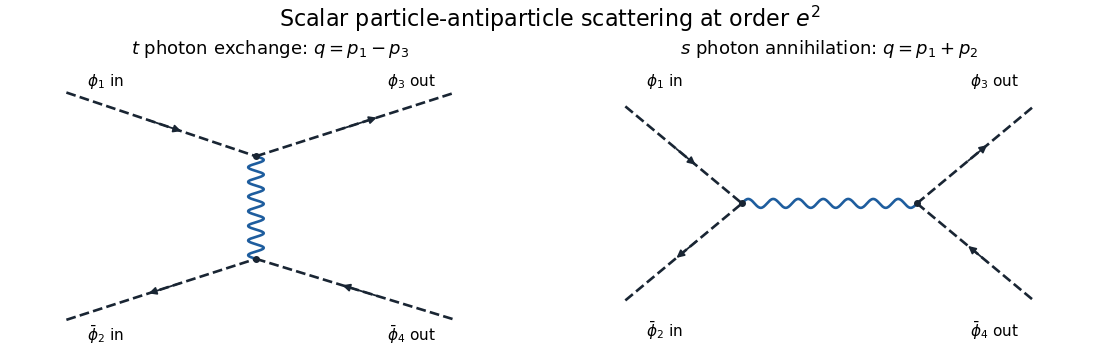
The leading t-channel photon exchange and s-channel annihilation diagrams for scalar particle-antiparticle scattering
. Details. 
Set and . The external currents areAll are transverse to the corresponding exchanged momentum: for instance and . This is the on-shell scalar quantum electrodynamics Ward identity. With the vertex convention above,The relative sign comes from the opposite particle/antiparticle charge in the exchange diagram and the two equal annihilation-vertex signs.
To see how the Coulomb gauge expression becomes covariant, let be either pair, , and initially take . The displayed photon propagator givesCurrent conservation gives and the same identity for . Since , the temporal coefficient simplifies asThereforeThe common Feynman pole prescription is understood in these formulas. This Coulomb-gauge propagator between conserved currents identity proves equality of the physical amplitudes despite the noncovariant individual propagator components. It should be formed before taking limits such as : individual instantaneous and transverse terms can be undefined separately in that limit while their sum has a finite covariant limit away from a physical pole.
Substitution gives the final scattering amplitudeHere are the Mandelstam variables for the equal-mass external scalars. This is scalar particle-antiparticle tree scattering; overall external-state phases do not affect its relative channel sign.
A symmetry preserves the action, possibly up to a boundary term. In a classical field theory, this connects transformations of fields to conserved quantities. In a quantum field theory, it also constrains states, observables and scattering amplitudes. Continuous symmetries have Noether currents; discrete symmetries can be equally important without supplying a current through the same theorem.
For a local density depending on fields and their first derivatives, define and . Suppose a one-parameter transformation has fixed-coordinate variation and satisfies . The Noether's first theorem asserts thatFor Grassmann-valued fields the derivatives and ordering are chosen consistently; the same integration-by-parts argument applies. To prove the theorem, expand the density variation and integrate its derivative term once algebraically:Comparison with the assumed divergence gives . On shell every Euler-Lagrange expression vanishes. Integrating this continuity equation over space gives the Noether charge and . Thus is conserved whenever the boundary flux vanishes. Boundary conditions are part of the conservation statement; the local identity alone does not discard nonzero flux.
Translations illustrate the theorem in every relativistic field theory. For and , the current is , whereThe four charges are energy and momentum. For the Klein-Gordon field they reduce to the expressions derived in Question 1. Lorentz invariance gives angular momentum and boost currents. With a symmetric improved stress-energy tensor, these are . The canonical Dirac expression also carries an intrinsic spin current; improvement incorporates it into the symmetric tensor. Together translations and Lorentz transformations form the Poincaré group.
Internal symmetries act on field components without moving spacetime points. The global phase symmetry of a complex scalar field, , hasIts charge distinguishes particles and antiparticles. A Dirac phase transformation gives . This is preserved by the real-scalar Yukawa interaction, because the phases of and cancel; consequently fermion number is conserved even while scalar and fermion particles interact. A multiplet of real scalars with a potential depending only on has orthogonal internal rotations. Their antisymmetric currents can be written .
Discrete examples include for an even real-scalar potential, parity symmetry in quantum field theory, and charge conjugation, which interchanges a complex scalar with its conjugate and reverses the electromagnetic potential. Discrete transformations are not generated by an infinitesimal continuous parameter, so Noether theorem does not attach a local conserved current to each of them. Nevertheless they forbid interaction terms and relate physical processes.
A global symmetry in field theory uses parameters constant across spacetime and can act nontrivially on physical states. A gauge redundancy allows arbitrary spacetime-dependent parameters and relates descriptions of the same physical configuration. In scalar electrodynamics, replacing the scalar's global phase by a local phase requires the compensating gauge transformation of and the gauge covariant derivative; the invariant contraction uses the opposite representation for . In Yang-Mills theory, matter transforms in a representation of a non-Abelian gauge group and the gauge potential transforms so that covariant derivatives and field strengths transform covariantly. Gauge fixing, such as Coulomb gauge, chooses representatives of these descriptions rather than changing physical predictions. The current-contracted propagator identity of Question 3 illustrates why a noncovariant gauge choice leaves scattering Lorentz invariant.
The arbitrary local parameter produces a stronger statement than one independent conserved charge for each function. For the abelian scalar transformation, vary the action with an arbitrary compactly supported and integrate its derivative term:ThereforeThis consequence of Noether second theorem, the Noether identity for abelian scalar gauge symmetry, holds off shell: gauge invariance makes the field equations dependent. In Hamiltonian language the same redundancy is reflected by the Gauss law constraint in gauge theory and the elimination of unphysical gauge degrees of freedom. Gauge transformations that vanish at the boundary are redundancies; transformations with nontrivial boundary behaviour can instead carry physical surface charges. This is why identifying every gauge transformation with a zero-charge operation would be too strong.
Finally, symmetry of the action need not imply symmetry of a chosen vacuum. For a complex scalar with a symmetry-preserving potential whose minima occur at nonzero , different constant phases label degenerate vacua. Choosing one breaks the global phase symmetry of the state; the Goldstone theorem supplies a massless mode under its usual relativistic assumptions. When the same phase is gauged, the Higgs mechanism describes the phase degree of freedom becoming the longitudinal polarization of a massive gauge boson; the local redundancy is still present in the underlying description. At the quantum level a classical symmetry can also fail through a quantum anomaly, so a classical Noether derivation alone does not guarantee an exact quantum Ward identity. Conserved charges, physical global transformations and local gauge redundancy are related but distinct consequences of symmetry.
Articles by others on the same topic
There are currently no matching articles.