Only the empty binary configuration contributes to , and only the occupied configuration contributes to . Thus the Hirota tau functions giveHere denotes the velocity parameter, while without a subscript remains the coupling of Sine-Gordon theory. For , the field approaches the adjacent scalar-field vacua and at the two ends of space, so its topological charge is . Its center is , givingThe constraint implies . Hence this is precisely a Lorentz boost of the static Sine-Gordon kink, with the expected Lorentz contraction. As a direct check, if , then and , so .
The real-parameter condition also permits . That choice reverses the topological charge and describes an antikink. The all-kink scattering formulas below use ; the orientation dependence is stated explicitly at the end of the two-body calculation.
Write the rapidity parameters as , , and define . The signed coefficient in the Sine-Gordon multisoliton tau representation isFor distinct rapidities, . In particular, cannot be taken as a real logarithm of a positive coefficient. The finite sums defining the Hirota tau functions can instead be evaluated directly with the real, negative . They giveThe physical field is a continuous branch of a multivalued function, equivalently with the argument followed continuously. The principal inverse tangent alone jumps when changes sign.
Follow the first kink with . Then and . The two possible local limits arewhere the second field is written on the continuous kink branch. Thus both limits are single Sine-Gordon kinks of the same width and velocity, but their centers obey or . Following the second kink gives the same conclusion with labels exchanged. The incoming and outgoing velocities are thereforeThere is no change in the asymptotic rapidities or kink profiles.
Define the spatial shift as the outgoing center intercept minus the incoming center intercept. Since the large- limit occurs afterwards when , and beforehand when , the soliton time delay isThe time formula uses and requires . Its dependence on the velocities is explicit on substitutingFor a faster right-moving kink, and : it arrives earlier than its freely continued incoming trajectory. If , report the finite spatial shift; a fixed-position arrival-time delay for a stationary kink is undefined. Coincident velocities are excluded from a separated collision asymptotic.
For completeness, allowing antikinks means , , with . The velocities remain . For opposite orientations, , and the general spatial shift isThis follows from the same two local limits; it makes explicit the orientation hypothesis behind the velocity-only all-kink answer.
For the all-kink sector, keep and . Enumerating the even and odd binary configurations gives the Hirota tau functionsThe last minus sign is the product of three negative pair coefficients. As in the two-body limit, the three velocities are .
To follow the first kink, keep bounded and take . Let be the set of spectators whose exponential diverges in that limit:For no large spectators, . For one large spectator , . For two large spectators, the dominant terms give . On a continuous branch of a multivalued function, each case has local profile plus the appropriate vacuum offset, whereConsequently the incoming and outgoing intercepts are and . This provesAgain the time expression requires and distinct velocities; the corresponding spatial-shift identity holds also when . With mixed orientations, use the general pair shift established above and determine growing spectators by the sign of ; the same multiplication of pair coefficients proves additivity.
There is no independent three-body contribution to the asymptotic shift. The pairwise additivity of soliton shifts is a classical manifestation of factorized scattering in an integrable partial differential equation. The collision preserves the individual asymptotic rapidities and profiles, and the net shift is independent of the sequence of separated pair collisions. In the quantum theory, consistency of the corresponding species-changing S-matrices becomes the Yang-Baxter equation; the classical scalar shift identity is its physical precursor, rather than a derivation of all quantum matrix identities.
Choose boundary states with nonzero overlap with the lowest-energy state in the vacuum sector and in the one-kink topological sector . In a finite spatial box, a fixed scalar field configuration eigenstate may be used formally, with temporal endpoints equal to the chosen configuration. More generally, smear the endpoints with wavefunctionals . Their unitary time evolution kernels areThe inner scalar field path integral remains in the chosen topological sector, with . A zero-total-momentum projection can be included to select the rest state; alternatively, the translational prefactor does not change the large-time exponential. After a Wick rotation to physical Euclidean time , the energy eigenstate expansion gives . Thus the exact vacuum-subtracted soliton mass isEquivalently it is at large time with a damping prescription. The ratio subtracts the vacuum energy; the Hamiltonian operator and action here are the fully regulated and renormalized ones, not merely their classical approximations.
With the dimensionless coordinates of this paper, the correctly normalized classical action isFor the static Sine-Gordon kink, and , so . Write . Expanding and integrating by parts givesThe first variation is , plus boundary terms. It vanishes because the kink satisfies the Euler-Lagrange field equation and the fluctuations have the prescribed temporal endpoints and admissible spatial boundary behavior. This is the principle of stationary action, not a symmetry assumption about .
The printed expansion omits despite the stated Lagrangian density. Its displayed form is the expansion of ; it is not the physical at arbitrary coupling. Alternatively, writing puts the quadratic term in canonical normalization, while leaving the classical term unchanged. This normalization repair does not change or the physical fluctuation frequencies.
The Sine-Gordon kink fluctuation operator has the useful factorizationIt is nonnegative, and gives the normalized translational zero mode of a sine-Gordon kink:A displacement changes by . Thus the zero mode in field theory is the position collective coordinate of the kink, reflecting translation invariance. It has no restoring force and no oscillator zero-point energy. Integrate that collective coordinate separately rather than inserting a zero factor into the Gaussian functional determinant.
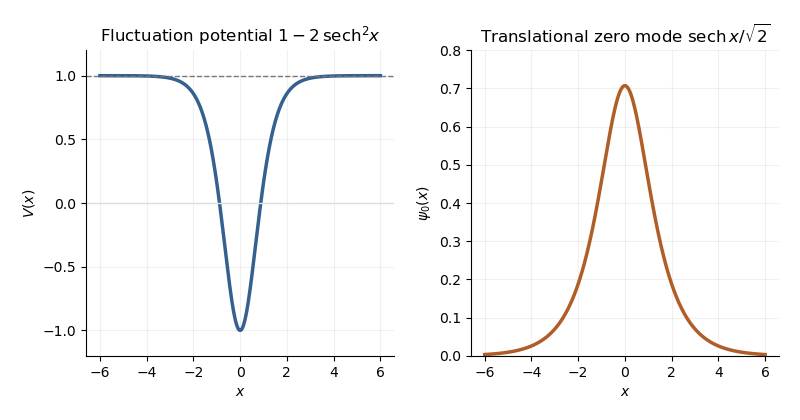
Sine-Gordon kink fluctuation potential and normalized translational zero mode
. Details. 
In the Gaussian fluctuation approximation, the formal oscillator contribution to the one-loop soliton mass correction, before adding any counterterm, isUse a common regulator for the two sums, include all discrete modes, and treat the translation mode as above. The vacuum sum is essential: subtracting only classical vacuum energy would leave an extensive oscillator energy. A periodic fluctuation and its derivative are matched at the two ends of the large box; the one-kink background lies in the twisted topological sector, and its infinite-line profile is accurate up to exponentially small boundary corrections.
For a continuum scattering wavefunction, equality of its two asymptotic values gives the periodic-box phase-shift quantizationAway from the threshold, expand at a matched mode number:Since consecutive free wave numbers are separated by , replacing the continuum-mode sum by an integral proves the displayed continuum contribution:The ultraviolet cutoff is retained until the counterterm is added.
There is a finite threshold issue if this expression is identified with the complete oscillator correction. It can be settled directly using the factorization: a continuum eigenfunction is . Its transmission phase obeyswith the odd phase branch that tends to zero at large . For , the continuum roots have labels ; there is no periodic continuum root at , since the limiting eigenfunction has opposite signs at the two ends. The bound state at replaces the free oscillator with . Consequently, in mode-number regularization of soliton masses,The PDF's continuum-only formula misses this finite under this standard phase and mode-counting convention. It has the correct logarithmic ultraviolet divergence, but the missing term is not suppressed by large . Changing the phase branch requires changing the mode labels and endpoint terms consistently; it cannot erase a physical mode from the formal spectrum sum.
At high momentum, , so both expressions have divergent part . The canonical field has a quartic interaction with coupling . Its vacuum tadpole diagram shifts the squared mass by , whereThe Sine-Gordon vacuum tadpole counterterm has and adds potential energy density . Since , its vacuum-subtracted kink energy iswhich cancels the logarithmic ultraviolet divergence. Finite parts require a specified renormalization condition. As a consistency check, with this tadpole subtraction and matched mode-number cutoff, integration by parts yieldsThe complete semiclassical soliton mass is then in that convention. This last finite result uses the bound-mode term and is additional to the requested ultraviolet cancellation.
Interpret the paired indices as incoming and as outgoing. For self-conjugate particles in the real vector representation of the orthogonal group, crossing the second incoming particle with the second outgoing one givesThe continuation exchanges the trace and permutation tensor structures and leaves the identity structure fixed. Therefore crossing symmetry imposesThese are analytic relations; they do not determine the three functions completely.
For unitarity, act on the two-species tensor product with the O(N)-invariant S-matrix . The invariant operators obey , and . Writing and multiplying givesThe three invariant operators are independent for . Equivalently, the orthogonal-invariant scattering channels have amplitudesand each satisfies . The trace singlet, symmetric traceless and antisymmetric channels have dimensions , and . For these are . With Hermitian analyticity of a two-particle S-matrix, on the real axis, so each channel has unit modulus. This expresses conservation of scattering probability.
The Faddeev-Zamolodchikov algebra orders particle operators by rapidity. Its associativity requires that a product of three operators be independent of parentheses and, in particular, that both sequences of adjacent exchanges give the same final ordered species word with the same coefficient. This is the Faddeev-Zamolodchikov associativity constraint, or spectral Yang-Baxter equation. The exchanges do not use the ordinary creation/annihilation normal ordering convention.
Take , with , , and abbreviateFor , start with and compare the coefficient of . First exchange positions , then , then . The initial equal-index exchange givesFrom the first term, the specified final word is reached through ; from the second term, the intermediate equal-index exchange uses to produce species , followed by . Thus this exchange route has coefficientFor the other route, first exchange positions , then , then . The first exchange is between different indices and gives . The first term reaches the target through , and the second reaches it through . ThereforeEquate these two coefficients, cancel the common term , and rearrange:Restoring the three arguments gives the required scalar Yang-Baxter equation. The derivation starts in the ordered physical region ; the identity extends to other values by the same scattering analytic continuation, wherever its factors are defined. Associativity must hold coefficient by coefficient for every species word; this displayed relation is one necessary component.
Articles by others on the same topic
There are currently no matching articles.