Write for the specific gas constant, with the printed denoting the atomic mass unit, and for the radiation constant. In the low-mass envelope the enclosed mass is approximately and the outward luminosity is approximately . The stellar hydrostatic equation, stellar radiative diffusion, and ideal gas equation giveThe Kramers' opacity law becomes . Dividing the two differential equations eliminates radius and mass density:Integrating from a surface matching point givesDeep compared with the photosphere, the surface terms are negligible. The radiative-zero white-dwarf envelope therefore hasThis is the leading envelope approximation used in the later parts, rather than an exact atmospheric boundary condition at .
At the base, temperature, mass density and pressure match the isothermal degenerate core. Let , where is the mean molecular weight per electron. Equating the gas and electron degeneracy pressure givesHence . Substituting this into the envelope relation at yieldsThe matching of a white-dwarf envelope to a degenerate core thus gives , the envelope relation underlying Mestel's cooling law. It depends on pressure as well as mass density continuity at the interface; otherwise the supplied core equation would not determine the matching mass density.
In the radiative-zero white-dwarf envelope, . Substitute this derivative into the stellar hydrostatic equation:Integrating from the idealized zero-temperature surface at givesThis also gives . A finite surface temperature adds to the integrated profile if the pure power-law pressure relation is retained locally. Near the actual photosphere, the integration constant in the pressure law also matters; the displayed expression is the radiative-zero limit implicit in the printed result and accurate in the deep envelope when .
Apply the preceding temperature profile at the envelope base. Introduce the dimensionless parameterThen , so the geometrical thickness of a white-dwarf radiative envelope isThe smallness to be established is therefore , up to the numerical factor .
That ordering follows from the cold, strongly electron-degenerate white dwarf model. Throughout the mass-bearing core, , where is the Fermi energy. For nonrelativistic electron degeneracy pressure,The stellar hydrostatic equation gives a characteristic core of order . Consequentlyfor fixed composition with order-one molecular-weight ratios, and . Equivalently, the matched base mass density is much lower than a characteristic core mass density, since . The degeneracy ordering applies in the bulk core; at the matching point degeneracy is becoming marginal.
The inequalities and express different facts. The first justifies ignoring surface-temperature terms, while the second makes the envelope geometrically thin. If the core were hot enough that were not small, the exact expression would not justify a thin-layer approximation.
Compare two cooling states of the same white dwarf, holding its mass, nearly temperature-independent degenerate radius and composition fixed. The matching of a white-dwarf envelope to a degenerate core gives , while the geometrical thickness of a white-dwarf radiative envelope gives at leading thin-layer order. Eliminate :Thus a luminosity drop makes the envelope thinner, with . This is the white-dwarf envelope thickness-luminosity relation. Retaining finite thickness in the radiative-zero model gives the correctionwhich reduces to the boxed result for .
Use stellar homology: dimensionless profiles and composition are fixed, so proportionality constants do not change along the model sequence. Scaling mass conservation and the stellar hydrostatic equation giveswhere the last relation uses the ideal gas equation of state with fixed mean molecular weight. The specific stellar energy-generation rate is , soBy stellar radiative diffusion, , henceEquate the generated and transported luminosity in thermal equilibrium. The homology relations for radiative stars giveThis division presumes a nonzero denominator. If it vanishes, the scaling balance instead imposes a condition on or leaves the radius scaling undetermined, depending on the numerator. For later use, the corresponding mass-luminosity relation exponent is
For PP chain burning and the Kramers' opacity law, insert , , and into the homology relations for radiative stars:Thus the radiative homology with proton-proton burning and Kramers opacity isTo obtain the Hertzsprung-Russell diagram slope, apply the Stefan–Boltzmann law :Equivalently . The Hertzsprung-Russell slope of a stellar homology sequence refers here to logarithmic luminosity versus logarithmic effective temperature; a conventional diagram reverses its horizontal axis, so the line descends toward the right.
For fixed composition, electron-scattering opacity is effectively independent of mass density and temperature, so . With the specified CNO cycle exponent , the homology relations for radiative stars giveThe radiative homology with CNO burning and electron scattering is thereforeThe Stefan–Boltzmann law now givesEquivalently . These slopes are illustrated with arbitrary separate reference-model normalizations:
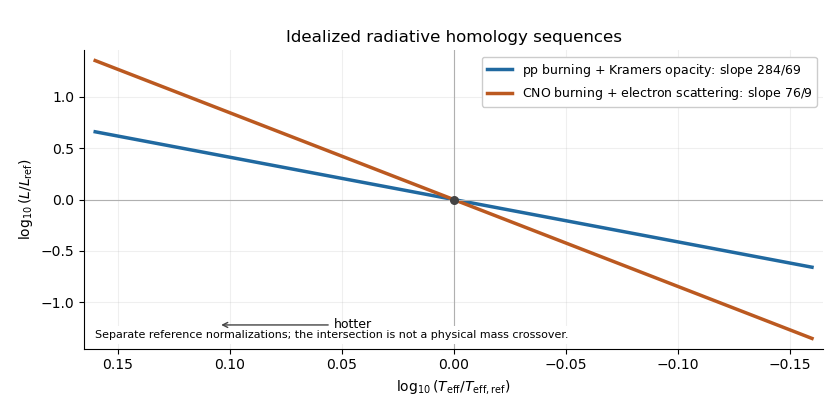
Logarithmic Hertzsprung-Russell slopes for the two idealized radiative homology sequences, with temperature increasing to the left
. Details. 
The proton–proton/Kramers model applies to the lower-mass regime; the CNO/electron-scattering model applies to the higher-mass regime. Higher-mass cores are hotter, making the more temperature-sensitive CNO cycle efficient, and highly ionized material favors electron-scattering opacity. These are the stated idealized radiative, gas-pressure-supported sequences: a fully convective low-mass star or a radiation-pressure-dominated massive star needs a different structural model. The intersection of independently normalized lines in the figure does not specify a physical crossover mass.
Let denote specific entropy, reserving from the first question for envelope thickness. The stellar adiabatic exponents are defined at fixed composition byIt is useful to introduce , so .
Take the stellar gas to be a fully ionized, nonrelativistic monatomic ideal gas, with fixed specific gas constant . Its mixture with thermal radiation hasHere is specific internal energy, and the stellar gas-pressure fraction is . The assumption of monatomic gas fixes its heat capacity; the perfect-gas pressure law alone would not determine it.
At fixed and fixed , respectively, the pressure derivatives areFor an isentropic process, the first law of thermodynamics gives . Differentiate the internal energy rather than artificially holding fixed during the perturbation:The parenthesis is , givingSince ,Using the relation between the exponents gives the adiabatic exponents of a monatomic gas-radiation mixtureThe requested values, including the adiabatic temperature gradient, areThe pure-radiation and pure-gas rows are understood as limits of the mixture.
For uniform composition, the Schwarzschild criterion for stellar convective instability isTo test whether a radiative configuration becomes unstable, use its required stellar radiative temperature gradient for . Since , the equivalent radial condition isAn outward-displaced parcel then cools less than its new surroundings, remains less dense at the same pressure, and is further accelerated outward.
The requested Eddington-model convective-core mass fraction follows from the usual global constant- closure. At the outer radiative surface, put , , and . Dividing the radiation-pressure gradient by the stellar hydrostatic equation givesThere is no energy generation outside the convective core, so use there. The local radiative-gradient formula isThe same representative has been used in the global luminosity closure and at the boundary. Setting this gradient equal to at producesThis is , , and for , respectively, with a marginal radiation-dominated limit.
There is a consistency qualification to this last model estimate. It cannot be an exact stellar solution if all the printed assumptions are enforced pointwise. An exactly uniform nonzero radiation fraction would give at every radiative point. The exact equations would then requireIf is constant throughout an envelope with positive mass density, increases with radius, so this equality cannot hold there. Equivalently uniform fixes the actual gradient to , whereas for . The boxed core fraction is the intended Eddington closure and boundary estimate, which relaxes exact constancy of in the detailed envelope. The constant-beta radiative-envelope obstruction identifies the missing approximation; it is not legitimate to silently assert exact compatibility.
For a slowly evolving spherical star, use a Lagrangian enclosed mass coordinate . Let be specific thermal internal energy and follow a mass element. The stellar energy balance equation isThe outward luminosity is energy transported through the mass shell, is nuclear rest-mass energy released per unit mass and time, and is escaping neutrino power per unit mass. Define the gravothermal stellar energy generation by . At fixed composition it is by the first law of thermodynamics. During composition changes the full internal-energy derivative must use the appropriate equation of state, with nuclear rest-mass changes counted only once. If a tabulated nuclear rate already subtracts reaction-neutrino energy, that loss must not be subtracted a second time in .
In a nearly steady main sequence star, stellar nuclear fusion supplies most of the luminosity. Before stable hydrogen ignition, Kelvin-Helmholtz contraction releases gravitational energy. In a gas-supported hydrostatic star the stellar virial theorem gives , so about half the change in gravitational binding energy heats the star and half is available for radiation. The associated timescale is . After nuclear burning ends, a white dwarf can shine by losing stored thermal energy; crystallization releases latent heat, and composition separation can add gravitational energy. These are heat and gravitational reservoirs rather than sustained hydrogen fusion.
Stellar nuclear fusion is possible because lighter nuclei can combine into products with larger nuclear binding energy. The energy per reaction is , including the relevant particles consistently. Although thermal energies are below the Coulomb barrier, quantum tunnelling permits fusion. The thermonuclear reaction rate averages a cross-section over the thermal relative-speed distribution:For nonresonant charged-particle reactions the energy weighting contains ; the compromise between the thermal tail and penetration produces the Gamow peak. A resonance can greatly enhance the rate. Density, abundances and temperature therefore all affect the stellar energy-generation rate, and power laws such as or are local approximations.
For the proton–proton chain, first produce deuterium and helium-3:The initial reaction is slow because it converts a proton to a neutron through the weak interaction. It is the bottleneck that allows long hydrogen-burning lifetimes. The alternative pep reaction also feeds the same chain. There are three principal proton-proton chain branches. In pp I, two helium-3 nuclei terminate the chain:In pp II, helium-3 first captures an existing helium-4 nucleus, then electron capture and proton capture finish the branch:In pp III, the beryllium-7 instead captures a proton:Relative branch weights change with temperature and composition. All branches convert four protons into a net helium-4 nucleus, with two weak conversions and two neutrinos, allowing for the electron consumed in pp II. After including positron annihilation, the atomic-mass energy budget is approximately per net helium-4 nucleus, but the deposited heat is smaller by the branch-dependent escaping-neutrino energy. Near ordinary low-mass main-sequence conditions, is a useful local approximation.
The CNO cycle provides an alternative catalyzed hydrogen burning route in hotter cores. The CNO-I cycle, also called the CN cycle, consists ofThe carbon seed is regenerated: the net reaction again consumes four protons and produces one helium-4 nucleus, two positrons and two neutrinos. The slow reaction governs the ordinary cycle and causes nitrogen-14 to accumulate. The CNO-II cycle branches through , , , and , after which the main cycle continues. Thus CNO nuclei are catalytic in the closed cycles, although their relative abundances change. A local rate is with a much steeper exponent than the PP chain; the preceding homology problem specifies . The concentration of this heating near the centre favors a convective core in hotter, more massive hydrogen-burning stars.
Once hydrogen is exhausted in a core, contraction can raise its temperature enough for core helium burning. The Triple-alpha process overcomes the absence of stable mass-5 and mass-8 nuclei by maintaining a tiny transient beryllium-8 population:The Hoyle state, an excited carbon-12 resonance near the three-alpha threshold, makes the second capture efficient enough despite beryllium-8's very short lifetime. The net conversion is , releasing about . Because three alpha particles are required, the specific rate scales as ; a schematic resonant rate isIts local temperature exponent is , of order forty near . A degenerate core cannot expand promptly to regulate this increase, giving a helium flash; in a nondegenerate core the stellar thermostat permits stable helium burning. The competing reaction determines much of the eventual carbon-oxygen mixture.
If the core becomes hot enough, carbon burning follows, for example through and . Neon burning begins with photodisintegration, , followed by alpha capture such as . The first step consumes heat, but the combined rearrangement can release net energy. Oxygen burning includes and channels producing phosphorus and other nearby nuclei. At still higher temperatures, silicon burning proceeds through photodisintegration and particle captures in a reaction network approaching quasi-statistical equilibrium, producing iron-group nuclei. It is not simply direct silicon-plus-silicon fusion; the products depend on the electron fraction and weak-interaction timescale.
The increasing nuclear binding energy per nucleon supplies progressively less energy as products approach the iron group. Further fusion past that region cannot provide sustained net heat to support a core. Massive stars can therefore end with an unstable iron-group core; lower-mass stars do not attain all these burning stages and instead leave remnants such as carbon-oxygen white dwarfs. Heavy-element neutron captures can synthesize nuclei beyond the iron group without being the principal hydrostatic power source.
Finally, stellar neutrino energy loss competes with every heat source. Reaction neutrinos accompany the proton–proton and CNO chains. Hot or dense material also emits neutrino pairs through , plasmon decay, , and electron-ion bremsstrahlung. These neutrinos usually escape, unlike the photons whose transport is diffusive; neutrino trapping requires much more extreme collapse conditions. Late burning has smaller fuel-energy reservoirs and strong neutrino cooling, so its duration is much shorter than core hydrogen burning. The surface luminosity is the escaping photon power, , not the sum of photons and unobserved neutrino power. Radiative diffusion in a star, convection and electron conduction redistribute energy, while the energy-balance equation distinguishes true sources, losses and storage. Accretion or mass loss adds boundary energy and mechanical work when present, rather than changing the nuclear reaction budget.
Articles by others on the same topic
There are currently no matching articles.