Use the meridian of a knot and Seifert longitude of the unknot on its boundary torus. The unknot's knot exterior is a solid torus whose disk-bounding curve is . A genus-one Heegaard diagram is thereforeHere the horizontal coordinate is and the vertical coordinate is . The drawing uses a small translate of to avoid intersections on the edge of the square; opposite edges are identified. The algebraic intersection number of curves on an oriented surface has absolute value five.
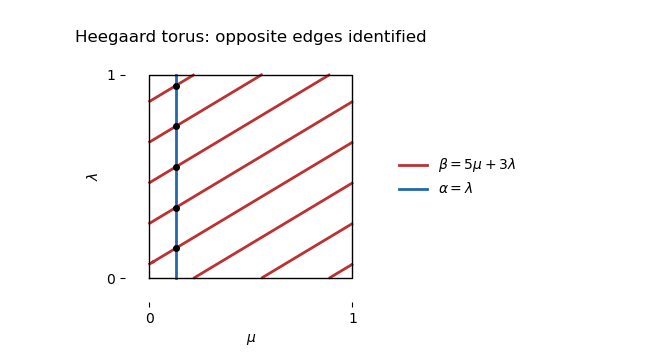
Starting with , attach a three-dimensional two-handle along , using its surface framing, and cap the resulting sphere with a three-handle. This gives the solid torus on that side. Attach a two-handle along , again using the surface framing, and cap its sphere with a three-handle. The second solid torus has its disk-bounding curve identified with , so the resulting oriented lens space is precisely the specified Dehn filling.
The solid torus supplied by the side has fundamental group generated by the image of , while is trivial. The two-handle imposes . The three-handles do not change the fundamental group, so
The elliptization theorem says that a closed oriented three-manifold with finite fundamental group has spherical geometry. When the fundamental group is a cyclic group, it is a lens space. Consequently the candidates are with , using the same surgery orientation convention throughout.
The oriented classification of lens spaces says that and are related by an orientation-preserving homeomorphism exactly when . Since , , and modulo five, the complete list isThese are three distinct oriented homeomorphism classes. Reversing orientation interchanges and ; the class containing and admits an orientation-reversing homeomorphism. The elliptization theorem and the stated oriented classification of lens spaces are the general classification results used here.
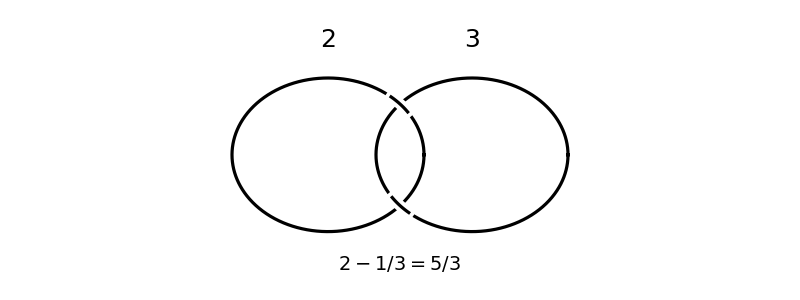
Surgery diagrams and continued-fraction coefficients
. Details. The slam-dunk move eliminates a meridional component with coefficient and replaces the other coefficient by . Eliminating the component with coefficient three givesThus this Dehn surgery on a framed link becomes Dehn filling on the unknot, with the required orientation. As a check, its surgery linking matrix iswhose determinant is five.
Apply the given skein relation to a positive and a negative kink in a diagram of the unknot. Both crossed link diagrams represent the unknot, whereas the oriented smoothing represents the two-component unlink. ThusFactor the left-hand side and cancel the nonzero factor in the Laurent polynomial ring:The positive sign follows from the skein relation as printed in this paper. It differs from the frequently used Jones polynomial convention whose two-component unlink has value . With the printed convention, an -component link has invariant times that convention's Jones polynomial.
Insert a kink on any component of an oriented link diagram for . Switching the kink's crossing gives another link diagram of ; its oriented smoothing separates off a small unknot in a ball disjoint from the rest of . The skein relation therefore givesCancel the nonzero factor in the Laurent polynomial ring to obtain
Reflection through the projection plane reverses the orientation of and exchanges the overpassing and underpassing strands at every crossing. Thus switching all crossings gives the mirror of a link, with the component orientations transported by the reflection.
Define . Reflection exchanges with and preserves the oriented smoothing. Apply the printed skein relation to the reflected triple at parameter :Multiplication by gives the original skein relation for . Also . The stated uniqueness of the Jones polynomial now gives , hence
Let be the positively oriented Hopf link obtained by closing a two-strand braid with two positive crossings. Switching one crossing gives the two-component unlink; the oriented smoothing gives the unknot. The printed skein relation givesRepresent the right-handed trefoil knot by the closure of the two-strand braid with three positive crossings. Switching one crossing gives the unknot, while its oriented smoothing gives . Consequentlyso the two Jones polynomials areThe second expression follows from the mirror of a link identity. They are unequal Laurent polynomials, so invariance under link isotopy proves that the right-handed and left-handed trefoils are not isotopic.
Label the four crossings in top, left-middle, right-middle, bottom order. Label the bounded regions (left), (right), (upper middle), (central bigon), (lower middle), and the unbounded region . The drawing preserves the crossings and the orientation of the supplied figure-eight knot diagram. Its overpassing strands are the outer-left/upper-right strand at , the upper-left/lower-central strand at , the upper-central/lower-right strand at , and the lower-left/outer-right strand at .
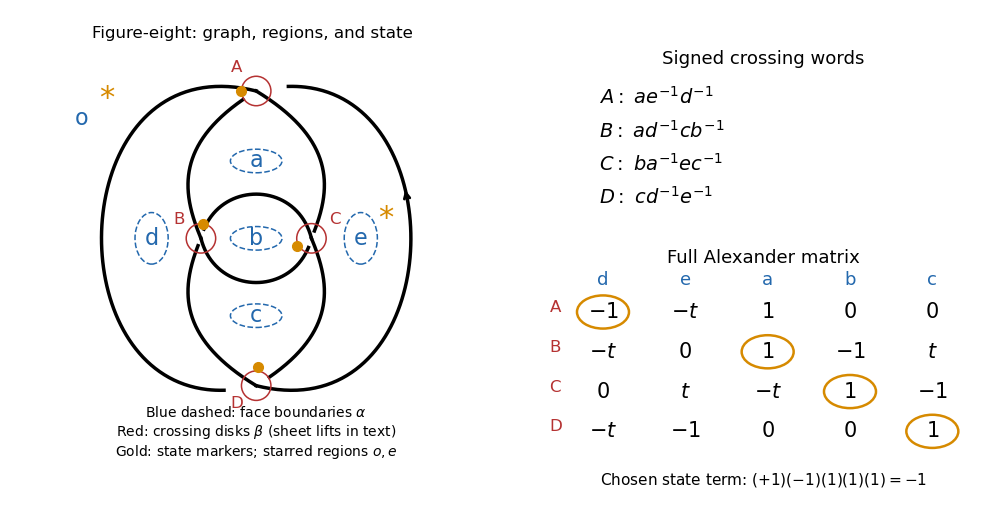


Here is the Dehn presentation Heegaard diagram specified by this drawing. Replace the underlying four-valent planar graph by a small three-dimensional regular neighborhood and put . Since has four vertices and eight edges, has genus . On , take the five curves bordering the bounded faces, pushed slightly onto the boundary of . They bound a complete disk system in the complementary handlebody ; their labels are .
The four curves bound the disks dual to the four short crossing tunnels in . Lift the crossing circles shown in red onto the upper and lower sheets of , routing them along the corresponding face boundaries; the crossing's overpassing strand determines the lift. Orient the disk normals and the curves so that their signed successive intersections with the curves areAt the missing fourth corner is the unbounded region , whose generator is omitted. This sheet-lifting prescription, together with the projected graph, specifies the curves on the Heegaard surface; the red circles alone are only their local projections.
To recover the knot exterior from , attach five two-handles along the curves on one side and cap the resulting sphere with a three-handle. On the other side attach four two-handles along the curves. Compressing that side leaves the boundary torus of the knot exterior, which is retained. In particular, the counts are five compressions and four compressions, rather than two complete genus-five disk systems.
Use the region labels and curve orientations from part (a). A Dehn presentation of a knot group generator goes from the basepoint above the projection plane through its region and returns through the unbounded region. Equivalently it is dual to the correspondingly labeled disk of the Heegaard diagram. A crossing relator records the signed intersections of its curve with these disks. Setting givesFor example, the overpassing strand at equates the meridian of a knot words and ; at it equates and . The other two crossings equate with and with .
Choose the region-generator direction so that is the shown meridian of a knot . The Alexander numbering of the regions, starting from zero outside and increasing by one on crossing an oriented strand from right to left, isOne can also obtain this directly by abelianization of the relators: , , , and . The last two imply , and the resulting first homology group is freely generated by . Thus , with no extra torsion.
Keep all four relators and all five generators, in the orders and . Under abelianization, these generators become . The Fox calculus rules areFor example, gives the nonzero Fox derivative entries , , , in columns , respectively. After abelianization these are . The full Alexander matrix isThe Fox calculus identity supplies a useful check:Deleting the column, adjacent to the unbounded region across the marked meridian of a knot, givesThus is a representative of the Alexander polynomial of a knot of the figure-eight knot, with its customary ambiguity of multiplication by .
Star the adjacent regions . Choose the Kauffman state of a knot diagram putting the marker at in region , at in region , at in region , and at in region . Every unstarred region is used exactly once, and every crossing has exactly one marker.
In the full Alexander matrix, circle the entries , namelyIn the reduced Alexander matrix , these are the diagonal entries in column order . The associated permutation is the identity, with sign of a permutation , so this Kauffman state of a knot diagram contributesto . The other four nonzero permutation terms are . The drawing circles the same four entries literally; the boxes above identify them in the typeset matrix. Different row or generator conventions multiply the Alexander polynomial of a knot and its state weights by the corresponding overall unit.
Write . Filling one end of times an annulus gives a solid torus, so is a solid torus. The prescribed algebraic intersection number of curves on an oriented surface convention gives . HenceIn , the first Dehn filling imposes , while . ThereforeThe class is primitive because , a consequence of . It is therefore the disk-bounding meridian of a solid torus of . Since meets it once, Dehn filling along glues two solid torus pieces with disk boundaries meeting once. This is the standard genus-one Heegaard splitting of , soTo identify the regular fiber geometrically, put it on their common boundary torus. Invert the displayed basis change:Here bounds a disk in the newly attached solid torus and bounds a disk in . Thus the curve has winding numbers and in the two complementary solid torus pieces. Both coefficients are positive and , so it is the positive torus knot. This identifies the torus knot directly from the genus-one splitting, without invoking a theorem specifically about torus knots.
All classes in the nontrivial homological equalities are taken in , where . The two internal gluing torus components still have inclusion maps into this knot exterior. Interpreting the maps instead as maps into the closed would make every displayed class zero.
Before the two Dehn fillings, has generators and relation . The Dehn fillings add and . Put . Eliminating the relations using givesFor completeness, the three relation rows in generators are , , when computing the quotient by . Their determinant is , so really generates the entire first homology group, and no finite torsion or index is hidden in the elimination.
Orient each exceptional-fiber longitude by . In the boundary basis , write and , where . ThenThe filled meridian of a solid torus maps to zero, and , yieldingAdding multiples of to has no effect. The word “any” therefore means any longitude with this compatible orientation; negating a longitude would negate the corresponding equality.
To compute Turaev torsion, use the general product formula and multiplicativity under gluing along torus components. For a pair of pants, , so the unfilled piece contributes . The two filling solid torus pieces contribute and . With , the equalities above give , , and . ThereforeHere allows the unit : a fully refined Turaev torsion requires an Euler structure and a homology orientation, neither of which the statement specifies. The displayed rational function is the representative whose expansion at starts with , equivalently the standard nonnegative-exponent normalization.
The fiber monodromy is periodic when isotopy is allowed to move the boundary, in the sense of a periodic surface homeomorphism. Here is a justification from the Seifert fibered space structure, rather than a special formula about torus knots. Its base is a disk with cone-point orders . The fiber Seifert surface is an incompressible surface because its inclusion in the mapping torus is injective on fundamental groups. It is also a boundary-incompressible surface: lift a proposed boundary-compressing disk to the infinite cyclic cover and project to . This would homotope an essential arc of into , contradicting its essentiality. The classification of incompressible surfaces in Seifert fibered spaces therefore applies. A vertical surface in a Seifert fibered space has zero intersection with a regular Seifert fiber, whereas the fibration class evaluates on as . Thus the Seifert surface is isotopic to a horizontal surface in a Seifert fibered space, with intersections per regular orbit.
Following the oriented Seifert fibers from one intersection to the next gives a first-return homeomorphism of the horizontal topological surface. It is a representative of the fiber monodromy, and its -th power is the identity. It has order : a regular orbit meets the connected horizontal surface in a Seifert fibered space in cyclically ordered points. This realizes the periodic case of the Nielsen–Thurston classification theorem. It is neither an Anosov homeomorphism nor a pseudo-Anosov homeomorphism.
There is a boundary convention here. A representative fixed pointwise on the boundary is not periodic relative to the boundary: its -th power is a boundary Dehn twist (with sign determined by the return-map convention). Capping the boundary, or allowing it to rotate during isotopy, gives the finite-order representative intended by “periodic”. This distinguishes periodic surface type from literal finite order in the mapping class group relative to the boundary.
For any fibered knot, its Alexander module is with the deck transformation given by homological monodromy, so its Alexander polynomial of a knot is up to a unit. The general Turaev torsion relation and part (b) therefore giveThis rational expression is a polynomial: in its factorization into cyclotomic polynomials, cancels all denominator factors. It is monic, has constant coefficient one, and has polynomial degree . The characteristic polynomial has polynomial degree , is monic, and has constant coefficient , because homological monodromy preserves the intersection form. These facts remove the unit ambiguity and giveThe sign change between and is trivial because is even. As a separate geometric check, the orbifold Euler characteristic of the base is , and its -sheeted horizontal surface in a Seifert fibered space has Euler characteristic .
Choose a fiber monodromy representative fixing the boundary of the fiber Seifert surface pointwise. The boundary of each fiber is the Seifert longitude, precisely the slope used by zero Dehn filling. Attach the filling solid torus as , matching with the boundary of the fiber at . The fibers cap off to closed topological surfaces of the same genus ; extend the fiber monodromy across the disk by the identity. ThusThis is a foliation by fibers of a bundle over , and every leaf is compact with genus .
Choose a point in the interior of the capping disk, which fixes. Its suspension is an embedded closed curve in the mapping torus. It is transverse to the foliation and meets every fiber once. Hence every leaf meets a closed transversal to a foliation, which is the defining criterion for a taut foliation. Therefore the fiber foliation is taut.
Articles by others on the same topic
There are currently no matching articles.