Put , write for perturbation pressure divided by , and set . The linearized Boussinesq approximation, incompressibility and material derivative giveTaking the curl eliminates pressure; differentiating the resulting vorticity equation in and using incompressibility gives . A further application of therefore yieldsFor a stationary nonzero horizontal Fourier mode, , so cancellation of gives the stationary Taylor–Goldstein equationThis division requires on the interval considered: a zero of is a critical level of an internal gravity wave. The mean profiles must be sufficiently smooth for the displayed derivatives, with background hydrostatic pressure and stable density stratification, , for propagating internal gravity waves. The horizontally uniform component is excluded from the cancellation. For a horizontal wavenumber , local vertical propagation additionally requires ; this is distinct from the smoothness restrictions. If stability of the background against other disturbances is needed, the Miles–Howard theorem supplies the sufficient condition , rather than a necessary condition for deriving the equation.
Take and assume an initially propagating mode, . Put and . Neglecting as stipulated, the Scorer parameter and stationary internal-wave WKB solution areThe positive root selects upward group velocity for the negative intrinsic frequency branch . The WKB approximation needs a slowly varying background relative to the local vertical wavelength, in particular and , away from a turning level or singular mean profile.
The local dispersion relation is . Its intrinsic and laboratory group velocities are, with ,Thus intrinsic energy propagation is upstream and upward, while laboratory energy propagation is downstream and upward, parallel to . Constant-phase lines of an internal gravity wave have slope and normal spacing ; the horizontal spacing remains .
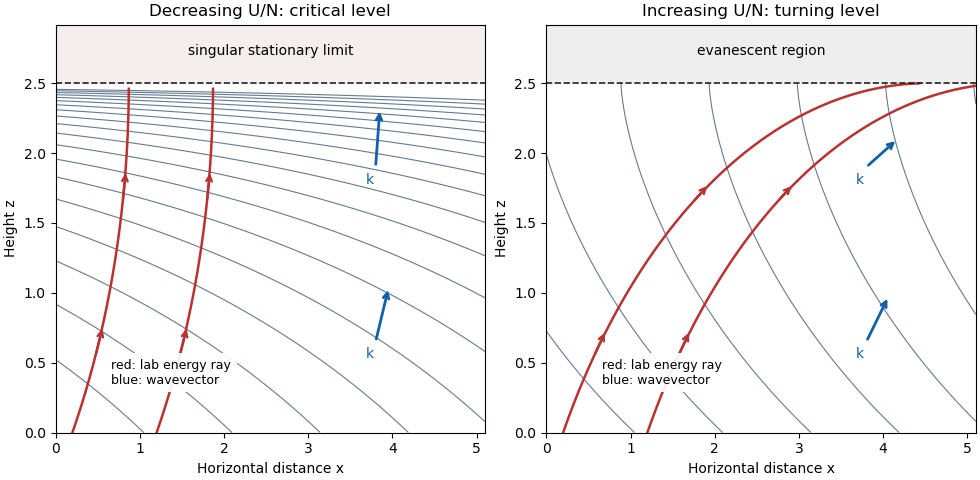
If , grows with height. The wavevector and laboratory energy ray become more vertical; phase lines become flatter and closer together. For finite nonzero , the heightis a critical level of an internal gravity wave: and the vertical wavenumber diverges. The laboratory group velocity tends to zero. Importantly, , so the formal WKB condition need not deteriorate before this level if that ratio is small. Nevertheless the stationary equation is singular at the level, the phase has no finite limit, and the horizontal perturbation velocity grows as ; the inviscid linear wave cannot be continued uniformly through it without additional physics.
If , decreases to zero atThe wavevector and laboratory ray become horizontal, the phase lines become vertical, and the normal spacing increases. Above , and the disturbance is an evanescent wave. Here diverges, so the WKB approximation fails in a turning region and must be replaced by a local connection solution.

Use a common factor , with and . For the upward propagating branches with , defineThese are the inclinations of upward-sloping constant-phase lines of an internal gravity wave to the horizontal. Write the incident, reflected and transmitted complex velocity amplitudes as . Incompressibility gives , , and .
The jump conditions for stratified inviscid shear flow require a common interface displacement, not a common vertical velocity: on each side. Since the background mass density is continuous, pressure is continuous without a hydrostatic jump. The horizontal momentum equation gives . HenceThese two matching equations determine internal-wave transmission across a velocity jump:The amplitude formula printed in the PDF is inconsistent with these material-interface matching conditions. In particular, identical layers have and , whereas its expression labelled “reflected” equals one. The displayed results above distinguish reflection from transmission and retain the intrinsic-frequency factors required by the kinematic boundary condition and pressure balance.
For equal buoyancy frequencies and the specified opposing current, , , andThe incident phase lines have slope , the reflected lines slope , and the transmitted lines slope : they steepen above the interface. For the other specified current, . The transmitted vertical wavenumber then diverges and there is no regular propagating upper-layer wave of that frequency: this is the critical level of an internal gravity wave limit. Approaching it from gives and vanishing transmitted vertical energy flux; setting the intrinsic frequency to zero directly is outside the regular matching calculation.
For a dilute particle suspension, take as the downward speed relative to the carrier fluid. The particle deposition flux through a horizontal absorbing bed is , where is the near-bed particle volume fraction. Without stirring, settling can create a particle-free upper layer and a descending concentration front, so uniform concentration throughout the remaining fluid is not automatic. Weak turbulence can maintain a nearly uniform suspended concentration while leaving the mean settling velocity approximately equal to the isolated-particle value; this justifies using in a mixed-layer balance. Strong stirring can produce resuspension and requires a separate erosion model.
For a bed inclined at angle to the horizontal, the normal settling speed is , giving deposition flux per unit actual bed area. There is also downslope particle motion, and near-wall effects or resuspension can alter this simplest absorbing-boundary model. Integrating the normal projection over a sloping bed is equivalent to integrating over its horizontal projection.
The mixture mass density is , so its reduced gravity isThe Boussinesq approximation requires , in addition to the dilution assumption.
The shallow-water approximation requires a small depth-to-horizontal-scale ratio, slow streamwise variation of the channel and interface, small vertical acceleration, and rapid enough cross-sectional mixing for and to be representative averages. Near the channel apex, or during the initial collapse at a sharp front, these conditions need not hold. The high Reynolds number permits neglect of leading viscous resistance; weak stirring mixes the particles without appreciable ambient fluid entrainment.
Put . At elevation , the channel width is , so the occupied area and interface width areVolume conservation and suspended-particle conservation giveThe excess hydrostatic pressure is . Its streamwise gradient averaged over the triangular section gives acceleration : the weighted mean of is . Thus the triangular-channel shallow water equations areThe quasilinear coefficient matrix in isIts three distinct real eigenvalues, for , establish strict hyperbolicity:On the material characteristic curve, . On each of the other two characteristic curves, multiplying by the left eigenvector gives the compatibility ordinary differential equationThe derivatives are along the indicated characteristic, with . At vanishing concentration, the gravity-wave speeds coalesce and strict hyperbolicity is lost.
Use the gravity-current front condition , with a specified order-one front Froude number. In a triangular-channel gravity-current box model, the depth and concentration are uniform over . The volume isThe horizontal projected deposition area is . Consequently the integral model isThis front speed is a closure for the integral model, rather than the assertion that its uniform interior is an exact solution of the spatially varying shallow water equations.
Eliminating time and integrating givesThe limiting runout length of a gravity current is thereforeThe additional distance beyond the release gate is . The limit is approached asymptotically as and ; the idealized box model does not predict a finite-time stop. Its numerical runout depends on the adopted front Froude number.
Take inward fluid entrainment speed to be positive. The non-Boussinesq form of the Batchelor entrainment hypothesis iswhere is the entrainment coefficient. Define physical, cross-section-integrated fluxes for the top-hat plume model byThus is mass flux, is momentum flux, and is a density-weighted buoyancy flux. The kinematic buoyancy flux in the Boussinesq approximation is . These definitions keep the factor ; conventions suppressing it simply rescale all three fluxes consistently.
For a homogeneous ambient, the sectional volume, mass and momentum balances areThe momentum source is the net upward buoyancy force; entrained ambient fluid initially supplies no vertical momentum. Subtracting the mass balance from times the volume balance gives conservation of the density deficit:Now , , and . Substitution produces the non-Boussinesq top-hat plume equationsFor reconstructing the fields without a Boussinesq approximation,The last expression uses the plume density in the acceleration denominator; it agrees with the ambient-density definition of reduced gravity to Boussinesq order.
Use the kinematic fluxes , and . In the steady Boussinesq approximation, the non-Boussinesq top-hat plume equations reduce toEliminating gives , where the integration constant vanishes for a pure plume from a point source. Write and . The two balances give and . The Boussinesq point-source plume is thereforeHere and tend to zero at the source, while remains positive. The plume Froude number is independent of height:The ideal point source is a far-field similarity idealization. Since , the Boussinesq approximation fails near and is valid only when . In terms of , this requires ; the density formula must not be extrapolated into its unphysical negative-density region.
Let as above. A self-similar starting plume has no source length or time scale; dimensional analysis therefore givesThe dimensionless constants depend on the entrainment coefficient and thermal closure. Thus is constant because the underlying Boussinesq point-source plume has . The steadily increasing thermal volume scales as , even though its reduced gravity decreases.
Let , and , with the subscript here referring to the plume fluid. The section at moves upward at . Its incoming volume flux relative to that moving section is thereforeThe thermal's sectional model allows no direct ambient fluid entrainment, so its volume and mass balances areSubtracting these balances with and gives the buoyant thermal mass balanceFor the self-similar starting plume, and , so . HenceUsing instead of the relative inflow would miss the volume swept out by the rising matching section. The larger thermal reduced gravity reflects fluid accumulated from earlier, lower, more buoyant parts of the plume.
Put and , so that and with constant . The volume balance givesConsequentlyFor the definition of printed in the question, using in its denominator, the starting-plume thermal Froude-number ratio isAll factors are constant in the self-similar starting plume. This expression decreases strictly with , givingThe stronger bound requested in the PDF does not follow from its stated definition and . For example, already contradicts that bound. If instead the thermal Froude number is normalized by its own reduced gravity, , the preceding result supplies the missing factor :The inequality is strict for , with equality allowed by the stated endpoint . This alternative normalization recovers the numerical bound while keeping the distinction between the plume and thermal reduced gravities explicit.
Articles by others on the same topic
There are currently no matching articles.