A particle suspension is a dispersed population of solid particles carried by a fluid. Its dynamics couple particle transport, drag force, gravity, and the compensating motion of the carrier fluid.
Sedimentation is separation of suspended particles through a body-force-driven relative motion. In the Perrin sedimentation experiment, diffusion balances gravitational settling to produce a stationary height profile.
Sedimentation equilibrium occurs when the downward tendency of suspended particles is balanced by their diffusion, leaving a stationary concentration profile with no net particle flux. For dilute identical particles in an isothermal fluid, let be their buoyant mass. Balancing the gradient of ideal osmotic pressure against gravity givesHere height increases upward, and heavy particles have .
The profile is a miniature atmosphere: thermal motion spreads particles upward while gravity favours lower positions. The Perrin sedimentation experiment measured particle counts at different microscope focal heights and used this competition to infer a molecular energy scale.[ref]
Mouvement brownien et réalité moléculaire by Jean Baptiste Perrin. 1909 memoir, §§15 and 20–22, vertical grain populations and tests using independently measured grain properties
A stationary profile requires sufficiently slow background flow and controlled temperature; a growing deposit during ongoing settling is a different situation.A monodisperse particle suspension has a narrow distribution of particle sizes. Treating its particles as having a single radius simplifies the Perrin sedimentation experiment model; residual size variation can still affect the inferred Avogadro constant.
More suspended heavy particles above fewer particles puts denser fluid above lighter fluid. Such a particle suspension may develop Rayleigh-Taylor instability and overturning in addition to one-dimensional kinematic sedimentation. A rarefaction solution alone does not establish hydrodynamic stability.
A heated particle suspension can have competing compositional and thermal contributions to its mass density. Let be the carrier-fluid mass density at reference temperature , the particle mass density and the carrier-fluid thermal expansion coefficient. In a dilute mixture, neglecting products of small changes,where is particle volume fraction, and . Heavy particles increase mass density, whereas warming an ordinarily expanding carrier fluid decreases it.
For a well-mixed layer of fixed depth with an absorbing horizontal bed, particle deposition flux gives , if is a constant downward settling velocity magnitude and other particle fluxes vanish. A separate heat balance determines . Their different time dependences can change the sign of , reversing the layer's reduced gravity relative to fluid at the reference state. A resulting unstable density stratification can invalidate the well-mixed or one-dimensional settling assumptions, so the density balance is also a consistency check on the model.
The particle volume fraction is the fraction of a representative mixture volume occupied by particles. Several particle species have fractions , while the carrier-fluid fraction is .
A bidisperse particle suspension contains two distinguishable particle populations, commonly with different sizes, densities, or settling velocities.
When two species share the same local settling velocity, their total particle volume fraction supports a nonlinear kinematic wave, while their relative composition is transported as a contact-like wave at the common particle speed.
The settling velocity is a particle's vertical velocity relative to a stated frame. With height increasing upward, a sedimenting particle has .
For spheres with the same density contrast, balance submerged weight, proportional to , against Stokes drag law, proportional to , to obtain . With constant drag coefficient, quadratic drag is proportional to , giving . The two radius laws require their corresponding particle Reynolds number limits.
A Reynolds number based on particle diameter and relative speed in the carrier fluid. Small values justify Stokes drag law; a high-Reynolds-number regime with nearly constant drag coefficient instead gives quadratic drag. The drag law must be evaluated in the appropriate regime for every species.
For downward settling velocity magnitude and near-bed particle volume fraction , a horizontal absorbing bed receives particle volume per area per time . A bed inclined at angle to the horizontal receives per unit actual area, in the absence of resuspension or additional normal fluid motion.
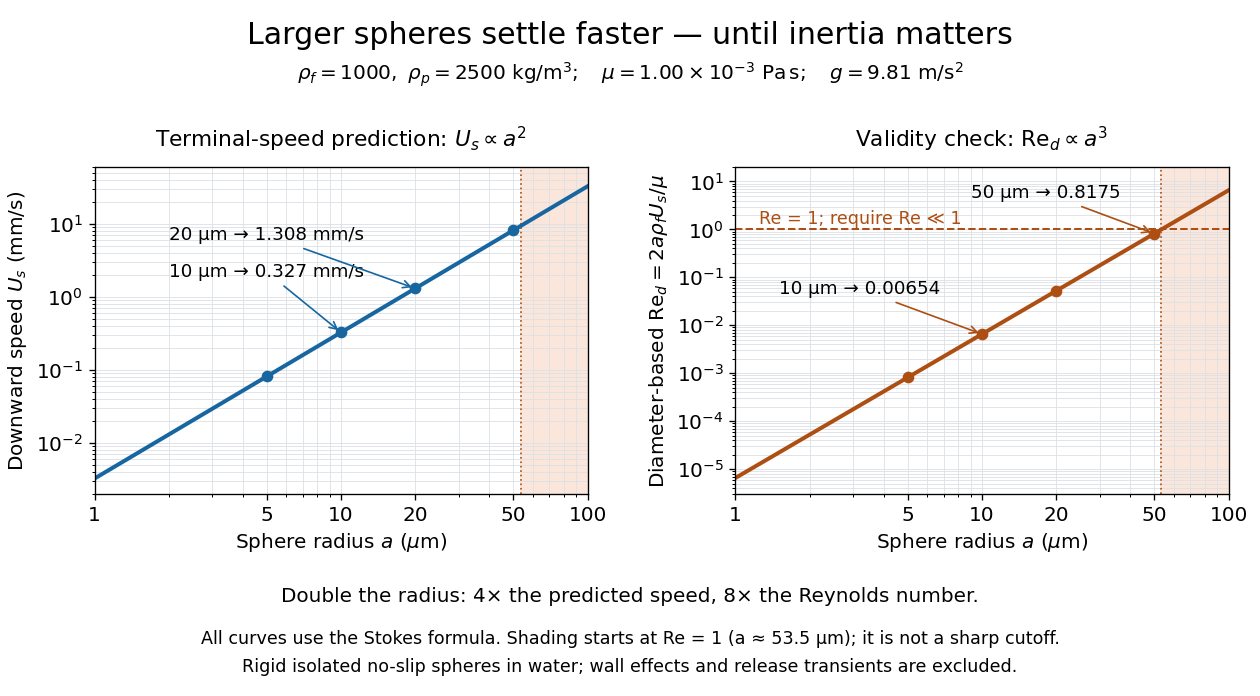
Sphere settling in water: terminal speed grows as radius squared while Reynolds number grows as radius cubed
. Details. 
Take downward as positive and let gravity have magnitude . For a rigid sphere of density in otherwise stationary fluid of density , its weight minus buoyancy is . At terminal velocity, this balances the Stokes drag law:This signed downward settling velocity is negative for a buoyantly rising sphere and zero for equal densities. For fixed density contrast and dynamic viscosity, the submerged weight grows as while linear drag at fixed speed grows as ; their balance gives the settling-velocity radius scaling . Meanwhile,Thus doubling the radius multiplies the predicted Stokes settling speed by four and the particle Reynolds number by eight. This makes the formula useful for separating particles by size, while also providing its own check against extrapolation to large particles.
For a computed water example, take , , , , and . These are specified rounded inputs rather than a claim of exact water properties at every temperature. They giveThe diameter is , and both the net downward weight and the upward drag force are . At this terminal velocity, falling takes . At the prediction is with ; at it is with , which is no longer a convincing small-Reynolds number case. The figure labels these as predictions of the Stokes settling velocity formula and shows where its inertia check fails.
The calculation describes the eventual terminal velocity, not the release transient governed by particle acceleration and possibly the Unsteady Stokes equation. Walls, hydrodynamic interactions, departures from a rigid sphere, or a different surface condition require a different resistance. For sufficiently small particles, Brownian motion can obscure individual settling trajectories; the formula still specifies the gravitational drift within its assumptions. The balancing argument already appears in article 43 of [ref]
https://mural.uv.es/daroig/documentos/stokes1850.pdf. Stokes's original investigation, collected-paper reprint
.Hindered settling is the reduction or modification of particle settling by the displaced carrier-fluid backflow and by interactions with other particles. A simple dilute mixture model gives every species the same volume-averaged backflow.
A one-dimensional particle suspension settling without particle diffusion or overturning obeys the scalar conservation law . The upward flux is negative for downward settling. Characteristic curves, compressive shocks and rarefaction waves describe concentration transport rather than individual particle paths.
For hindered settling with normalized particle volume fraction , upward coordinate and downward isolated settling velocity magnitude , the scalar conservation law has conservation law flux . For , its convexity changes at when this lies in the physical interval. This change distinguishes spreading rarefaction waves from compressing characteristic curves; a flux with an inflection can produce both a shock wave and a rarefaction wave in one transition. At the flux is linear and the profile simply translates.
A particle suspension contains two particle species with separate particle volume fractions. In an independent-settling model, each species obeys its own flux conservation equation, while a shared stationary deposit can couple the jump conditions through its maximum total packing fraction. Such independence is an imposed model; general hindered settling need not decouple species.
Consider a column initially filled with a uniform bidisperse particle suspension. In an independent-settling idealization, normalized concentrations obey fluxes , with . A stationary packed deposit has fractions . The deposit composition from sedimentation jump conditions determines its upward front speed and the fractions .
Suppose species 1 has the faster downward clearing front: . Before interaction, the fast clearing front is at , while the deposit front is at . They first meet atAll species 1 has then entered the earlier mixed deposit. Above it, only species 2 remains suspended; its later sedimentation shock adds a pure-species-2 layer. Separate particle-volume conservation laws giveHere is the final pure-species-2 layer thickness. This two-stage picture follows from the stated independent fluxes and packed stationary branch; general coupled hindered settling can have a different wave structure.
For a bidisperse kinematic sedimentation model with normalized suspension concentrations , isolated speeds , and a stationary deposit with , the upward deposit-front speed magnitude obeys . Adding gives ; substitution determines each deposited fraction. These are Rankine-Hugoniot conditions with a stationary compacted branch.
A moving discontinuity of particle volume fraction in kinematic sedimentation. Conservation of particle volume gives the Rankine-Hugoniot condition in a consistently oriented coordinate. A clearing front and a deposit front can both be sedimentation shocks. A stationary deposit uses zero particle flux; its compacted branch need not obey the suspension flux law.
Particle mass conservation gives . Averaging concentration over the entire original container gives . This average differs from the concentration inside the deposit itself.
Use the quadratic hindered-settling flux in upward coordinate , where is particle volume fraction normalized by the packed value. Initially for and for , with . Clear fluid lies above, and a stationary packed deposit with forms below.
The Rankine-Hugoniot condition gives the clearing, internal and deposit-front trajectories before interactions:The internal jump is compressive because the lower concentration is larger. If the internal and deposit fronts meet first, the remaining deposit/upper-suspension jump joins to and advances at . If the clearing and internal fronts meet first, their replacement joins to clear fluid. Either ordering conserves the same particle volume:Thus final packed thickness does not depend on which pair of fronts interacts first, although the intermediate wave pattern does.
For two-layer sedimentation with a compression shock, the clearing, internal and deposit fronts can all meet at one event. The concentration is normalized by the packed value: initially it is above and below, with , in a column of height .
Equating the clearing and deposit trajectories givesRequiring the internal front to pass through the same point givesThis also satisfies particle-volume mass conservation, . At the entire particle population has entered the stationary packed deposit and the remaining interface separates that deposit from clear fluid. The special value of is the boundary between the two possible orders of pairwise sedimentation shock interactions.
For downward settling speed in upward coordinate , particle flux is . The concentration-characteristic speed is and differs from particle speed. Since , decreasing concentration with height creates a compressive shock, while increasing concentration creates a rarefaction wave.
Let be particle volume fraction normalized by the packed value, and use the quadratic hindered-settling flux . Takewith clear fluid above . To isolate breaking of this smooth profile, do not impose an additional packed-bed discontinuity. A characteristic curve labelled by its initial height carries constant concentration and followsThe mapping first loses invertibility whenThe earliest time occurs at , giving and . This explicitly shows why the time uses normalized concentration and the isolated settling-speed scale ; the physical flux for is .
The new sedimentation shock joins concentrated fluid below to clear fluid above. Its signed speed is , initially as . As the state behind it becomes more concentrated, its downward speed decreases until a boundary interaction changes the problem. This is the onset of characteristic breaking, not the onset of a separately imposed deposition front.
If lower initial concentration is less than upper concentration , the entropy solution expands into a fan with . Its characteristic speeds range from to . The fan can be clipped by a clearing or deposition shock.
Consider normalized initial concentration above and below it, with , in the quadratic hindered-settling flux model. The final packed height is . The last surviving characteristic of a settling fan lies inside the fan only ifThe upper inequality gives ; the lower gives . Thus both front curves can be used through the final meeting only for .
If , the deposition front leaves the fan through its upper edge before meeting the clearing front. It then travels through uniform concentration at speed ; the clearing front stays straight. If , the clearing front instead leaves the lower edge first, while the deposition front stays at speed . Matching the appropriate straight and curved pieces givesThe expressions agree at the transition values. The bounds prevent an algebraic intersection of extrapolated curves from being mistaken for a physical meeting inside the settling rarefaction fan.
For the quadratic hindered-settling flux, let the initial normalized concentration be below and above it, within a column . The internal settling rarefaction fan hasBefore entering the fan, the upper clearing front follows and the lower deposition front follows . They reach the fan at respective times and .
Inside the fan, the Rankine-Hugoniot condition givesIntegrating these linear ordinary differential equations and matching to the entry events yieldswhere and . Each curve applies only after that front enters the fan and while its adjacent concentration lies between and . If a front leaves the fan, its subsequent speed is set by the uniform state it encounters, rather than by extrapolating these curves.
Suppose both curved settling fronts within a rarefaction fan meet while still inside the fan. Write and , where are the initial normalized concentrations below and above . Setting givesAt that point the fan concentration isThe final surviving characteristic curve runs from the initial internal interface to the meeting point. Its concentration must satisfy . Failure of either bound means that a front leaves the fan before final deposition, requiring another branch of the entropy solution.
The meeting height reduces to , agreeing independently with particle-volume mass conservation for a unit-normalized packed deposit.
The Rankine-Hugoniot condition for the quadratic hindered-settling flux gives , with lower and upper states labelled . It includes a downward clearing front (), an upward deposition front (), and a stationary final deposit/clear-fluid interface.
Articles by others on the same topic
There are currently no matching articles.