For polar coordinates, the rotating unit vectors satisfy and . Applying the product rule twice to gives the velocity and accelerationNewton's second law for a central force now givesMultiplying the azimuthal force equation by yieldsThis is conservation of specific angular momentum. Here is the signed radial component of the force; a negative value points inward.
When , is a valid local parameter along the trajectory. Put and let primes denote derivatives with respect to . The chain rule yieldsSubstituting into the radial Newton's second law equation and dividing by proves the Binet equation:
Here , so the Binet equation reduces toThe initial conditions becomeMultiply the differential equation by and use the chain rule:The initial conditions give . Since , cannot change sign at a finite value of . Thus on the physical branch. Separation of variables givesThereforeThe natural logarithm must be positive because . For the forward trajectory, and , so : the particle travels counterclockwise while strictly decreases.
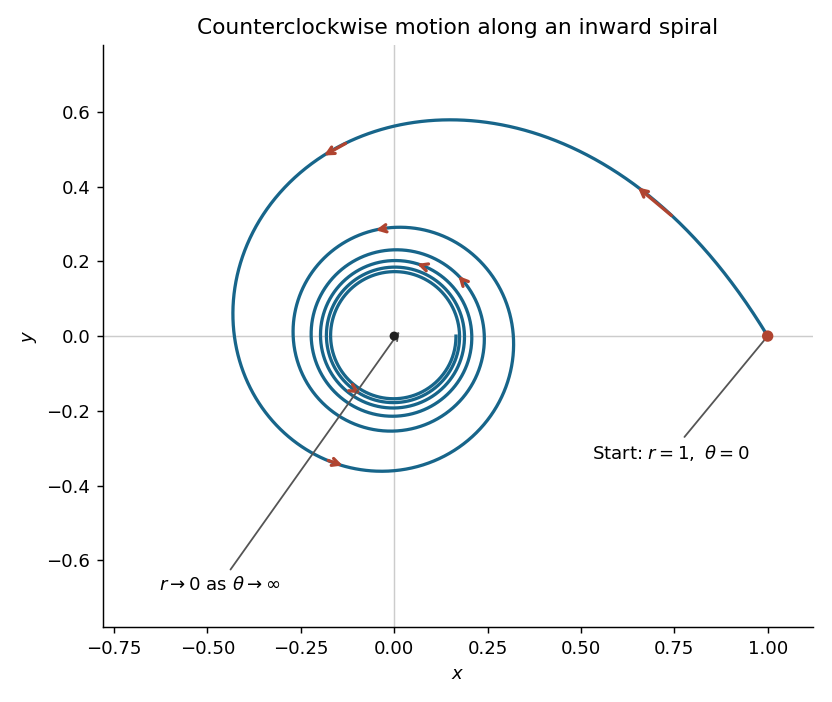
For , it starts at , with tangent vector proportional to . Its successive crossings of the positive coordinate axis have radiiIt makes infinitely many inward turns, approaching the origin as . There is no finite-time arrival at the origin: behaves as , whose improper integral diverges. If extended backwards, it comes from infinity as .

Articles by others on the same topic
There are currently no matching articles.