Write . The inverse coordinate formulas and are valid because . The multivariable chain rule givesApplying these operators twice and using the symmetry of second derivatives,Thus the wave equation is equivalent toFor each fixed , the partial derivative has zero derivative with respect to , so it is a function of alone. Taking an antiderivative in gives , where the integration constant may depend on . HenceConversely, direct partial differentiation verifies the wave equation for every twice differentiable pair . The two terms describe profiles moving left and right respectively at wave speed along the characteristic lines for the one-dimensional wave equation.
At , the initial conditions implyDifferentiate the first relation and solve for the two derivatives:Fix a reference point and set . Taking antiderivatives givesThe constants must be opposite to preserve the first initial condition; the arbitrary constant of integration does not change . Substitution yields D'Alembert's formula:The fundamental theorem of calculus verifies that its time derivative at zero is , and its value at zero is . The oriented integral also makes the formula valid for negative .
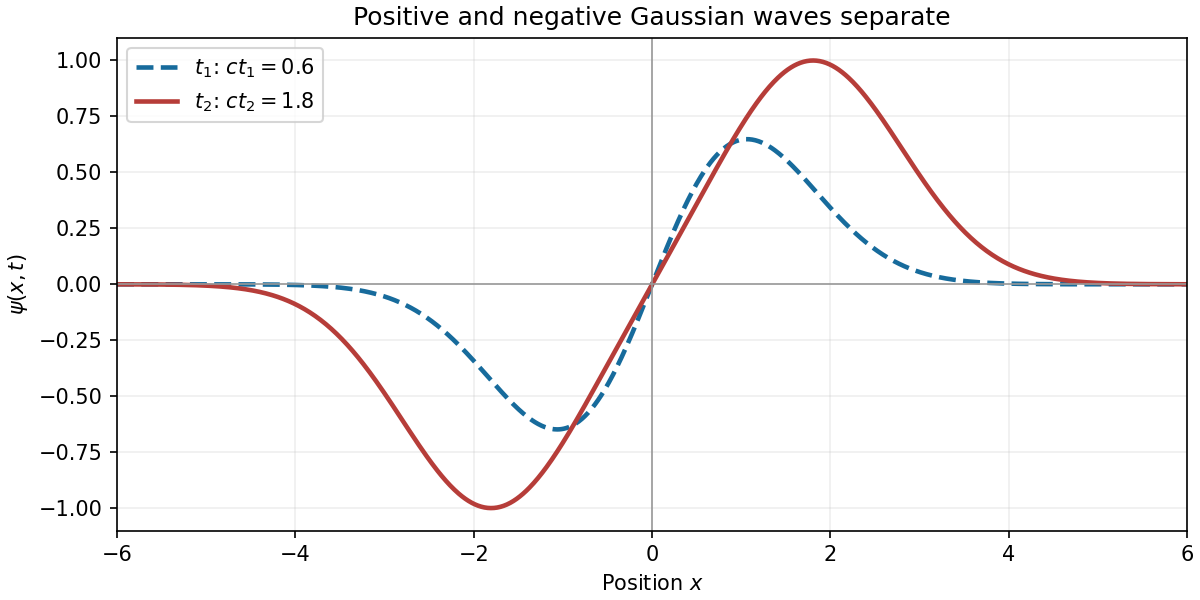
An antiderivative of the initial velocity is . Thus D'Alembert's formula givesThis is a positive Gaussian function moving right and a negative Gaussian function moving left. Their cancellation at gives the zero initial displacement, while direct differentiation gives .
For every , the profile is an odd function of , vanishes at , is positive for and negative for , and tends to zero at both spatial infinities. The signs follow from . The positive and negative lobes move farther apart as increases; for large separation they approach the individual unit-height Gaussian functions centred at . At finite separation the actual extrema lie slightly beyond these centres: writing , the positive global maximum occurs at the unique satisfying .

Articles by others on the same topic
There are currently no matching articles.