For , the chain rule gives . Differentiating the radial factor gives , so in Cartesian coordinatesThe origin is excluded because the scalar field is singular there.
The Stokes theorem states for a sufficiently smooth vector field and oriented surface with piecewise smooth boundary. The boundary orientation follows the right-hand rule relative to .
For the convective acceleration identity, use the Levi-Civita symbol contraction . It givesRearranging proves the required vector identity.
For orthogonal coordinates, define the scale factors of orthogonal coordinates and tangent unit vectors . They form an orthonormal basis, and . Equating with identifies each component. Thus the gradient in orthogonal coordinates isThis holds on a regular coordinate chart where all scale factors are positive.
Set in the heat equation. Separation of variables gives . Zero endpoint temperatures impose Dirichlet boundary conditions , selecting for . The separated factors can therefore be chosen asZero and negative separation eigenvalues give only the zero spatial solution under these boundary conditions.
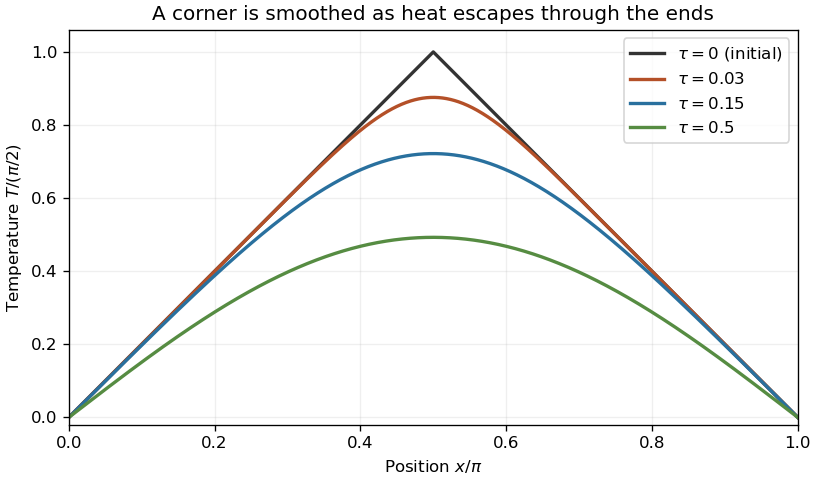
The initial profile is continuous and triangular, with midpoint height . Its Fourier sine series coefficients areConsequently the heat flow from a triangular initial temperature isFor , each summand has magnitude at most . The Weierstrass M-test proves absolute and uniform convergence. The initial Fourier sine series equals the continuous piecewise smooth profile, and for the exponential factors justify termwise spatial and time differentiation on every time interval bounded away from zero.
Use the conventionThese are the Fourier transform and inverse Fourier transform for suitably integrable data. Assuming the required ordinary transforms exist and the lower derivatives vanish at both ends, integration by parts gives . Repeating this argument yieldsThe decay assumptions are used to discard the boundary terms at each step.
For positive diffusivity , transforming the heat equation gives . Thus , where . The convolution theorem and the Gaussian heat kernel giveFor , the Fourier transform of a Gaussian is . Multiplying by the heat factor and inverting gives the Gaussian initial data for the heat equation solutionIt recovers the initial profile as and preserves its spatial integral .
By the spectral theorem, the Hermitian matrix has a complete orthonormal eigenbasis. If , idempotence gives , so every eigenvalue is zero or one. Since , at least one is zero. ThereforeThe trace of an idempotent equals its rank; here Hermiticity further identifies as an orthogonal projection matrix.
A complex inner product is conjugate-linear in its first argument, linear in its second, conjugate symmetric and positive definite: and for nonzero . An orthonormal basis is a spanning linearly independent family with . The associated norm is .
For two distinct basis elements , their orthogonality and unit norms give . Hence their distance is ; if the same element is selected twice, it is zero.
A unitary matrix satisfies over the complex numbers; a real orthogonal matrix satisfies . Their inverses are their conjugate transposes and transposes, respectively.
With , the coordinate has eigenvalue . In the plane, the traceless symmetric two-by-two matrix has eigenvalues , where . If , choose with and . Then an orthonormal eigenbasis isIf equals or , the corresponding eigenspace is the span of the two listed vectors with that eigenvalue. If , then , the plane is the zero eigenspace, and retains eigenvalue ; if also , every vector belongs to the zero eigenspace. This includes the degenerate cases that a division by would miss.
For the Cauchy-Schwarz inequality, take and remove the orthogonal projection of along . Positivity of the squared norm givesMultiplication by and square roots prove ; the case is immediate. Equality means linear dependence. ThereforeTaking the nonnegative square root proves the triangle inequality.
For , a singular point is a regular singular point if and are analytic there. The Bessel differential equation has and , so zero is regular singular.
Use the Frobenius method with , . Matching coefficients gives and , with missing negative-index coefficients zero. The regular root is . Then , all odd coefficients vanish, and the Frobenius series for Bessel functions has recurrenceFor noninteger , the root supplies an independent even-power series with and . None of these denominators vanishes. With standard normalization this is , independent of the Bessel function of the first kind . The real powers here are understood for .
For integer and the stated normalization , iteration givesThe ratio of consecutive term magnitudes is . Thus the series converges absolutely for every finite complex , defining an entire function for integer . At integer order, ; an independent solution is instead the Bessel function of the second kind.
Define the weighted inner product . For the stated operator , integration by parts gives the Lagrange identity for a Sturm-Liouville operatorThe endpoint terms vanish for Dirichlet boundary conditions. Taking proves each eigenvalue is real, since makes the squared weighted norm positive. For eigenfunctions of distinct eigenvalues, the same identity gives , proving their orthogonality.
For the specific equation, divide by to obtain , so its weight is , with . Put , and . The logarithmic change of variable in a Sturm-Liouville problem gives . Remove the first derivative with ; the equation becomes , with .
The Dirichlet spectrum with inverse-square weight is thereforeIndeed . Values give a linear or hyperbolic transformed solution and no nonzero solution vanishing at both ends.
Take and a source position . Before the source, the zero initial data require . After it, set ; the homogeneous equation becomes . Continuity of and a unit jump in at give , . Thus the causal Green function of a damped oscillator isHere is the Heaviside step function. For , take the continuous limit , giving . The formula is also unchanged when a nonzero changes sign. Its continuity removes a delta derivative, and its unit first-derivative jump supplies the required Dirac delta function.
For the forced equation use . The zero-initial-data Green function representation isThe sine-product identity reduces this to elementary exponential-trigonometric integrals. Evaluating givesFor an independent check, the steady particular part is , while the decaying homogeneous part has coefficients and that impose .
Introduce a Lagrange multiplier for the normalization and vary . With variation satisfying , integration by parts givesThe upper endpoint term vanishes, and the lower term vanishes because with the stipulated regular differentiable behavior. More generally the natural endpoint condition is there. The fundamental lemma of the calculus of variations gives , the stated Sturm-Liouville problem.
The Rayleigh-Ritz variational principle estimates the lowest eigenvalue by minimizing over an admissible finite-dimensional trial family. Restricting the family can only raise the minimum.
For the specific radial problem, and . The trial has . Normalization gives , with the negative sign an equivalent choice. The numerator is , soThis is the quadratic case of the power-law variational bound for a circular membrane. The exact first eigenvalue is smaller because the polynomial trial is not the exact Bessel function of the first kind eigenfunction. Expanding a trial in the exact orthonormal eigenbasis expresses its Rayleigh quotient as a weighted average of eigenvalues, so no admissible trial can lie below the lowest one.
Along an extremal, differentiate . The chain rule givesWhen , the Euler-Lagrange equation makes the right side zero. This proves the Beltrami identity, .
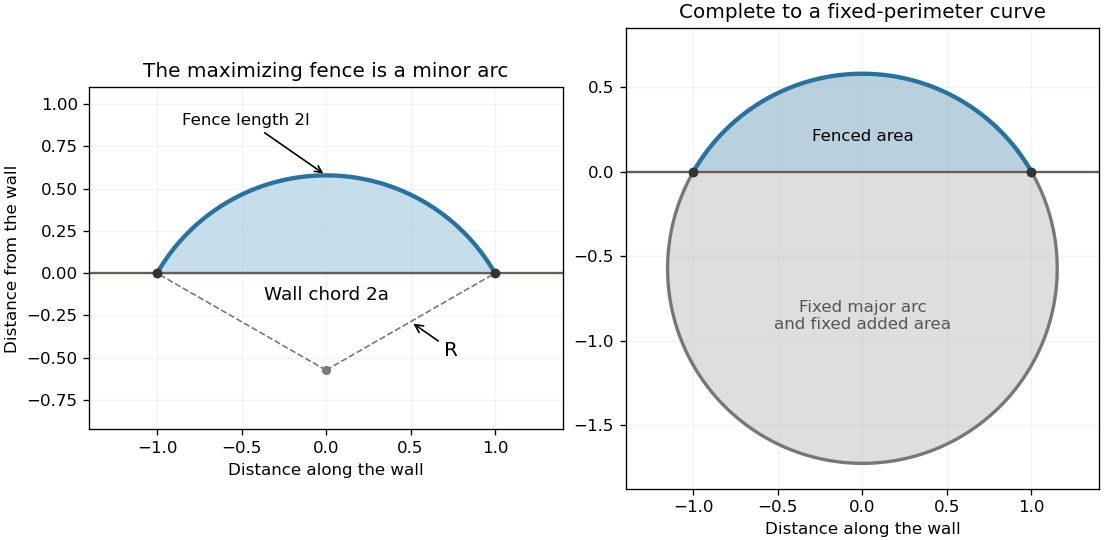
Place the wall on with attachments at , and write the fence above it as . Maximize area subject to length . The isoperimetric constraint gives the augmented integrand , where is a constant multiplier. Its Euler-Lagrange equation is , so the fence has constant negative curvature. Equivalently the Beltrami identity is .
The resulting maximum-area circular segment with fixed arc length and chord hasHere is the half-angle subtended by the arc. Its half-length is and half-chord is . The function increases from one to , so the given range determines a unique minor arc. Its enclosed area is .
There is also a global maximality proof for simple fences in the chosen half-plane, without assuming competitors are graphs. Complete the candidate minor arc with the complementary major arc of the same circle, which lies below the wall. Attach this same fixed major arc to any competing fence of length . The completed closed curve always has perimeter , and its area is the competitor's fenced area plus the same fixed area below the wall. The planar isoperimetric inequality bounds that total by , attained by the candidate circle. Hence no competitor encloses more area, and equality requires the circular arc.


Articles by others on the same topic
There are currently no matching articles.