The diagram has a connection between every pair of indices , including the fixed beam . Two parallel strings, each with spring constant , together have energy . Thus the printed is the energy of a connecting pair; calling it the energy of one string would introduce a factor-of-two discrepancy.
Take vertical coordinates positive upwards, with fixed. Each bar has gravitational potential energy and kinetic energy . The Lagrangian isDifferentiating gives the Euler-Lagrange equationsEquivalently, with , the spring term is . Gravity changes the equilibrium but not the stiffness matrix. Subtracting a static equilibrium and writing gives the normal mode systemThis is the spring system underlying normal modes of an anchored complete spring graph.

For two bars, after subtracting the gravitational equilibrium,A normal mode requires the generalized eigenvalue problem . With ,Thus, for ,Both squared angular frequencies are positive. A corresponding eigenvector is , from the first row of the matrix equation.
Let , so . The sum and product of roots of the characteristic polynomial in (i) giveEliminating yieldsTherefore the octave tuning in a two-mass complete spring graph has two positive solutions:The two values are reciprocals. Both meet the requested frequency ratio; substituting either into the expressions in (i) gives .
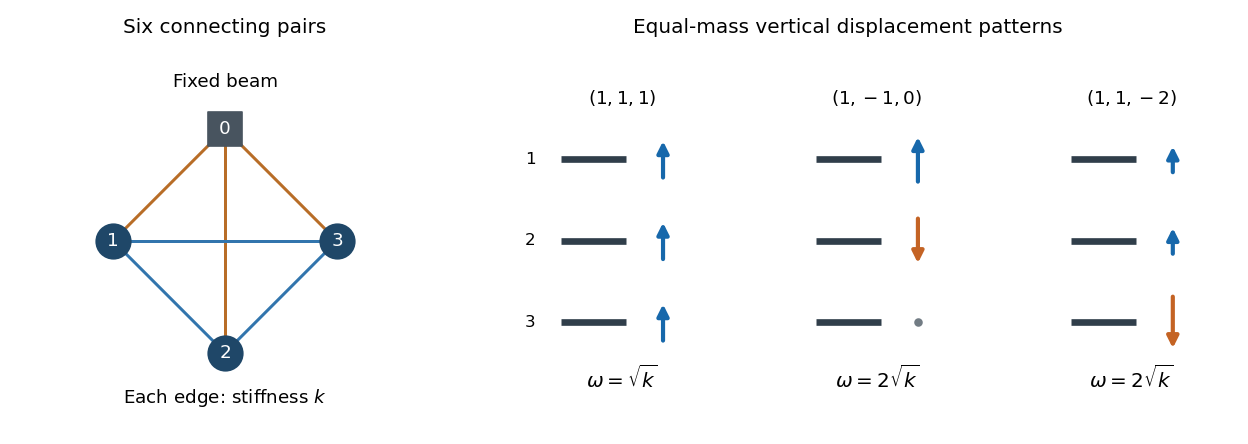
For three unit masses, andThe uniform vector has , whereas every vector with coordinate sum zero is annihilated by . One orthonormal choice of normal modes is thereforeIf is retained from (b), the angular frequencies are . The equal upper frequencies follow from degenerate normal modes from permutation symmetry: the stiffness is scalar on the two-dimensional sum-zero subspace. In the uniform mode the inter-bar strings do not change length, but all three beam connections stretch, giving the nonzero lower frequency. The motion is an arbitrary sine-cosine superposition of these modes about the gravitational equilibrium.
The pinned third bar has zero displacement, so remove its row and column from the stiffness matrix while retaining the springs that connect the moving bars to it. The remaining unit-mass system hasIts eigenvectors and have eigenvalues and . HenceFor these are and . The fixed value changes the static offsets and reaction force but not this linearized matrix.
Articles by others on the same topic
There are currently no matching articles.