Seek an integrating factor such that the differential expression becomes . Its leading coefficient requires , while the first-derivative coefficient requires . ThusChoose the positive solution . The Sturm-Liouville form is thereforewithThe weight is positive on the open interval. The endpoints are singular because vanishes there, but the prescribed boundedness of makes the integration-by-parts boundary terms vanish.
Multiply the Sturm-Liouville form for by and subtract the equation for multiplied by . Integration givesThe boundary expression is zero because and the functions and first derivatives remain finite. Since are distinct positive integers, this provesFor the derivatives, apply integration by parts once to the same Sturm-Liouville form:Thus the new weight isThis is derivative orthogonality when the Sturm-Liouville potential vanishes. For the derivative is identically zero, which is consistent with the identity.
Put , with . The chain rule givesConsequently the original differential expression becomes . If , direct differentiation givesTaking therefore yieldsThe apparent endpoint singularities are removable. Expansion at givesThus both endpoint regularity conditions hold. This is the Chebyshev polynomial of the second kind .
The trigonometric addition formula givesDividing by and writing gives the recurrence relationThe first two members are and . If has degree and leading coefficient , then has degree and leading coefficient , whereas has lower degree and cannot cancel that term. Mathematical induction provesFor example the sequence begins , agreeing with the Chebyshev polynomial of the second kind.
Use separation of variables in the form , with . Then and the spatial Sturm-Liouville problem isThese real separated Robin boundary conditions give a self-adjoint differential operator, so the eigenvalues are real. All three sign cases must be considered.
If , write . The first condition gives , while the second reduces toThus , and scaling the eigenfunction gives .
If , write . The first condition gives , and the second becomesHence , giving the single negative eigenvalue and spatial eigenfunction . Completeness of this regular Sturm-Liouville problem now givesThis is Robin diffusion with a growing mode. The growth is compatible with the stated conditions: they prescribe the same coordinate derivative at both ends, not identical dissipative outward-normal conditions.
Project the initial condition onto the orthogonal spatial eigenfunctions. Their squared norms in the ordinary inner product areThe latter follows from the integrals of and being , with the sine-cosine cross term zero. ThereforeFor square-integrable data the expansion converges to the data in the L2 norm at ; for the decaying high modes are smoothed. Initial data with zero projection have no growing term.
Use the Dirichlet Green function with the sign conventionThe normal derivative is taken with respect to the integration variable and the outward normal of . Green's second identity givesThe Dirac delta distribution evaluates the first volume term at . Substituting , on and there yieldsHenceOne can justify applying the identity to the singular Green function by removing a small sphere around the source and then taking its radius to zero.
The three-dimensional fundamental solution of the Laplace equation, with , isIt is harmonic away from the source, and its gradient has total outward flux one through a small source-centred sphere.
For , place the image at , outside the unit ball. On , expansion of squared distances gives . The method of images therefore gives the Dirichlet Green function inside a sphereThe boundary value is zero by the distance identity, and the image term is harmonic throughout the physical ball. Thus there. At the central source, take the finite limit of the weighted image term:
Reflect the physical source across , writing . Its radius is still , and its spherical image is . The Dirichlet Green function inside a hemisphere isExplicitly this four-source method of images isBoth terms vanish on the spherical cap. On the flat equatorial disc, reflection equates the two physical-source distances and also the two image-source distances, so both pairs cancel. The reflected physical source lies in the lower half-ball and the two inverted images lie outside the sphere. Consequently the only source in the upper half-ball is , with the correct coefficient:The Dirichlet uniqueness for the Poisson equation then identifies this as the required Green function.
Specify the branch before defining a signed jump. Choose , and let be the value on the side with argument tending to from above, while is the value on the other side, with argument tending to from below. The entire function has the same limiting value on both sides, soThus the jump of a fractional power across a branch cut isEquivalently the ratio of the limiting values is wherever is nonzero. Reversing the definition of the jump reverses its sign. Choosing a different branch multiplies both limits by the corresponding common phase.
The factor has algebraic branch points at zero and infinity. Near zero the leading behaviour is ; with , the behaviour near infinity is . These are four-sheeted branch points.
The polynomial denominator vanishes at , with nonzero derivative , and the fractional factor is finite and nonzero near either point on any chosen local branch. HenceA single-valued holomorphic branch is obtained by choosing a branch cut joining zero to infinity. Points along the chosen cut mark its discontinuity, rather than additional isolated poles.
For this real integral choose , so the upper bank of the positive real axis has . Use a counterclockwise keyhole contour with inner radius and outer radius , enclosing . The upper-bank contribution tends to . On the lower bank, , and the reversed orientation makes its contribution .
The large arc is because , while the small arc is . Both vanish, givingThe residues on this branch areThe residue theorem yieldsThereforeThe branch cut in (a) was arbitrary; here placing it on the integration axis makes the bank contributions directly proportional to the desired positive-real integral.
Use the Fourier transform convention . Split at zero and integrate the decaying exponentials:The transform is real and even because is real and even.
Put . The Fourier transform of a derivative turns the differential operator into , soUse the partial fraction decompositionThe inverse-transform pair is the one-dimensional modified Helmholtz Green function. HenceIn terms of the original length scale,This is the convolution of with the fourth-order Green kernel with two decay scales, here . It decays at both infinities. Although the individual exponential pieces have cusps, their derivative jumps through order three cancel, so the result has no unintended Dirac delta distribution at zero. The decaying solution is unique: the homogeneous solutions have no nonzero globally decaying combination.
At the origin, combine the rational coefficients before taking the limit:Equivalently . The apparent poles at cancel, givingThe entire limiting profile is also finite:which independently gives the same central value.
For a Cartesian change of components , a rank- tensor transforms according towith repeated indices summed. An isotropic tensor has unchanged components under every proper rotation matrix.
For rank two write . Invariance under quarter-turns implies invariance under their squares, the coordinate half-turnsEach off-diagonal entry changes sign under at least one of these, so all off-diagonal entries vanish. A quarter-turn about the third axis then interchanges the first two diagonal entries, making them equal; a quarter-turn about the first axis equates the other two. ThereforeConversely for every rotation. This proves the isotropic second-rank tensor classification without assuming that the original tensor was symmetric. Also is a scalar, since the trace is rotation-invariant.
Let , and . Taking the trace of the proposed decomposition givessince and . Contracting twice with gives . Solving these two scalar equations yieldsA single contraction gives , and . HenceFinally setThis is manifestly symmetric. The formulas give ; substituting them into gives zero, and taking the trace gives . Since is symmetric, also holds.
A geometric form makes the axis decomposition of a symmetric matrix explicit. With the transverse orthogonal projection ,Here is half the transverse trace and is its symmetric traceless rank-two tensor part. Every term was forced by contractions, so the decomposition is unique.
The required contractions areSubstituting into the axis decomposition of a symmetric matrix givesIndeed , and . Adding reconstructs the given tensor.
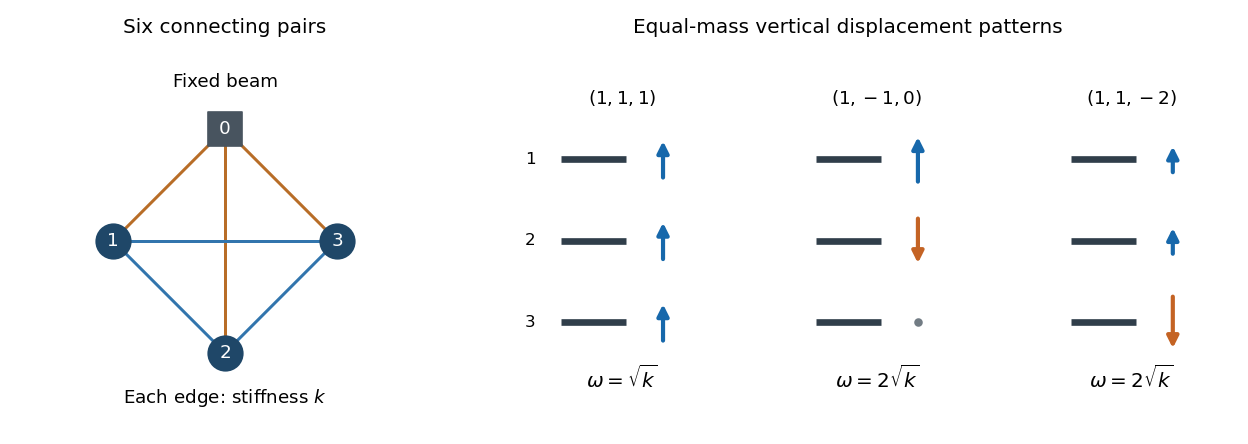
The diagram has a connection between every pair of indices , including the fixed beam . Two parallel strings, each with spring constant , together have energy . Thus the printed is the energy of a connecting pair; calling it the energy of one string would introduce a factor-of-two discrepancy.
Take vertical coordinates positive upwards, with fixed. Each bar has gravitational potential energy and kinetic energy . The Lagrangian isDifferentiating gives the Euler-Lagrange equationsEquivalently, with , the spring term is . Gravity changes the equilibrium but not the stiffness matrix. Subtracting a static equilibrium and writing gives the normal mode systemThis is the spring system underlying normal modes of an anchored complete spring graph.

For two bars, after subtracting the gravitational equilibrium,A normal mode requires the generalized eigenvalue problem . With ,Thus, for ,Both squared angular frequencies are positive. A corresponding eigenvector is , from the first row of the matrix equation.
Let , so . The sum and product of roots of the characteristic polynomial in (i) giveEliminating yieldsTherefore the octave tuning in a two-mass complete spring graph has two positive solutions:The two values are reciprocals. Both meet the requested frequency ratio; substituting either into the expressions in (i) gives .
For three unit masses, andThe uniform vector has , whereas every vector with coordinate sum zero is annihilated by . One orthonormal choice of normal modes is thereforeIf is retained from (b), the angular frequencies are . The equal upper frequencies follow from degenerate normal modes from permutation symmetry: the stiffness is scalar on the two-dimensional sum-zero subspace. In the uniform mode the inter-bar strings do not change length, but all three beam connections stretch, giving the nonzero lower frequency. The motion is an arbitrary sine-cosine superposition of these modes about the gravitational equilibrium.
The pinned third bar has zero displacement, so remove its row and column from the stiffness matrix while retaining the springs that connect the moving bars to it. The remaining unit-mass system hasIts eigenvectors and have eigenvalues and . HenceFor these are and . The fixed value changes the static offsets and reaction force but not this linearized matrix.
The group order of a finite group is its number of elements, . A subgroup is normal when conjugation by any group element leaves it unchanged:Equivalently, its left and right cosets agree: for every .
Label the triangle's vertices counterclockwise as . Let rotate it by and let reflect it in the axis through vertex 1 and the midpoint of the opposite side. ThenThe six dihedral group elements areThe first three are the identity and the rotations by ; the last three are reflections fixing vertices , respectively. These are all possible symmetries: the image of one vertex has three choices, and the order of the other two has two choices.
Use rightmost-first composition. From the generator relation,with exponents reduced modulo three and two. The row-times-column multiplication table isThus every symmetry is expressed in the two group generators .
Each reflection has order two, giving exactly the three order-two subgroupsConjugation by sends to , cycling the three reflections. None of these subgroups is therefore normal.
The two nonidentity rotations generate the same order-three subgroup:It is invariant under conjugation by , and shows invariance under as well; since generate the group, this proves normality. The complete partition into conjugacy classes isThe rotations are mutually conjugate by , and the reflections by ; no rotation is conjugate to a reflection because conjugation preserves the order of a group element.
Map each symmetry to the permutation it induces on the three vertices. This is a group homomorphism, because composing geometric motions composes their vertex permutations. In the labels chosen in (b), the map isAll six images are distinct and exhaust the symmetric group . Equivalently, the kernel is trivial because a triangle symmetry fixing all three vertices is the identity. Thus the map is bijective and
For , the left coset of represented by isIt is a subset of obtained by multiplying every element of on the left by the same group element. The identity representative gives .
For each , the mapis surjective by definition of a coset and injective by left cancellation. Its inverse is multiplication by . ThereforeThe same argument with right multiplication proves the analogous result for right cosets. This equality of sizes is the counting step in Lagrange's theorem.
Write . By Lagrange's theorem, the order of a group element divides four. Since no element has order four, all three nonidentity elements have order two. Thus every element is its own inverse. For any ,so the group is Abelian. Also cannot equal or , by cancellation and the fact that are distinct nonidentity elements. Hence . The remaining products are forced, givingThe map , , , preserves this table under componentwise addition modulo two. Thereforethe Klein four-group, also called the Vierergruppe.
A cyclic group is generated by one element: . The hypothesis needs the qualification no proper nontrivial subgroup: every nontrivial group has the proper trivial subgroup , so the literal wording admits no examples.
Under that intended hypothesis, choose . The subgroup is nontrivial and must therefore be all of , proving cyclicity. If had infinite order, then would be nontrivial and proper, since is not an even power of an infinite-order generator. Thus has finite order and .
If were composite, choose a divisor with . Then would have order , strictly between one and , again contradicting the hypothesis. ConsequentlyConversely, Lagrange's theorem shows that a group of prime order has only itself and its trivial subgroup. This proves the characterization of groups with no proper nontrivial subgroups, even without assuming finiteness at the outset.
The explicit matrices areDirect matrix multiplication givesThe reverse products have the opposite signs: , , . Since is the identity matrix and ,These are the usual quaternion multiplication relations in the complex matrix representation of quaternions.
The products in (a), together with and , give closure of the eight-element set. Associativity is inherited from matrix multiplication, is the identity element, and the inverses from (a), with , remain in the set. Thus the group axioms hold. This is the quaternion group .
In the element order specified in the question, the multiplication table isInterpreting “character of the group” as the character of a representation specified by these matrices, take the trace of each matrix:A character belongs to a representation; the underlying abstract group can have other characters.
The three order-four subgroups areIn each case the generator has powers , so all three are cyclic and mutually isomorphic to , a cyclic group of order four. For the table isThe maps and are explicit group isomorphisms. These are all order-four subgroups: any such subgroup contains an element other than , and that element has order four and already generates the subgroup. They share the order-two subgroup and are each normal, being of index two.
For , define the one-dimensional complex group representationExplicitly , , and . Since , the map is well-defined on exponents modulo four and preserves products. Its four images are distinct, so it is also a faithful representation. The same construction applies to either of the other cyclic subgroups.
Articles by others on the same topic
There are currently no matching articles.