The Riemann mapping theorem gives a conformal bijection exactly whengiven the hypothesis that is a simply connected domain. A domain is nonempty, open, and connected, so no extra nonemptiness qualification is needed.
For necessity, a conformal bijection would be a bounded nonconstant entire function, contradicting the Liouville theorem. For sufficiency, is a proper simply connected domain, exactly the hypothesis of the Riemann mapping theorem.
Use the univalent functions on , namely the univalent functions . Each has nonzero derivative, so its image is a domain conformally equivalent to , and is therefore simply connected. This image is proper: otherwise would be a bounded nonconstant entire function, contrary to the Liouville theorem.
Conversely, every proper simply connected domain is for some such , by taking the inverse of a Riemann mapping theorem bijection. Thus these functions parameterize all proper simply connected domains by their images. The complex plane itself is the exceptional simply connected domain and must be listed separately.
The parameterization has redundancy: two univalent functions have the same image if and only if for an automorphism of the unit disk . All such automorphisms have the formIf an interior point is prescribed, the normalization and real removes this redundancy. Equivalently one can describe these maps through their convergent Taylor series on , imposing univalence on the resulting holomorphic functions.
Write . For real and , the denominator cannot vanish: if its zero is real, and if then . Taking the imaginary part after multiplying by givesThus . Alsoso it is conformal. Cross-multiplication shows that implies , proving injectivity.
The inverse Möbius transformation isIts coefficients are real and its determinant is again , so the same imaginary part identity shows that it maps into . Therefore every has a preimage in , proving surjectivity. Hence maps one-to-one and onto itself.
The prescribed pole lets us choose and . Write . Fixing and givesso and . ThusIts determinant is , so it is a genuine Möbius transformation. Direct substitution gives , , and a pole at ; the numerator at that pole is .
To identify the image of the unit disc, putThen , , andIn particular, its pole is outside the closed unit disc. The identityshows . For any , solve to getIts denominator is nonzero, and the same modulus identity for this inverse gives . Thus , and global injectivity of a Möbius transformation proves the required one-to-one correspondence.
There is no such map for the domain printed in the paper. The planar domain is not simply connected. For example, a sufficiently large positively oriented circle surrounds and lies in , whileThe integrand is holomorphic on . If were simply connected, the Cauchy integral theorem would force this integral to be zero. A conformal bijection is a homeomorphism and preserves simple connectivity, whereas is simply connected. Thus a conformal bijection is impossible.
The explicit construction also pinpoints the missing point. DefineThis Möbius transformation sends the removed line segment to the nonpositive real axis, together with infinity. More precisely, its image on the stated planar domain issince has no finite solution when . Conversely, its inverse is defined for every in this set and cannot lie on , proving this image description exactly.
Take the principal square root of , characterized by positive real part, and then multiply by . The result is the conformal mapEach stage is injective and onto the indicated image; the square root maps the slit plane to the right half-plane, with the point omitted here. Hence this is a conformal bijection onto the punctured upper half-plane. Its inverse isIf the source is instead on the Riemann sphere, the same map extends with and becomes a conformal bijection onto all of . Indeed, in the local coordinate it has expansion , whose derivative at is nonzero. This gives the sphere version of the requested construction without silently changing the printed planar domain.
Use the same principal square root , which is holomorphic on because its argument avoids the nonpositive real axis. Thenis a holomorphic function satisfyingThus it is a holomorphic branch of the requested square root. This construction does not require a global holomorphic logarithm of or separately. Its sign is fixed by at infinity, so . The negative of this function is the other holomorphic branch; any two branches have a continuous quotient taking values in , which is constant because is connected.
The two boundary circles meet at : subtracting their equations gives , and either equation then gives . Send these points to zero and infinity by the Möbius transformationThe point is on the boundary, so is holomorphic throughout . Write . Substituting the inverse gives the exact equivalencesThusThere is no missing point from the inverse here: lies outside this sector. The image is therefore exactly the stated sector, rather than merely a subset of it.
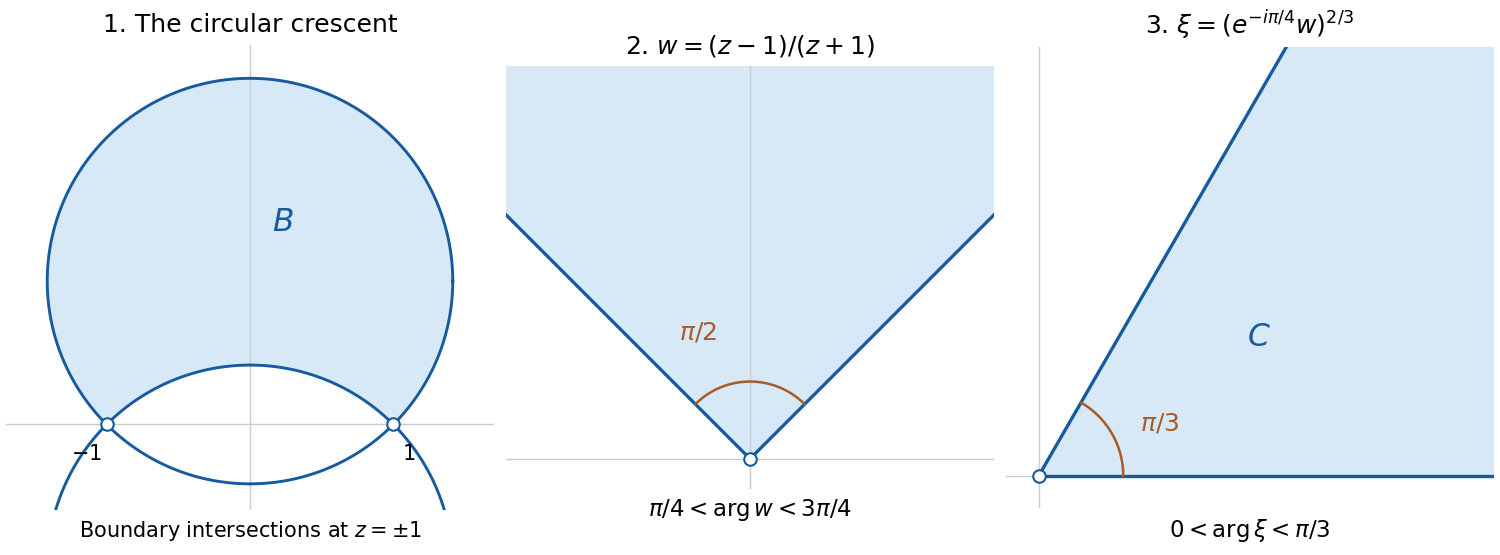

Rotate by to obtain the first quadrant, and take the power using its holomorphic logarithm with . The required map isHere the principal logarithm works because the expression inside it lies in the first quadrant. It multiplies its argument by , giving , and maps its modulus to , which ranges over all positive real numbers.
For explicit surjectivity and injectivity, given with , definewhere uses . Then , so and , and these are inverse operations. Each stage is holomorphic with nonzero derivative, proving that is the requested conformal bijection.
Articles by others on the same topic
There are currently no matching articles.