Original paper: 23 April 2014, physical PDF pages 678–680.
Put . For a temporally uniform envelope, and , so the propagation equation reduces to . Thus the power stays and the accumulated nonlinear wave phase is . The optical Kerr effect gives an intensity-dependent refractive index, and hence self-phase modulation. For the usual power normalization , with effective guided-mode area . Losslessness preserves the background power; it does not remove the self-phase modulation. The carrier wave phase has already been factored out.
Write . To first order,Cancelling the background and its phase derivative leavesThe last term couples a perturbation to its complex conjugate: the pump can transfer energy into a pair of sidebands. It is not an independent wave phase of each Fourier component. This sideband coupling is the linear origin of fibre modulational instability.
For real , put . Matching the two exponential coefficients givesA nonzero pair requires a zero determinant, henceFor unstable complex , the real-coefficient assumption is too restrictive. The consistent pair is , with complex . Its equations give the same determinant and allow the growing and decaying branches. Merely inserting imaginary while treating the two original coefficients as real would not respect complex conjugation.
For and nonzero , exponential growth requires andFor ordinary positive Kerr nonlinearity this means anomalous group velocity dispersion, . Define . The growing branch is , with amplitude growth rateSideband power grows at rate , rather than . The cutoff and zero-frequency modes have no exponential growth; in a degenerate zero-frequency sector a secular phase response can remain. Positive dispersion with positive gives real and oscillatory perturbations.
Initially small ripples grow into pronounced intensity peaks and deplete the uniform background. Dispersion and self-phase modulation can then support localized bright pulses. A fundamental temporal bright soliton obeys , so its width is comparable to when its peak power is comparable to the original power. The dominant ripple spacing is , not simply . Propagation distance is the evolution variable; measures time within the envelope. An ideal conservative fibre need not settle permanently into a unique pulse train: nonlinear compression, interactions and recurrence depend on the seed and boundary conditions.
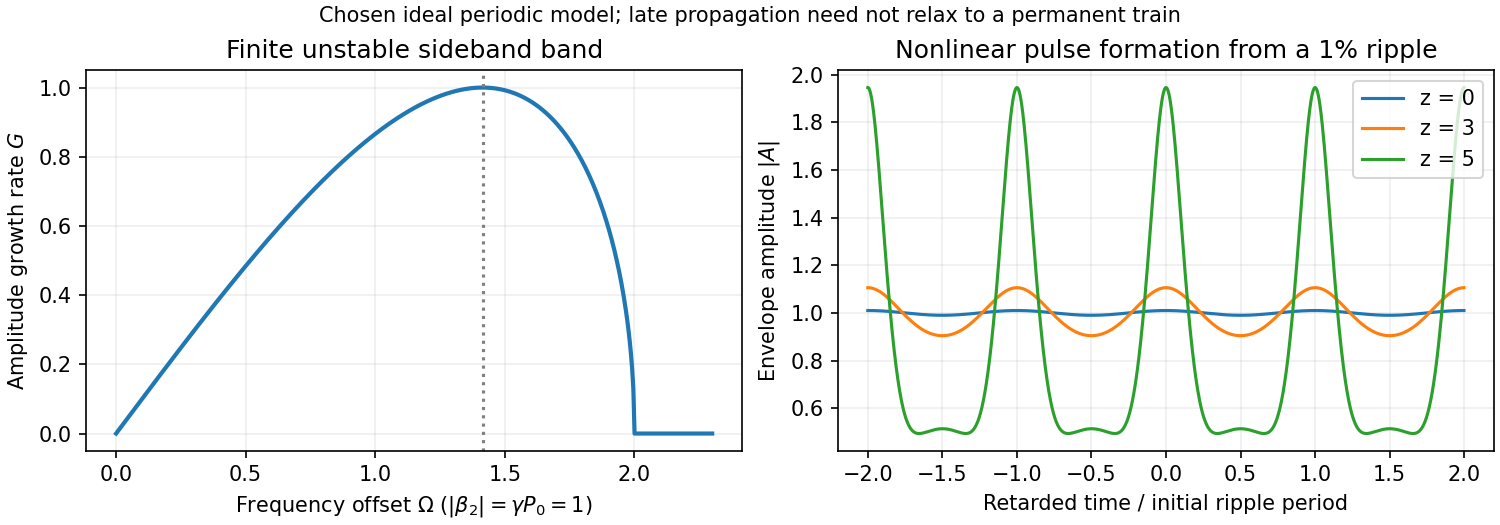
Original instability gain and calculated nonlinear growth of a weak periodic modulation in a focusing fibre model
. Details. A degenerate optical parametric amplifier sends a strong pump at through a phase-matched second-order nonlinear medium, creating pairs in a selected mode near . With the pump treated classically and undepleted, the effective interaction is quadratic in the mode's creation and annihilation operators. Vacuum input evolves into an optical squeezed vacuum; the pump phase fixes the quiet optical quadrature. A cavity enhances the interaction below oscillation threshold. balanced homodyne detection compares this optical quadrature's noise with the blocked-signal vacuum reference; phase locking, detector balance, electronic-noise measurement and loss calibration distinguish squeezing from an instrumental noise reduction. A primary cavity experiment observed below-vacuum noise by degenerate down conversion and balanced homodyne readout.[ref]
Generation of Squeezed States by Parametric Down Conversion by Ling-An Wu and others. 1986, abstract: cavity down conversion and homodyne noise reduction
Use , so . Write , and . Vacuum expectations then givePair creation makes the mean field zero while the mean photon number is positive. Expanding the transformed ladder operators in the vacuum gives the squeezed-vacuum photon-number moments: and ; equivalently .
The vectors produced by photon addition and photon subtraction in the paper are not normalized. Their squared norms are and , respectively. A particularly direct evaluation isBoth successful operations therefore prepare the same squeezed one-photon state, up to an overall phase, whenever subtraction has nonzero probability. Since , the unnormalized moments areThe printed photon-added formula equals , not a normalized mean. With its literal unnormalized convention, the corresponding subtraction result is andThis difference tends to one as and grows as for large positive . Keeping this convention recovers the paper's requested expression without misidentifying it as a physical conditional mean.
For the normalization of photon-added and photon-subtracted states, divide by the squared norms to obtain actual conditional means:These equalities for subtraction require . As the normalized successful subtraction tends to , but its success probability vanishes; exactly at , gives no conditional state. At large , both normalized means grow as , while their difference remains zero.
For the photon statistics of a squeezed vacuum, the even-number probabilities areAfter subtraction the normalized distribution is . It has only odd occupation and no vacuum component. photon addition gives , identical here to . The diagram uses normalized distributions with an explicitly chosen , rather than treating the unnormalized moments as means.
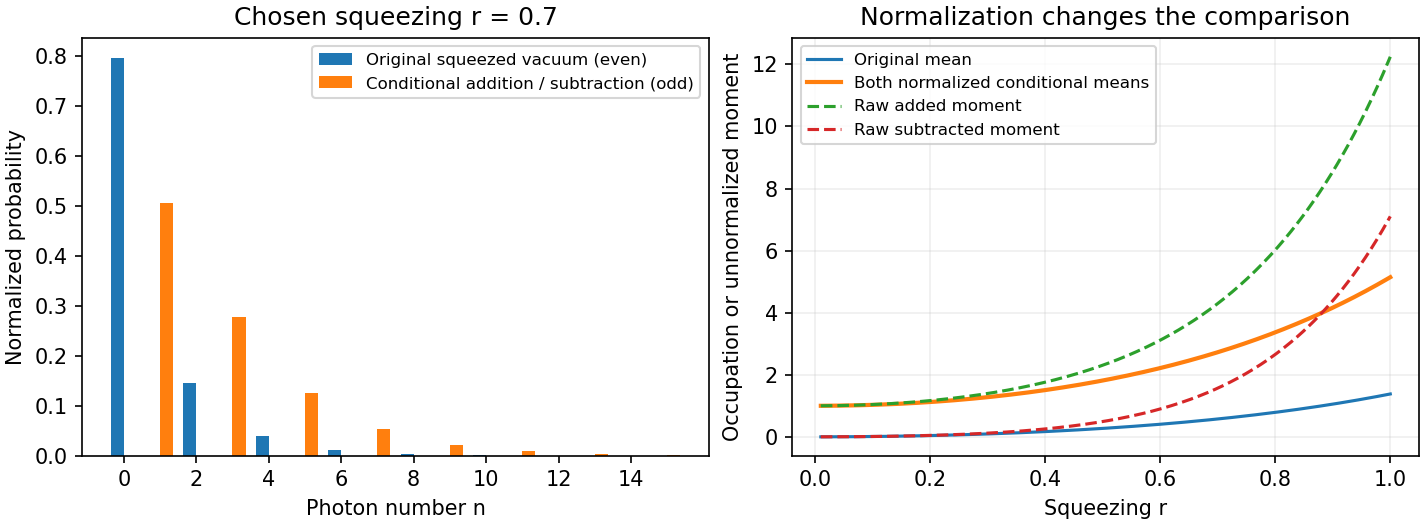
Original normalized even squeezed-vacuum and odd conditional photon-number distributions, with raw-moment and mean conventions distinguished
. Details. A subtraction event samples initial occupation with weight , preferentially selecting the larger components before removing one photon. In general . Here the large variance gives . This conditional photon-number bias does not create energy by removing a photon: the unconditional ensemble also includes the runs without a heralded event.
An optical soliton maintains a localized profile because nonlinear refraction compensates linear spreading. A temporal optical soliton balances group velocity dispersion against self-phase modulation; a spatial optical soliton balances diffraction against self-focusing. The relevant coordinate and sign of nonlinearity must be specified.
For anomalous group velocity dispersion and positive , a fundamental temporal bright soliton isThe identity verifies both the width relation and propagation phase. Its dispersion length equals its nonlinear length . Bright pulses decay to zero background. dark solitons are intensity depressions on a nonzero background with a phase change across the dip; black dips reach zero intensity, while grey dips do not. For positive the corresponding temporal defocusing regime has normal group velocity dispersion.
A higher-order temporal soliton has soliton order equal to an integer greater than one for the special initial profile in normalized units. It breathes through compression and splitting/recombination, rather than keeping one fixed shape. Separated fundamental solitons can interact and acquire collision shifts. An arbitrary pulse with noninteger is not automatically a pure higher-order soliton; dispersive radiation can carry part of its energy.
In ideal one-dimensional cubic propagation, dispersion and nonlinearity support stable fundamental bright pulses. Loss, higher-order dispersion, delayed nonlinear response and finite bandwidth change real-fibre propagation. A one-dimensional spatial bright solution also does not guarantee stability against two-dimensional collapse. Profile preservation, finite-energy background conditions and robustness should be checked rather than inferred from any solitary-looking peak.
A detector too slow to resolve a femtosecond field can measure its integrated nonlinear response instead. Split the pulse, delay one replica, overlap both in a thin phase-matched crystal, and select the sum-frequency signal. For negligible depletion and sufficiently broad phase matching, the cross-generated field is proportional to ; integrated signal gives the second-harmonic intensity autocorrelationA noncollinear geometry can reject each replica's individual second harmonic. The optical response supplies the fast gate while the detector integrates slowly. Crystal thickness, group-velocity mismatch, spectral acceptance, beam overlap and delay calibration limit resolution.
For a Gaussian pulse specified by its intensity profile, the autocorrelation's full width at half maximum is times the intensity full width at half maximum. For a sech-squared intensity profile the ratio is about . These are model-dependent conversion factors. An intensity autocorrelation is symmetric in delay and loses phase information; different pulses can share it. An interferometric autocorrelation retains rapid carrier fringes but still does not generally reconstruct an arbitrary complex field uniquely.
frequency-resolved optical gating also resolves the gated signal's spectrum, giving a two-dimensional delay-frequency record. For second-harmonic frequency-resolved optical gating,where is measured relative to the signal's carrier. An iterative retrieval seeks an envelope whose predicted record matches the measurement. Alternatively, polarization-gating frequency-resolved optical gating uses the optical Kerr effect to gate the probe by a delayed replica's intensity, with signal envelope proportional to . The original FROG work introduced nonlinear optical gating plus spectral resolution to characterize arbitrary femtosecond pulses.[ref]
Characterization of arbitrary femtosecond pulses using frequency-resolved optical gating by Daniel J. Kane and Rick Trebino. 1993, abstract: nonlinear gating and spectrogram construction
Absolute wave phase and absolute time origin remain undetermined by these intensity records. The SHG record also cannot distinguish from , so its time-direction ambiguity remains. Retrieval agreement, an independently measured spectrum, adequate signal dynamic range and gate-response calibration are practical consistency checks. A pulse train that changes between shots can yield an averaged record that no single pulse faithfully represents. Thus nonlinear gating solves the detector-speed problem but does not remove inverse problem ambiguities or experimental limitations.
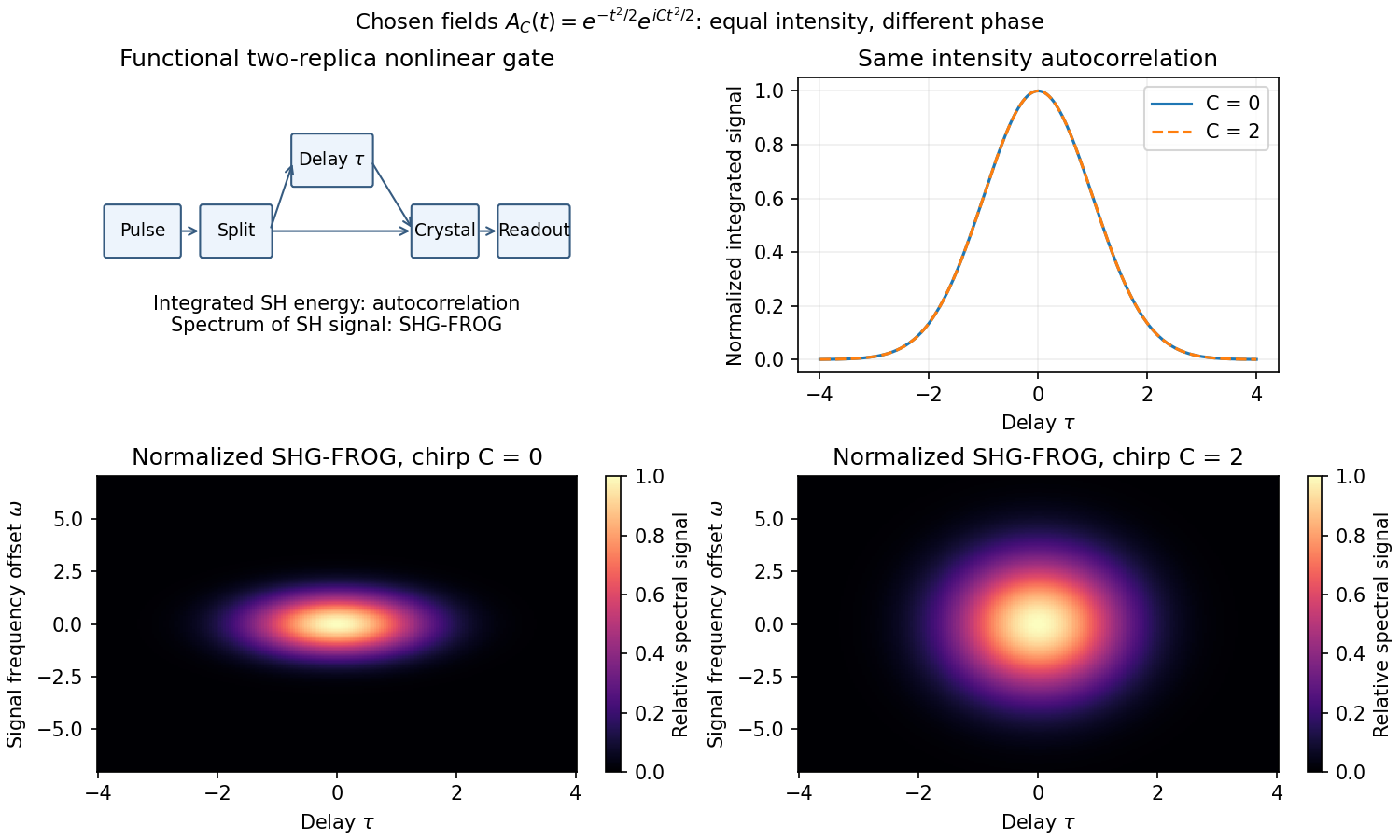
Original nonlinear pulse-gating layout and a calculated Gaussian chirp example distinguishing autocorrelation from spectral gating
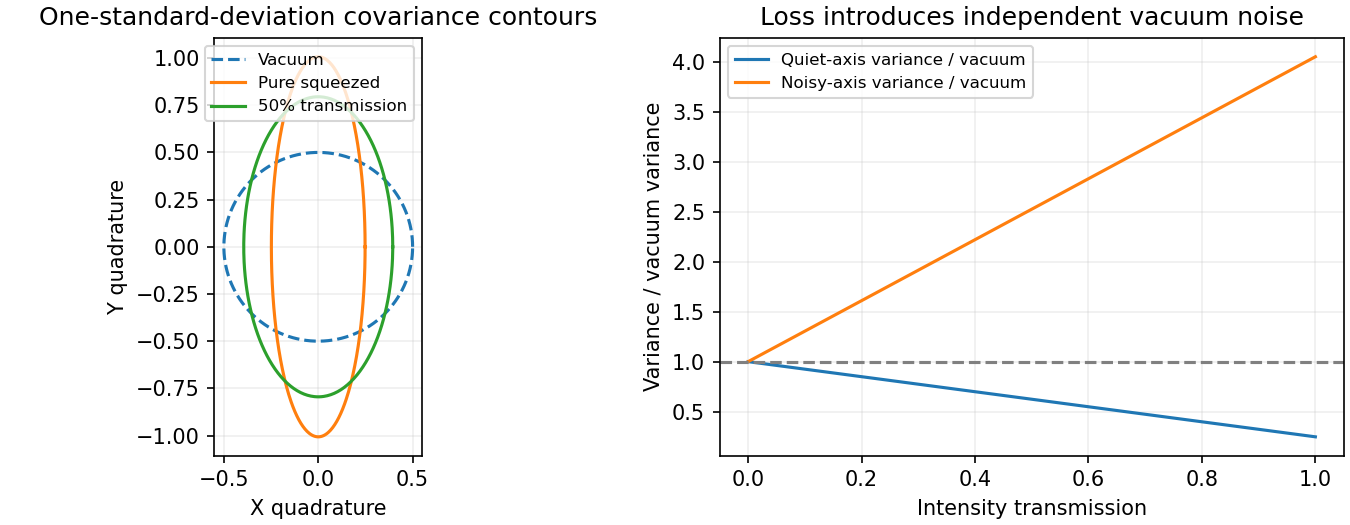
. Details. For and , , so . Vacuum and coherent states have variance in either optical quadrature. quadrature squeezing means that some rotated optical quadrature has variance below this reference, with compensating noise elsewhere. A reduced second moment about zero is not the correct test when the field's mean is displaced.
For and , the quiet principal axis of the optical squeezed vacuum is at angle under the squeeze-operator convention used above, andThe pure Gaussian quantum state saturates the uncertainty product. Displacement moves its centre without changing its covariance ellipse; squeezed thermal states instead have a larger uncertainty product. The optical squeezed vacuum has zero mean field, even photon-number parity and mean occupation ; it need not have sub-Poissonian photon statistics. number squeezing and quadrature squeezing are different conditions.
Degenerate parametric amplification generates single-mode squeezing; a two-mode squeezed vacuum instead has correlated occupations and joint quadrature squeezing. Either individual mode of an ideal two-mode state is thermal after the other is ignored, not individually squeezed. balanced homodyne detection measures the noise versus local oscillator phase. Reference phase drift admixes the anti-squeezed optical quadrature, while electronic noise and detector imbalance need separate checks.
For an optical loss channel with efficiency and vacuum entering the unused port, optical squeezing degradation by loss givesThe linear-loss limit follows directly by writing the output field as with independent vacuum mode . Loss therefore places a floor under measured squeezing. Squeezed input can improve phase-sensitive measurements when aligned with the measured optical quadrature; it does not reduce every noise source or both conjugate uncertainties at once.


Articles by others on the same topic
There are currently no matching articles.