Nuclear-field pair creation is . A virtual photon exchanged with the nucleus supplies recoil momentum, while the real photon and virtual photon attach to the electron line joining the outgoing pair. The figure shows a representative graph. The second attachment ordering must be included in the full amplitude. A real photon cannot create a free massive pair in vacuum: its invariant mass is zero, whereas . Nuclear recoil resolves that kinematic obstruction and permits energy-momentum conservation.
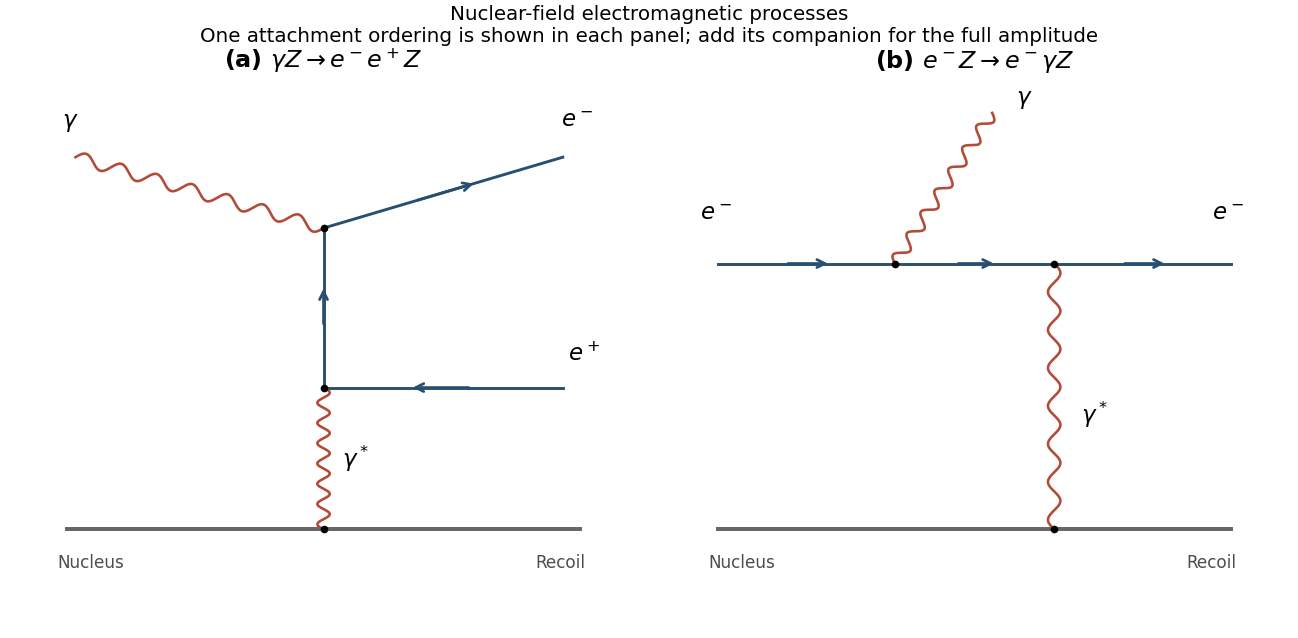

For bremsstrahlung, the electron scatters from the nucleus by virtual-photon exchange and emits a real photon: . The two lowest-order graphs have emission before or after the Coulomb scattering. One is drawn in the figure; interchanging the emission and exchange vertices gives the other. Their sum is needed for the full gauge-consistent amplitude. Reversing the charged-lepton arrows gives Positron bremsstrahlung, with the same underlying electromagnetic mechanism.
At low charged-lepton energy, collisional ionization and excitation dominate over radiation. A slowing Positron also eventually annihilates, usually yielding photons. Low-energy photons lose energy through Compton scattering and, at sufficiently low energy, photoelectric absorption; pair production is kinematically unavailable below its threshold.
The electron critical energy is the energy where mean bremsstrahlung and collisional losses are equal. With and a slowly varying collisional loss,Above this energy, radiation and pair creation multiply shower particles efficiently. Below it, charged particles mainly deposit their energy by collisions and the shower dies out. Critical energy is material dependent; it is not a new photon-production threshold.
In the binary branching model of an electromagnetic shower, after ideal equal-sharing generations, the model has particles of energy , at depth . Stop the branching when . ThusThe continuous estimate is . At 13 generations the particles still have approximately , whereas at 14 they have approximately . The ideal branching model therefore suggests roughly – before multiplication stops.
This is not an accurate containment criterion. Real conversion and radiation distances fluctuate, bremsstrahlung energy sharing is broad rather than always one half, some energetic branches penetrate beyond the average, and particles below critical energy still have stopping and absorption ranges. The simplified stopping depth is closer to its own model's shower-maximum scale than a depth containing all deposited energy. A calorimeter needs additional longitudinal depth to control leakage and event-to-event tails. These effects explain why approximately can be required even though the equal-sharing estimate is smaller. The toy model does not predict the realistic shower maximum or leakage fraction quantitatively.
The principal passive-material requirement is a short radiation length in centimetres, normally obtained using a dense, high-atomic-number absorber such as lead or tungsten. It produces and contains an electromagnetic shower in a compact detector. Mechanical construction, transverse spread, cost, radiation tolerance and inactive gaps also affect the choice, but the absorber is selected for shower formation rather than signal production.
Liquid-argon gaps are a suitable active sampling medium. Ionization electrons drift in an electric field and induce a measurable charge signal. Advantages include radiation tolerance, stable response and useful spatial segmentation. Disadvantages include cryogenic infrastructure, high-voltage and purity requirements, signal collection times and electronic-noise control. Only the active fraction is measured directly, so fluctuations of energy shared between absorber and active gaps introduce a sampling contribution to the resolution. A high active fraction and fine sampling help, at the price of construction complexity and additional channels.
For independent contributions the parametrization meansThe stochastic coefficient includes fluctuations in the sampled shower fraction, the finite number of signal quanta, and intrinsic shower fluctuations. A number of detected quanta proportional to has fluctuations proportional to , giving relative resolution proportional to . The noise coefficient describes an approximately fixed energy-equivalent readout uncertainty, including electronic noise and, for specified running conditions, Pile-up contributions. The constant term represents residual fractional nonuniformity, calibration and response variations, imperfect correction for inactive material, and leakage effects over the fitted range. The simple three-term model is an approximation; leakage and Pile-up need not follow these powers exactly.
A homogeneous calorimeter uses the showering material itself as the active medium, for example a scintillating crystal. It removes the absorber-versus-active sampling fluctuation and can have a much smaller stochastic term, but it does not eliminate signal statistics or intrinsic shower fluctuations. Its noise and constant terms are not automatically smaller: they depend on light collection, calibration, temperature, radiation damage, electronics and geometry. Homogeneous detectors can offer excellent energy resolution and compact construction, but large crystal volumes can be costly and fine longitudinal segmentation difficult. Sampling detectors often provide economical large coverage and flexible segmentation with robust absorbers, at the cost of sampling fluctuations and inactive material. If energy is expressed in GeV, has units , has units GeV and is dimensionless.
Articles by others on the same topic
There are currently no matching articles.