Work in the W boson rest frame, taking the spin-quantization axis along its laboratory motion. Neglect charged-lepton and neutrino masses. The weak charged current produces a negative-helicity and a positive-helicity antineutrino. Their momenta are opposite, so both spin Vectors point opposite to the charged lepton's direction ; the final total spin projection along is .
Let denote the parent spin projection along . In the given probability amplitude, use and the rotation element . The supplied spin-one rotation elements giveThe transverse states have spin projections ; the longitudinal state has projection zero, not total spin zero. The original diagram below distinguishes momenta from spins and shows the corresponding normalized angular profiles.
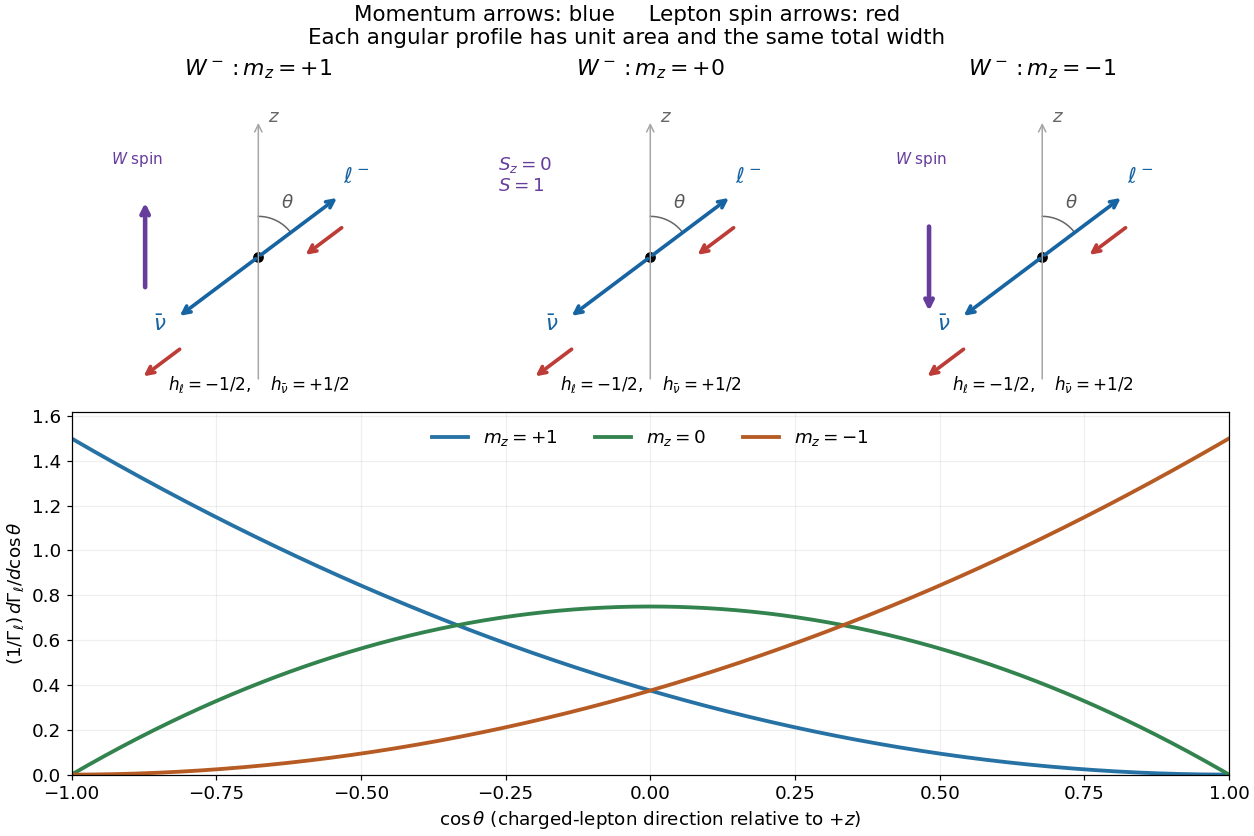

With relativistically normalized one-particle states, Fermi's golden rule becomesIn the parent rest frame, the three-momentum delta function fixes . The energy delta function fixes the common magnitude ; its radial Jacobian converts the remaining phase-space factor intoOnly one momentum magnitude remains because the two final momenta are constrained, not independent. Explicitly,For leptonic W boson decay both final masses are small compared with , including the tau mass at the precision requested, so .
For the longitudinal state,Insert this and into the phase-space formula:Rotational invariance makes the integrated decay probability independent of the orientation of the initial spin. Both transverse polarizations therefore have the same rate. An unpolarized sample averages these three equal rates; it does not add three copies. Hence its width into one specified charged-lepton flavour is also .
At a hadron collider, select events and reconstruct the transverse massusing missing transverse momentum for the neutrino. Fit the shape, especially the region above the nominal Jacobian edge, with finite-width resonance templates convolved with detector resolution, recoil modelling and backgrounds. The Breit-Wigner width controls this off-shell tail. Calibrated momentum and missing-momentum resolutions must be separated from the physical width. This is a lineshape measurement; the lifetime is far too short for a direct flight-distance measurement.
Assume only Standard Model decay channels, negligible final-state masses, three lepton families, three quark colours and a unitary CKM matrix. The top-quark channels are kinematically closed. Summing the allowed quark channels gives times one leptonic width, while the leptons contribute three. Neglecting QCD and electroweak radiative corrections,The source's rounded CKM entries give almost the same factor; their tiny nonunitarity is not physically significant. ConsequentlyThe propagated uncertainty uses , taking as fixed. It is the measurement uncertainty within the stated tree-level approximation; omitted radiative corrections are an additional modelling limitation. In particular QCD increases the hadronic width and lowers the inferred coupling when included.
The printed electromagnetic comparison is , not the probability amplitude coupling . Compare like quantities:Equivalently exceeds . The weak interaction is weak at low energy primarily because of the massive propagator, rather than an exceptionally small fundamental coupling.
Articles by others on the same topic
There are currently no matching articles.