Let measure the rim point mass's displacement from vertically below the fixed axis. The disk has moment of inertia , and the rim mass contributes another . Its varying gravitational potential energy is . ThusThe disk's centre of mass remains fixed, so its own gravitational contribution is a constant and has been omitted. The total fixed-axis moment of inertia is .
The Euler-Lagrange equation from a is . Linearizing about givesBoth angular frequency and ordinary frequency are given to distinguish the two conventions. The stable position places the extra mass below the pivot.
For the rolling disk with a rim point mass, impose rolling without slipping and take the clockwise angular displacement from the configuration with the extra mass at the bottom. The disk centre has and . The extra mass hasThe disk's translational and rotational kinetic energies sum to . Including the rim mass givesThe exact Euler-Lagrange equation isTo first order, . ThereforeAt the bottom the extra mass is instantaneously at the contact point and has no first-order velocity. The increased effective inertia comes from the moving disk. Static friction enforces the rolling constraint without doing work at the stationary contact.
In the rim-mass pulley coupled to a hanging mass, the printed figure shows the smaller pulley fixed overhead, and the mechanical string leaves the right-hand tangent of the larger pulley. Let increase counterclockwise from the downward vertical to the radius carrying . Then the hanging mass moves downward by . The string is taken to grip the rim without slipping. Its tension must be solved dynamically, rather than set equal to during motion.
The kinetic energy and potential energy areThe Euler-Lagrange equation and the condition for equilibrium areOne can also eliminate the tension from and . For , the solution with is stable; the other solution in a full turn is unstable.
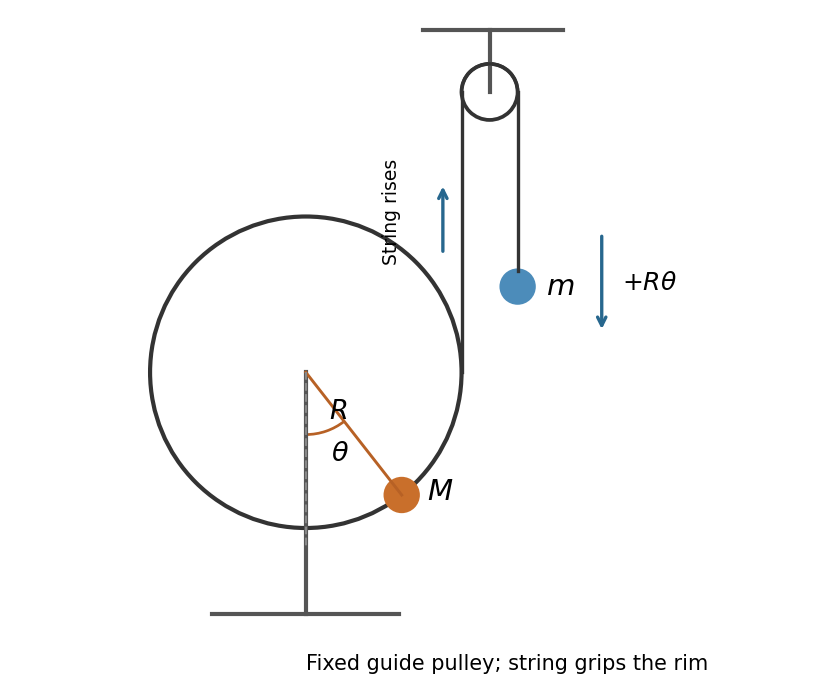

Put at the stable equilibrium. Since , linearization of d givesThusAs , the result approaches , the simple pendulum value. As , the restoring curvature tends to zero and this small-amplitude frequency tends to zero; the endpoint itself is not a stable quadratic minimum.
Articles by others on the same topic
There are currently no matching articles.