For , define and . The parameter relating quality factor and viscous damping regimes isAt weak damping it also equals times stored energy divided by energy lost per cycle. The stored-energy convention and frequency matter: this cycle-based interpretation should not be extended to free motions that never complete a cycle.
For the free motion is , where . Thus underdamping means . High gives many oscillations per amplitude-decay time, narrow resonance and strong frequency selectivity; a lightly loaded tuning fork, optical cavity or low-loss electrical resonator provides examples. The amplitude decay time is , while the slowly averaged energy decays with . These times differ by a factor of two.
At critical damping, and , with . There is no ringing; a simple critically damped position indicator can settle without oscillation. For and , there are two real negative decay rates . Increasing very strong drag slows the long-time return, whose rate approaches . A strongly viscously damped mechanical indicator illustrates this regime. These classifications concern the linear homogeneous equation, not every possible nonlinear damping law.
The driven displacement amplitude isThe displacement-resonance threshold of a viscous oscillator requires , or ; it lies at . Some underdamped systems therefore have no such maximum. Average absorbed power instead peaks at for this viscous model. Its half-power frequencies are , so their separation is and . For broad response this ratio remains a useful parameter but not a claim of many free oscillations. The familiar displacement-linewidth version is a high- approximation.
A series RLC circuit has and for the charge oscillation. Resistance dissipates energy, inductance provides the inertial analogue and capacitance the restoring analogue. Ringdown and a calibrated half-power scan independently estimate loss; parasitic resistance, loading and radiation change the measured value. A large increases frequency selectivity but also lengthens settling time, so it is not universally the best instrumental choice.
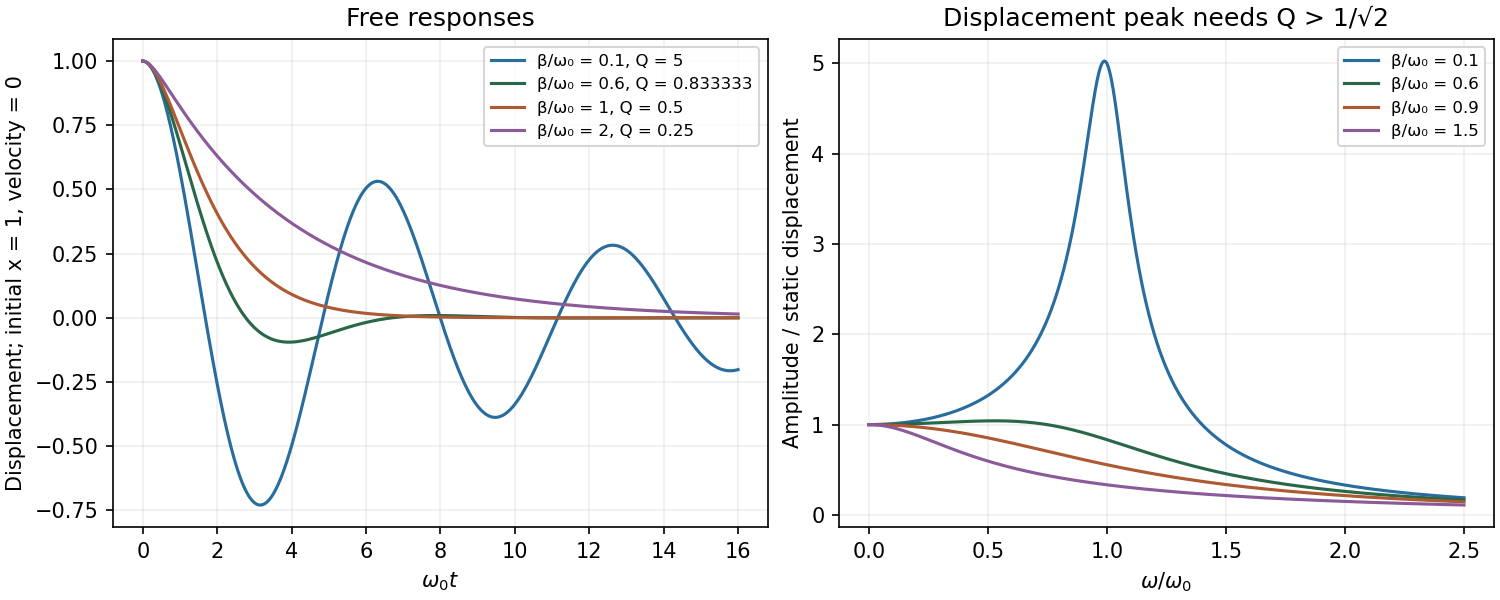
Original free decay and forced-displacement curves distinguishing underdamping, critical damping, overdamping and the resonance threshold
. Details. 
A three-phonon normal process conserves crystal wavevector without a reciprocal-lattice shift, . An Umklapp process instead hasThe crystal can absorb the reciprocal-lattice momentum; after reduction to the first Brillouin zone the phonon drift transporting heat is relaxed. A normal process redistributes phonons while preserving their total crystal momentum, so it is not by itself the same resistive mechanism. energy must also be conserved in either process.
At low temperature, large-wavevector phonons are rare, suppressing Umklapp scattering. Boundary and defect scattering then limit the mean free path; with a nearly constant boundary-limited path, grows as . As temperature increases, heat capacity rises but Umklapp scattering shortens , often producing a electrical conductivity maximum. At sufficiently high temperature a simple anharmonic model has nearly constant and , giving . These are regime estimates, not a universal law for every material or size.
For degenerate carriers with approximately elastic scattering and a common transport relaxation time, and . Using and givesThis is the Wiedemann–Franz law. The same mobile electrons carry charge and heat, but Pauli statistics set the electronic heat capacity and hence the Lorenz number. The relation applies to electronic thermal conductivity, not automatically to total electrical conductivity including phonons. Inelastic electron-phonon scattering can relax energy and charge currents differently; nondegeneracy and strong energy dependence of scattering also limit the simple form.
A meaningful test combines a four-terminal electrical measurement with a steady thermal-gradient measurement on the same sample and temperature range. Contact heat resistance, parasitic heat leaks, phonon conduction and sample geometry must be controlled before interpreting a measured Lorenz ratio as an electronic departure from the law.
A carrier in a locally parabolic isotropic band obeys , soIlluminate a high-mobility crystal with a transverse alternating electric field, sweep a calibrated static magnetic field at known microwave or far-infrared frequency, and detect resonant absorbed power. Cooling lengthens the relaxation time; resolving the resonance generally needs . Varying field direction measures band anisotropy, while circular polarization distinguishes the two senses of rotation for opposite carrier charges. This is orbital motion rather than electron spin resonance.
The classic silicon/germanium measurements used single crystals near , light modulation and circularly polarized microwaves, with directional scans to infer anisotropic carrier-energy surfaces.[ref]
Cyclotron Resonance of Electrons and Holes in Silicon and Germanium Crystals by Gene Dresselhaus and others. Abstract: low-temperature single crystals, light modulation, circular polarization and anisotropy
Carrier generation, calibration, scattering linewidth and inhomogeneity must be separated from a genuine mass shift.In a general band the cyclotron mass is an orbit property, for the appropriate field-normal orbit. It need not equal every component of the band-curvature mass tensor. For an ellipsoidal parabolic band with field along a principal direction it is . Thus a single resonance does not determine a whole effective-mass tensor without angular information.
Articles by others on the same topic
There are currently no matching articles.