The free electron model replaces the microscopic ionic potential and interacting electronic motion by independent mobile electrons in a uniform neutralizing background, with approximately parabolic dispersion . Its quantum version fills states according to Fermi-Dirac statistics and the Pauli exclusion principle. Scattering is represented by a momentum relaxation time , rather than derived from the model's ideal free trajectories. This model explains a Fermi energy much larger than room-temperature thermal energy, an electronic heat capacity proportional to temperature at low temperature, and a Drude electrical conductivity. With appropriate scattering assumptions it also yields the Wiedemann-Franz law. It cannot by itself explain band gaps, detailed band anisotropy, strong correlations, or the microscopic temperature dependence of .
The inertial term is mass times the rate of change of mean drift velocity. The electric force is , taking the printed as the signed electron charge, and describes loss of directed momentum to scattering. electrons retain large microscopic velocities; this damping is of their mean directed motion. In a steady DC field,Both charge factors are negative for electrons, so the conductivity is positive. If instead denotes a positive charge magnitude, the force and current equations each require a minus sign and give the same result.
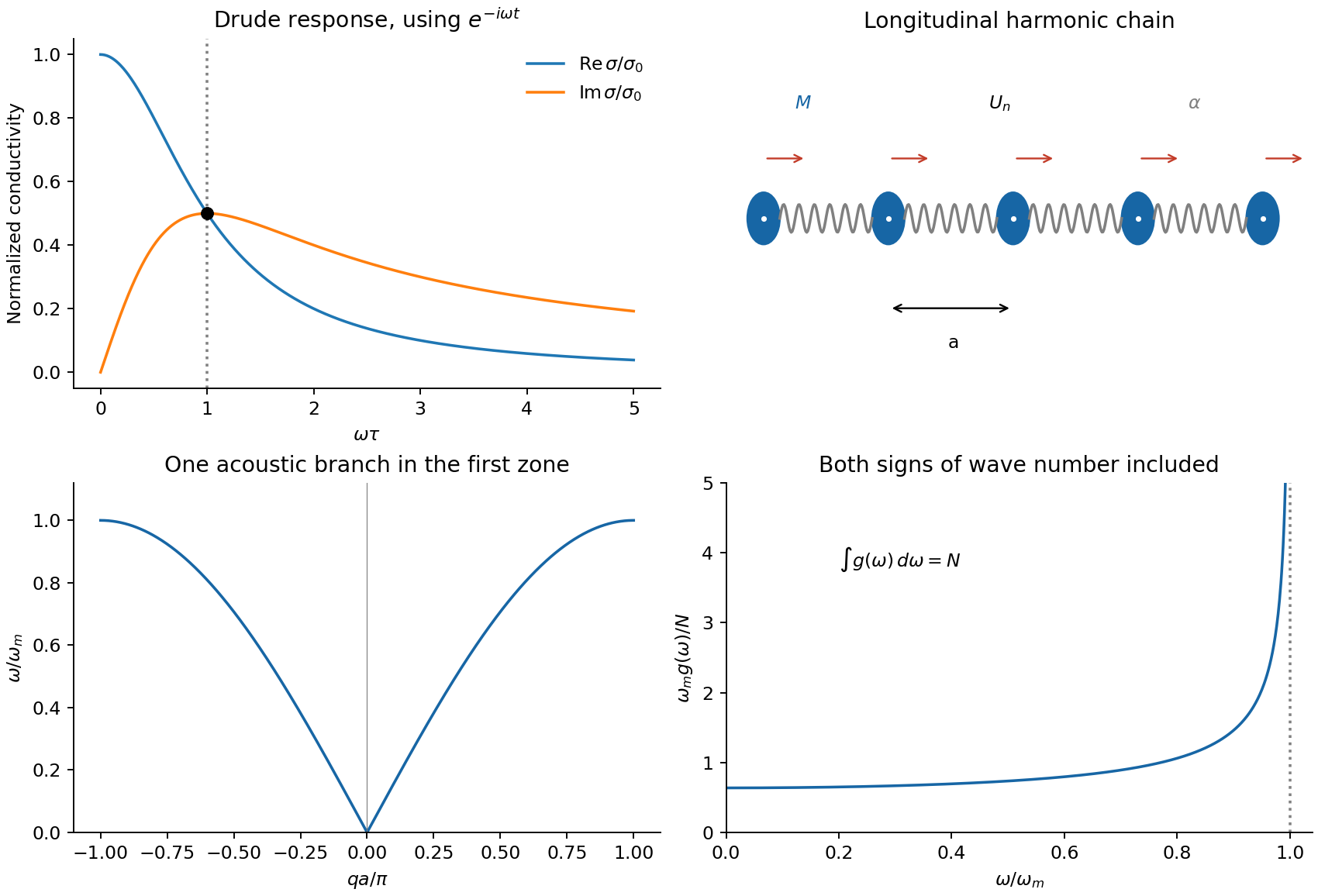
For AC response choose physical fields as real parts of phasors proportional to . Substitution givesThusThe real part decreases from to zero. The imaginary part starts at zero, reaches at , and falls as . The real part falls as at high frequency. With an convention, only the sign of the imaginary part changes. Positive gives positive cycle-averaged dissipation .

Articles by others on the same topic
There are currently no matching articles.