identical particles have the same intrinsic properties, including mass, charge and spin. Their labels are bookkeeping devices rather than measurable identities. When wave functions overlap, quantum mechanics supplies no observable trajectory that permanently identifies “particle 1” independently of “particle 2”. A many-particle description must therefore treat exchange consistently. The Hamiltonian and physical observables are invariant under relabelling identical particles.
For two particles, the exchange operator obeys . The usual three-dimensional symmetrization postulate selects states symmetric under exchange for bosons and antisymmetric for fermions. In relativistic quantum theory, the Spin-statistics theorem associates integer spin with bosons and half-integer spin with fermions under its locality and positivity assumptions; the connection is not derived merely from in elementary nonrelativistic mechanics. For orthonormal one-particle states and , the two-particle spatial combinations areThe sign concerns the complete state, including spin and other internal variables, not necessarily the spatial factor alone.
The antisymmetric state vanishes if both fermions occupy the same one-particle state: this is the Pauli exclusion principle. For fermions in orthonormal spin orbitals , the normalized Slater determinant supplies the required exchange sign. Bosonic occupation has no corresponding upper limit, and symmetrized products describe many bosons. Fermionic occupation is zero or one per complete one-particle state; two electrons can still occupy the same spatial atomic orbital with opposite spin.
Spin and spatial symmetry are linked. A two-electron spin singlet state is antisymmetric, so its spatial factor must be symmetric. A symmetric triplet state instead requires an antisymmetric spatial factor. Exchange then changes pair correlations and the energies available when interactions depend on particle separation, even without introducing a new classical “exchange force”. It contributes to atomic shell structure, bonding and magnetic behaviour.
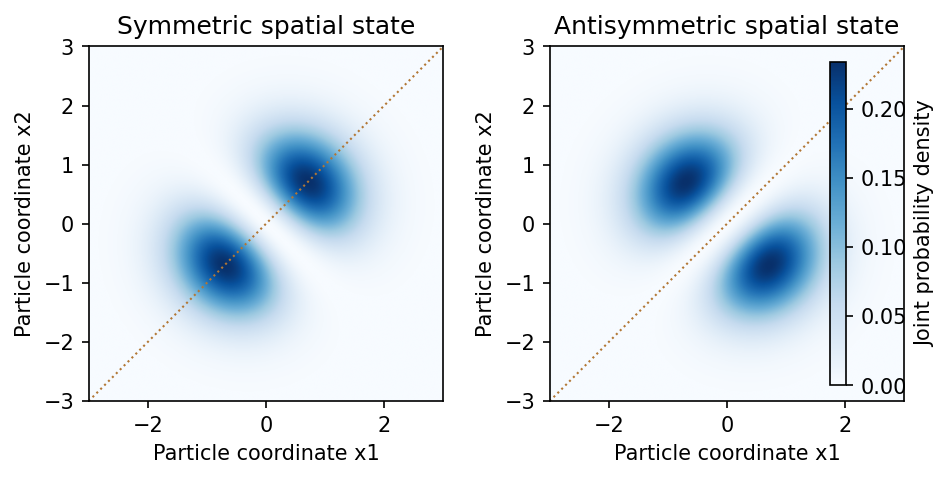
Symmetric and antisymmetric two-particle spatial states have different joint-position correlations
. Source. Details. 
In an occupation-number description, bosonic creation and annihilation operators satisfy , whereas fermionic operators satisfy and anticommute among themselves. The latter imply . This formalism implements the same exchange constraints without assigning permanent particle labels.
For noninteracting particles in thermal equilibrium, the mean occupation of a state of energy isFermi-Dirac statistics produces a filled Fermi sea at zero temperature and degeneracy pressure; Bose-Einstein statistics permits macroscopic Ground state occupation when the density of available states and thermodynamic conditions allow condensation. The different statistics therefore have measurable collective consequences, not just different notation.[ref]
Statistical Physics by David Tong. Chapter 3, §§3.5–3.6: Bose and Fermi distributions, condensation and degenerate Fermi gases
When phase-space occupation is dilute, both distributions reduce to the Maxwell–Boltzmann statistics limit. Likewise, well-separated localized wave packets have negligible overlap and small exchange corrections, so effectively labelled classical trajectories can become a useful approximation. In two spatial dimensions more general exchange statistics are possible; the standard boson/fermion account here concerns ordinary three-dimensional particles and their total states.
For the nonrelativistic Coulomb Hamiltonian with reduced electron-proton mass , separation in Spherical coordinate system gives . The quantum numbers obey , and . These are joint eigenstates of energy, and , with the latter two eigenvalues and .
The Coulomb bound-state energies and characteristic length areFor example, is spherically symmetric and has no radial node. In general the radial part contains an exponential times a Generalized Laguerre polynomial, with radial nodes. The spherical harmonic specifies angular structure and azimuthal phase; real linear combinations of degenerate states give familiar directional orbitals.
The leading Coulomb energy depends on alone, giving spatial states for each principal shell, or including electron spin. Fine structure, Lamb shift and Hyperfine structure lift parts of this ideal degeneracy. An atomic orbital is a probability amplitude, not a classical planetary path.[ref]
Quantum tunnelling is supported by transport and decay through barriers that classical particles of the same energy cannot traverse. Three complementary examples are:
- In alpha decay, an alpha cluster escapes the attractive nuclear region through a Coulomb barrier. The barrier penetration factor depends exponentially on a forbidden-region action, helping explain the strong dependence of lifetimes on emitted alpha energy. This is evidence from systematic decay rates, rather than direct imaging of an alpha inside the barrier.
- A scanning tunnelling microscope measures current across a narrow vacuum gap between a conducting tip and sample. At small bias an approximate dependence is with . The strong gap-distance sensitivity enables atomic-scale imaging and local spectroscopy. Electronic density of states and barrier height also affect the current, so constant-current contrast is not an unqualified geometric atom map.[ref]Surface Studies by Scanning Tunneling Microscopy by Gerd Binnig and others. Vacuum-tunnelling measurement and surface imaging
- A heavily doped Tunnel diode has a narrow p-n barrier. Bias changes the overlap of occupied and empty states across it; interband tunnelling produces a characteristic peak and Negative differential resistance interval in its current-voltage curve. The measured voltage dependence agrees with the changing band overlap, providing a solid-state transport example.[ref]New Phenomenon in Narrow Germanium Junctions by Leo Esaki. Germanium-junction tunnelling characteristic
Together these test barrier penetration in nuclear decay, vacuum-gap transport and semiconductor transport. Their detailed currents depend on state supply and matching as well as the barrier transmission probability.
For the Quantum harmonic oscillator defineThe Canonical commutation relation gives , andThus the creation operator and annihilation operator raise or lower the energy by one quantum. Positivity of and termination of downward stepping give , . Normalized actions are and . The annihilated ground state obeysThe nonzero Ground state energy is the zero-point energy, consistent with position-momentum quantum uncertainty. Since , a perturbation linear in position connects only neighbouring number states. The algebra is especially useful for matrix elements and selection rules.[ref]
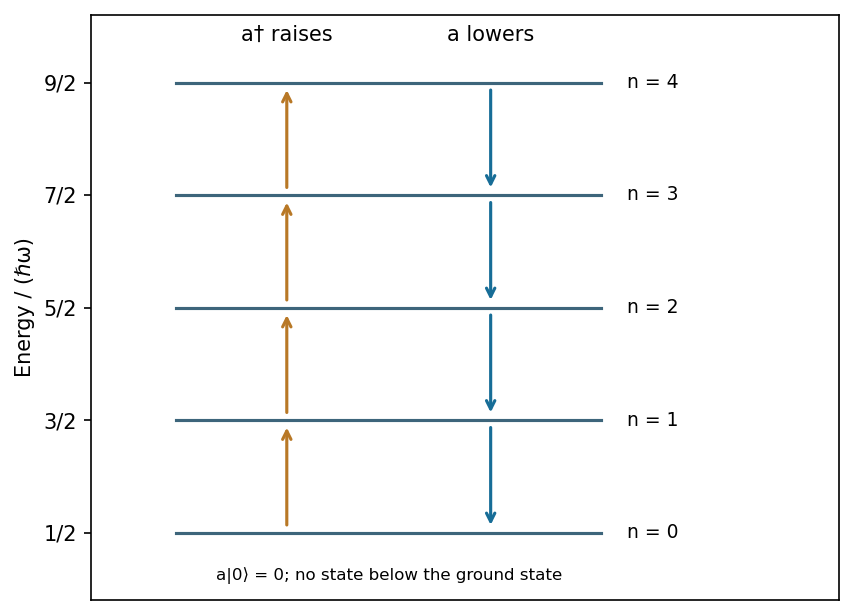
Creation and annihilation connect equally spaced oscillator levels while the ground-state lowering action vanishes
. Source. Details. 
Articles by others on the same topic
There are currently no matching articles.