The one-dimensional time-independent Schrödinger equation isHere is the particle mass, its potential energy, the stationary energy eigenvalue, and the reduced Planck constant. The spatial wavefunction is ; the full stationary state is . Physical bound states satisfy the boundary conditions and wavefunction normalization . The operator on the left is the Hamiltonian operator, the sum of kinetic and potential energies.
Assume and define so that the potential is that of a quantum harmonic oscillator. The two trial forms have derivativesSubstitution into the stationary Schrödinger equation cancels the terms precisely when . Normalizability selects the positive root,The remaining constants giveFor later overlaps choose positive normalization constants. The Gaussian integral gives , while its second-moment integral gives . Thus both wavefunctions have unit norm and are orthogonal by their opposite parity.
The real Gaussian is positive everywhere and has no nodes; the odd state has exactly one node at . The Sturm oscillation theorem orders one-dimensional bound states by their node count. Consequently these are the ground state and first excited state, respectively, also agreeing with the oscillator spectrum .
The infinite wall imposes , and the wavefunction vanishes for . The even full-oscillator ground state fails this boundary condition; the lowest admissible state is the positive-half restriction of the odd first excited state. Multiplying by restores normalization because half its probability originally lay on either side.
With , the half-harmonic oscillator ground state isIt rises from zero at the wall, reaches its wave-amplitude maximum at , and decays to zero as . It is positive throughout the interior of the allowed region, with no interior node, as required for its ground state. The wall need not make the derivative continuous with the forbidden half-line.
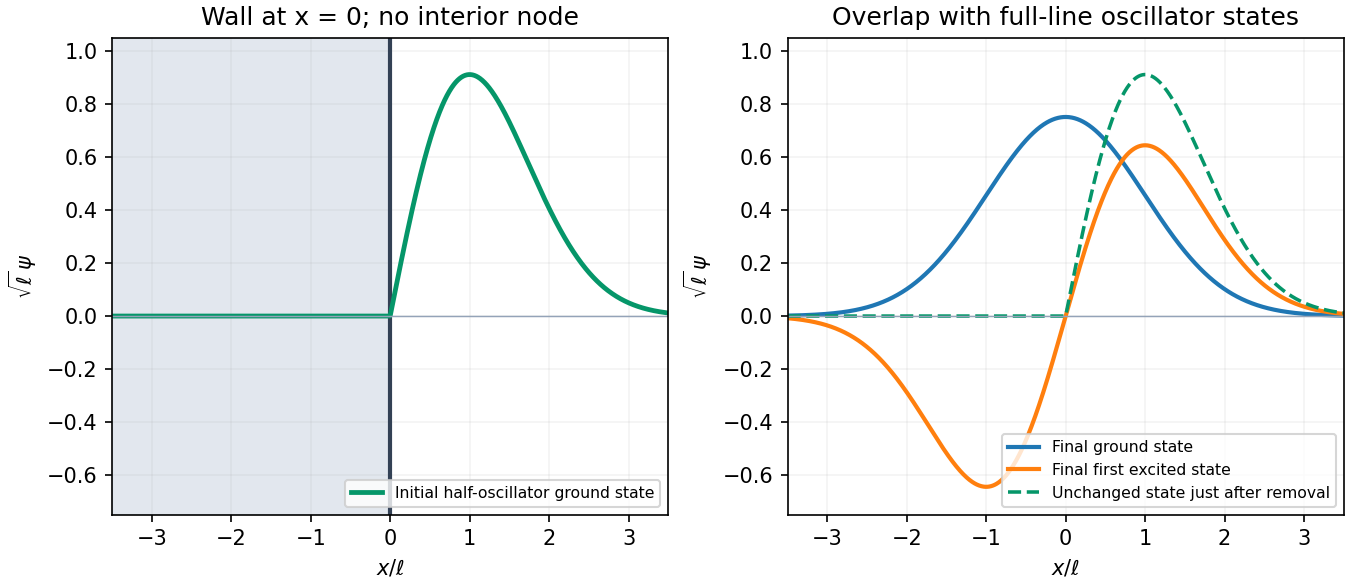

For removal of a half-oscillator wall, the sudden approximation keeps the state unchanged during the change of potential. Its probability in the new full-oscillator ground state is the squared overlap:where . ThereforeThe integral runs only over the initially occupied half-line. The initial state is not the odd full-line eigenstate: it is zero, rather than negative, on the left. Indeed its overlap with that final first excited state is , giving probability , and the remaining probability lies in higher states. Subsequent evolution under the new fixed Hamiltonian operator changes the quantum phases of its energy components without changing these energy-measurement probabilities.
Articles by others on the same topic
There are currently no matching articles.