For a reversible isothermal expansion of one mole of an ideal gas, internal energy depends only on temperature, so . The first law of thermodynamics givesThis uses quasistatic expansion against the gas pressure. Specifying only the initial and final volumes and constant temperature would not fix heat for an arbitrary irreversible process: an insulated ideal-gas free expansion has .
Take the wires along , with the first at carrying , and observe at . The Biot-Savart law gives a first-wire field in ; wire is away. ThereforePairing adjacent terms, with ,Thus . Its direction is opposite to the field of the first wire at the observation point. Reversing every electric current reverses this answer.
An empty perfectly conducting rectangular electromagnetic waveguide hasThe lowest transverse electric mode has indices or . A simply connected hollow metallic guide has no transverse electromagnetic mode. With , the two lowest modes are degenerate and their cutoff frequency isPropagation with nonzero axial energy transport requires ; the equality is the lower limiting frequency, with zero axial group velocity. A filling medium would replace by .
Suppose two distinct reversible adiabatic processes intersect at an equilibrium state . Choose an isothermal process that meets the two branches at distinct states and , forming a nonzero-area three-sided thermodynamic cycle. There is no heat exchange on or , so the only net heat comes from the one heat reservoir on . Since around a cycle, .
Choose the direction in which this nonzero cycle delivers positive work. It would then convert heat from a single reservoir entirely into work, violating the Kelvin-Planck statement of the second law. Distinct reversible adiabats cannot intersect. Equivalently, their constant entropy labels cannot differ at one equilibrium state. The argument concerns an ordinary equilibrium family of reversible adiabats, not arbitrary irreversible insulated paths. The usual local uniqueness of an equilibrium adiabat excludes coincident segments described as distinct curves.
The trihydrogen cation is a nonlinear three-nucleus molecule. Removing three translations and three rigid rotations leaves vibrational degrees of freedom. One normal mode is the symmetric in-plane breathing motion: every nucleus moves radially toward or away from the centre. The remaining two normal modes form a degenerate in-plane distortion pair, stretching one direction while compressing another.
For an explicit sketch, let be the equilibrium vertices relative to their centre. Displacements proportional togive the breathing mode and a basis of the degenerate pair. Linear combinations within the latter pair are equally valid. Their actual frequencies require molecular force constants, which are not supplied. An apparent out-of-plane motion of three point nuclei is a translation or infinitesimal rigid rotation, rather than an additional independent vibration.
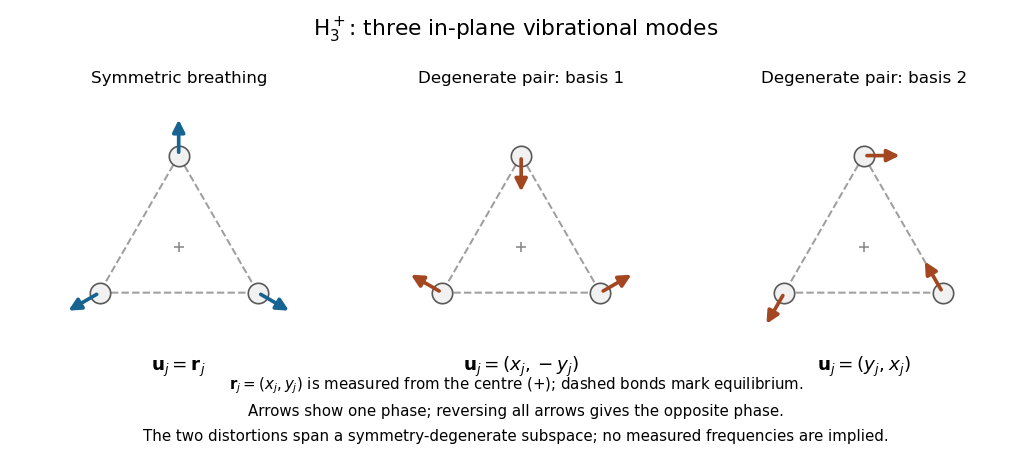
Breathing and degenerate distortion modes of an equilateral molecule
. Original displacement vectors in a simple symmetric bond-spring illustration. The degeneracy is fixed by symmetry; no measured molecular frequencies are asserted. Details.
Articles by others on the same topic
There are currently no matching articles.