Keep the problem's one-mole convention throughout. The excluded-volume parameter represents the loss of available translational volume due to short-range repulsion; it is an effective covolume, not simply the literal molecular material volume. The attraction parameter reduces the pressure below its purely repulsive value. In a mean-field picture, interaction energy is proportional to pair density, so the attractive free-energy contribution scales as for one mole and the pressure correction as . Equivalently, molecular cohesive forces and the number striking a wall each supply a density factor. These parameters approximate microscopic correlations rather than measuring every pair potential exactly.
At fixed temperature, . Substituting and integrating gives the isothermal free-energy change of a Van der Waals gasThe arbitrary temperature-only term cancels. The internal-energy derivative is insteadExpansion raises the attractive internal energy toward zero. As a check, the entropy change is , so . Constant and a homogeneous branch with are assumed. If a subcritical equilibrium path crosses coexistence, a Maxwell construction replaces the unstable homogeneous continuation; the displayed integral is the direct equation-of-state result, not a claim that such a continuation is physically stable.
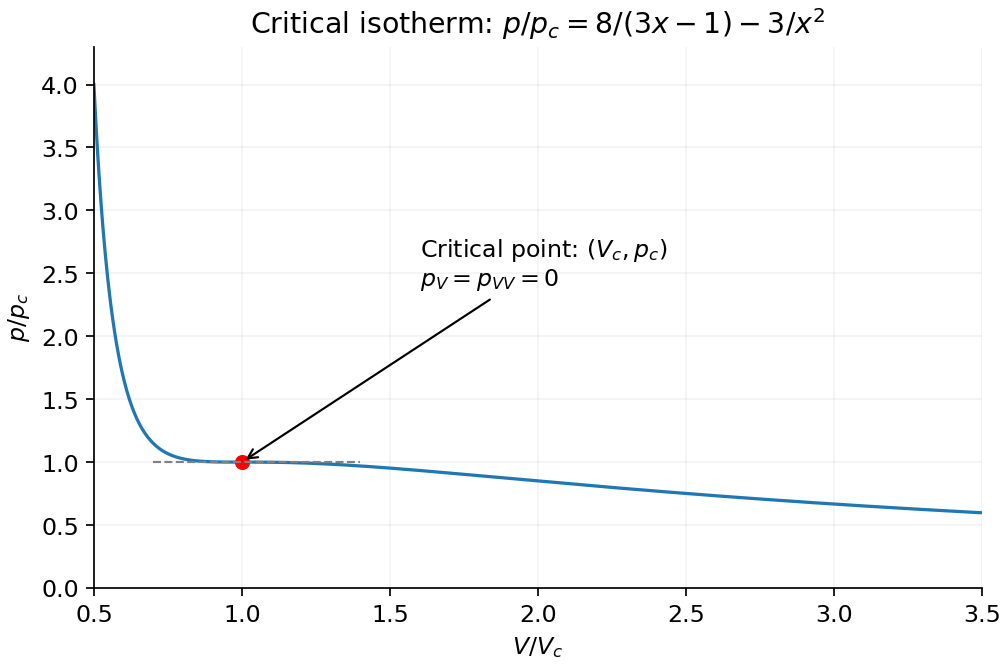
At the Van der Waals critical point, the critical isotherm has a stationary inflection:Equating the resulting expressions for gives , henceIn reduced variables , the critical curve is : it decreases through with zero first and second derivative, rather than having separate liquid/gas turning points at the critical temperature.

Articles by others on the same topic
There are currently no matching articles.