Use for the heat capacities of the entire -mole sample. For a stable simple compressible gas, a Maxwell relation giveswhere and . This heat-capacity difference and mechanical stability explains the sign without assuming the internal energy depends only on temperature. It is strictly positive for an ordinary expanding gas; the unrestricted word “always” needs the qualification that equality is possible when thermal expansion vanishes.
For an ideal gas, thermodynamic consistency givesConsequently , while . Differentiating gives : at fixed pressure extra supplied heat permits expansion work in addition to the internal-energy increase.
Differentiate the supplied entropy at fixed :Thus , consistently recovering , andThe coefficient in this entropy corresponds to five active quadratic thermal degrees of freedom per molecule. It should not be replaced by the monatomic value. Reference scales needed to make logarithms dimensionless are absorbed into the entropy constant and do not affect these derivatives.
With open windows the house equilibrates mechanically at approximately the same atmospheric pressure before and after heating. It is an open system: its mole number is not fixed. The isobaric ideal-gas internal-energy density isAt a fixed house volume, : fewer molecules occupy the house, each with greater mean energy. Heating energy can enter while enthalpy leaves with escaping air. Treating the room as a sealed fixed- gas would give the wrong energy-density comparison.
Keep the problem's one-mole convention throughout. The excluded-volume parameter represents the loss of available translational volume due to short-range repulsion; it is an effective covolume, not simply the literal molecular material volume. The attraction parameter reduces the pressure below its purely repulsive value. In a mean-field picture, interaction energy is proportional to pair density, so the attractive free-energy contribution scales as for one mole and the pressure correction as . Equivalently, molecular cohesive forces and the number striking a wall each supply a density factor. These parameters approximate microscopic correlations rather than measuring every pair potential exactly.
At fixed temperature, . Substituting and integrating gives the isothermal free-energy change of a Van der Waals gasThe arbitrary temperature-only term cancels. The internal-energy derivative is insteadExpansion raises the attractive internal energy toward zero. As a check, the entropy change is , so . Constant and a homogeneous branch with are assumed. If a subcritical equilibrium path crosses coexistence, a Maxwell construction replaces the unstable homogeneous continuation; the displayed integral is the direct equation-of-state result, not a claim that such a continuation is physically stable.
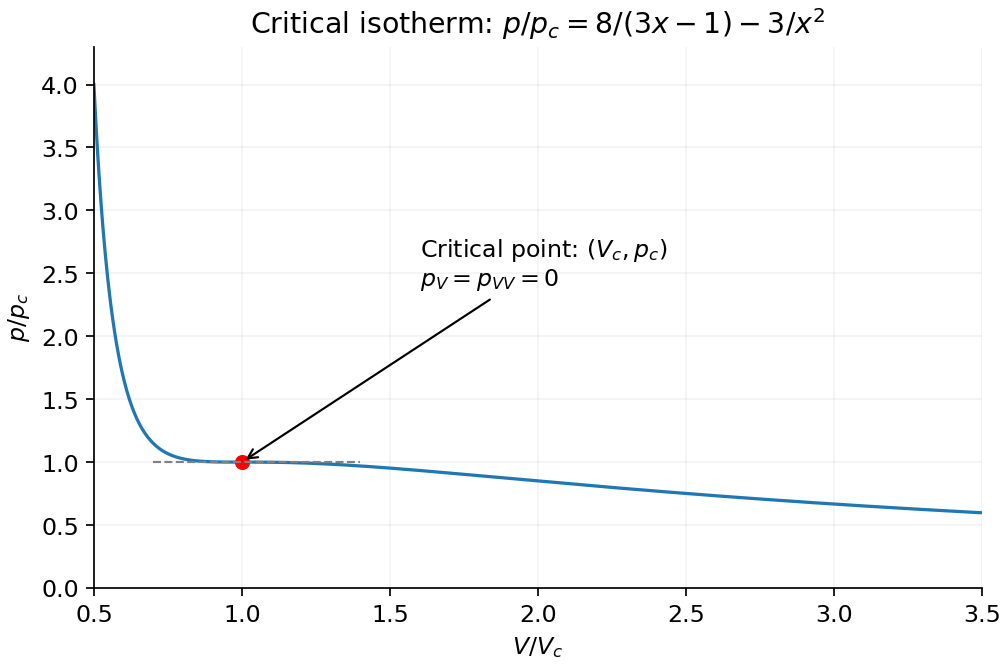
At the Van der Waals critical point, the critical isotherm has a stationary inflection:Equating the resulting expressions for gives , henceIn reduced variables , the critical curve is : it decreases through with zero first and second derivative, rather than having separate liquid/gas turning points at the critical temperature.

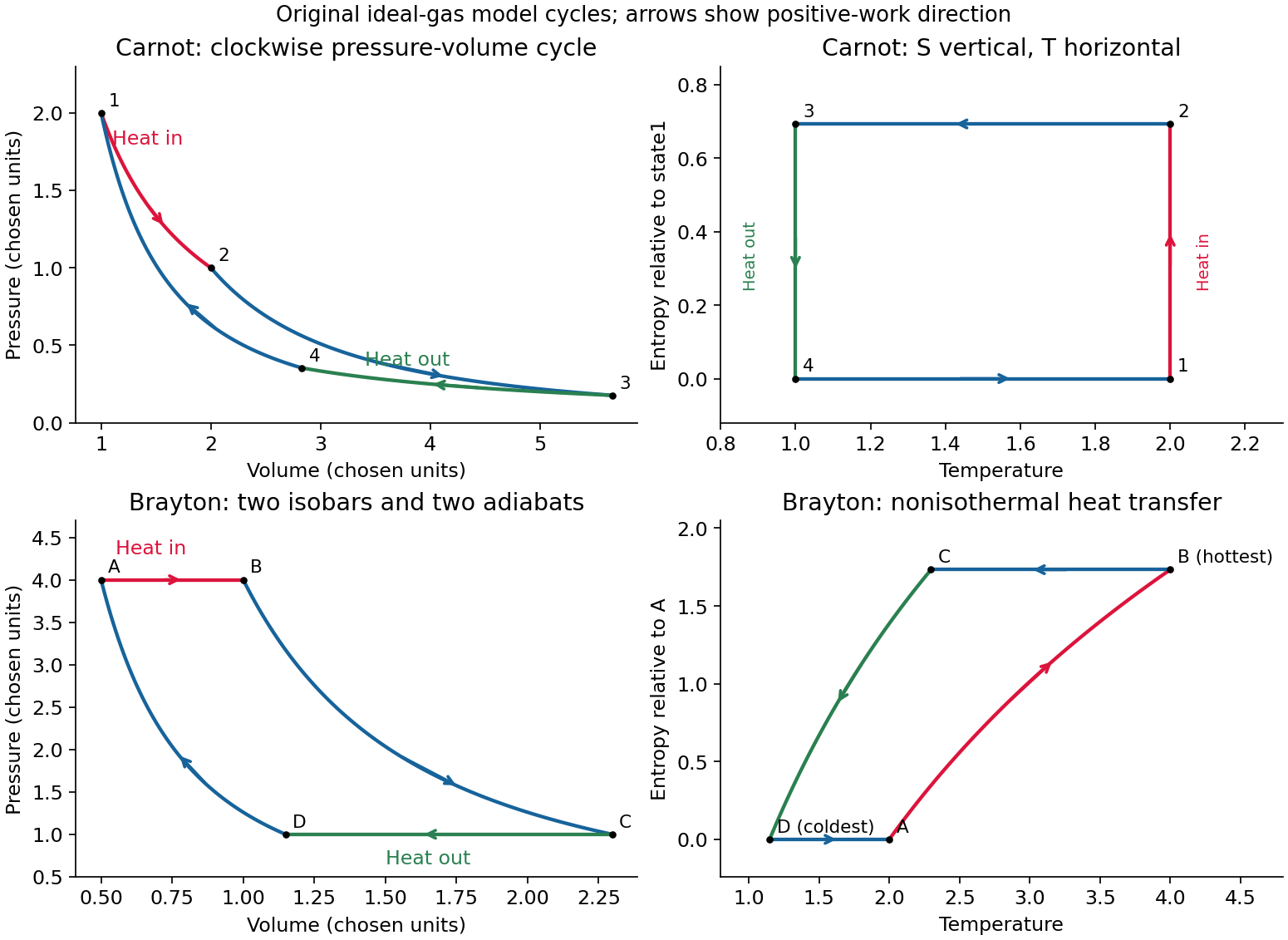
In the Carnot cycle, let be reversible isothermal expansion at , reversible adiabatic expansion, isothermal compression at , and adiabatic compression. The pressure–volume curve is clockwise. The entropy–temperature figure below uses temperature on the horizontal axis and entropy on the vertical axis, literally an – plot: isotherms are vertical and adiabats horizontal. The hot isotherm increases entropy by and absorbs ; the cold one rejects . Thus and .
For the second engine, choose the working direction with heat addition during at and rejection during at . A reversible ideal-gas adiabat obeys . DefineThe two constant-pressure heat transfers are and , where rejected heat is quoted positive. Therefore the Brayton cycle efficiency isfor . All heat-capacity amount conventions cancel in the ratio.
Since and , , the maximum is at B and the minimum at D. The Brayton-Carnot efficiency comparison isThe inequality is strict for a nondegenerate cycle with positive heat input. Although each process can be reversible, the isobaric heat transfer spans a range of temperatures; making the whole cycle reversible requires a succession of matched-temperature reservoirs, rather than just the hottest and coldest reservoirs.
For an ideal diatomic gas with active rotation and frozen vibration, andHere . This comparison holds at the same pressure ratio and assumes temperature-independent heat capacities in the stated mode regime. Frozen rotation or excited vibration would require their actual heat capacities.
Carnot and Brayton cycles
. Details. 
A microstate specifies the microscopic state: classically the positions and momenta of all particles, or quantum mechanically an allowed many-body state. A macrostate specifies a few coarse variables such as energy, volume and particle number. Many microstates can give the same macrostate. A statistical ensemble is a probability assignment over hypothetical copies prepared with the same macroscopic constraints; it does not require a sample to be literally divided into many physical copies. An observable's ensemble mean is , with an integral replacing the sum in classical phase space.
For an isolated system at fixed , the microcanonical ensemble assigns equal probability to accessible microstates in a narrow energy shell. If their number is , the Boltzmann entropy is . Thermal contact between two initially isolated systems allows energy to be shared while their sum stays fixed. The most probable division maximizes , so equilibrium requires equal . This gives the statistical temperature definitionFor positive temperature, energy tends to flow from lower entropy slope to higher entropy slope until those slopes agree. The narrow energy-shell width represents macroscopic resolution; it must not exclude the physically accessible states.
For a small subsystem exchanging energy with a much larger bath, the bath has energy when subsystem microstate has energy . Expanding its entropy gives . Counting compatible bath states therefore yields the Boltzmann distribution and canonical ensemble:The exponential weights individual microstates. An energy level of degeneracy has total probability ; a more degenerate excited level can outweigh one ground-state level even though each of its microstates is less probable. The Gibbs entropy gives . The equilibrium energy variance is , linking measurable fluctuations to a macroscopic response.
If particle exchange is also allowed, a reservoir fixes and chemical potential . The grand canonical ensemble weights a state by , with . Mean particle number is , while volume remains a constraint in this version. Thus the ensemble follows the physical exchange conditions: fixed energy, thermal contact, or thermal and particle contact.
In ordinary large short-range systems, relative fluctuations often decrease as and the ensembles give the same bulk thermodynamics away from singular limits. Finite systems, critical fluctuations and long-range interactions require care. Interpreting a time average as an ensemble average additionally requires appropriate sampling or mixing dynamics; it is not guaranteed solely by naming an ensemble. thermal equilibrium probability assignments do not describe every driven or relaxing state.
Articles by others on the same topic
There are currently no matching articles.