Apply Faraday's law to a shrinking rectangular loop crossing the interface. For bounded fields the magnetic-flux term vanishes with its area, giving . A shrinking Gaussian pillbox similarly gives . Thus normal is continuous when no free surface charge is present, even though a bound polarization charge may remain. These are the assumptions needed for the stated dielectric-interface boundary conditions.
Write , and . Use each region's own permittivity in its Coulomb potential:At , continuity of potential and normal displacement givesSolving,This permittivity convention for transmitted image charges matters: if the vacuum Coulomb prefactor is used even for , its combined effective source is instead. The physical potential is the same. The two numbered leaves identify how these sources satisfy the equations in their respective regions.
The real charge feels only the image contribution after removing its own singular self-field. The image at is separated from it by , soFor the bound charge, the outward normal of the dielectric is and . Differentiating at gives . ThereforeIts integral over the plane is , consistent with the external image representation. For both the image force and induced surface charge vanish.
For the dielectric half-space the two formal sources coincide at , outside the region being represented. Their sum is in the dielectric Coulomb kernel, henceThere is no charge singularity inside this half-space. The expression satisfies Laplace's equation there, decays at infinity, and matches the vacuum solution's tangential electric field and normal electric displacement. The coincident image is a mathematical representation, not an extra physical charge in the vacuum region.
For the vacuum half-space keep the actual charge at and put its image at the reflected point . ThenThe reflected singularity lies outside this region. The real singularity has the correct charge strength, and the interface coefficients obey the two matching equations in the parent Solution at every . With decay at infinity, uniqueness of an electrostatic dielectric boundary-value problem establishes the construction throughout both half-spaces.
Self-inductance relates current to its own magnetic flux linkage: , so the induced electromotive force is for fixed geometry. A long solenoid has and area . Its turns giveThe homopolar generator uses a disc rotating through this axial field; integrate the motional Lorentz force from shaft to rim:For a homopolar disc dynamo, choose the wiring and rotation sense giving positive magnetic feedback. Kirchhoff's voltage law isfor prescribed constant . ThusA nonzero seed grows when , decays when , and is marginal at equality. This explains the printed as the threshold including its boundary; equality does not itself give exponential growth. An exactly zero initial current remains zero in the ideal homogeneous equation, and reversing the feedback sense prevents the instability.
In the torque-controlled homopolar dynamo equilibrium, a radial current element exerts a braking torque , so . For steady rotation and nonzero steady current, and . Hence the field intensity magnitude isThe two current signs give opposite magnetic polarities. Finally,The steady magnetic and rotational energies do not change. This is a steady-state balance, not an assertion that every dynamical trajectory must approach that state.
Insert and into the given identity. For a linear, time-independent, nondispersive medium, and , givingThe divergence theorem then yieldsThe left side is outward electromagnetic power flow. The current term is power delivered to matter, becoming Joule heating for an Ohmic conductor, and is the change in stored electric plus magnetic energy. The minus sign says outward flux reduces stored energy unless supplied locally.
Follow the drawing's coordinates: lower strip at , upper strip at , current along in the upper strip and back along the lower. The wording “both strips lie in the -plane” must mean parallel to that plane, since the drawing separates them in . Neglect the side and end fringes using . Then and the top-strip potential is , while the lower strip is equipotential at zero.
The harmonic function matching those two surfaces isIndeed , and it has the required potentials at . ThusThe two current sheets reinforce their magnetic field between the strips; its direction follows the right-hand rule. The Poynting flow in resistive parallel strips follows from their cross product:Power flows along the gap towards the load and upwards into the resistive strip. Across a transverse area , falls from to . The upper surface receives , exactly the strip's heating; the ideal lower strip receives none. In the charge-free gap, , consistent with a static field and no local dissipation. The small longitudinal electric field cannot be discarded if this upward energy transfer is to be represented.
In a homogeneous, source-free, nonmagnetic dielectric the electric wave equation isSet and . Substitution gives . For the labelled field form (a), , so . For form (b), with , so . These give the two stated inequalities, with equality a zero-transverse-wavenumber limiting case.
Faraday's law gives the associated wave magnetic field, without an added static field,Thus in case (a), and . In case (b), and . In both cases .
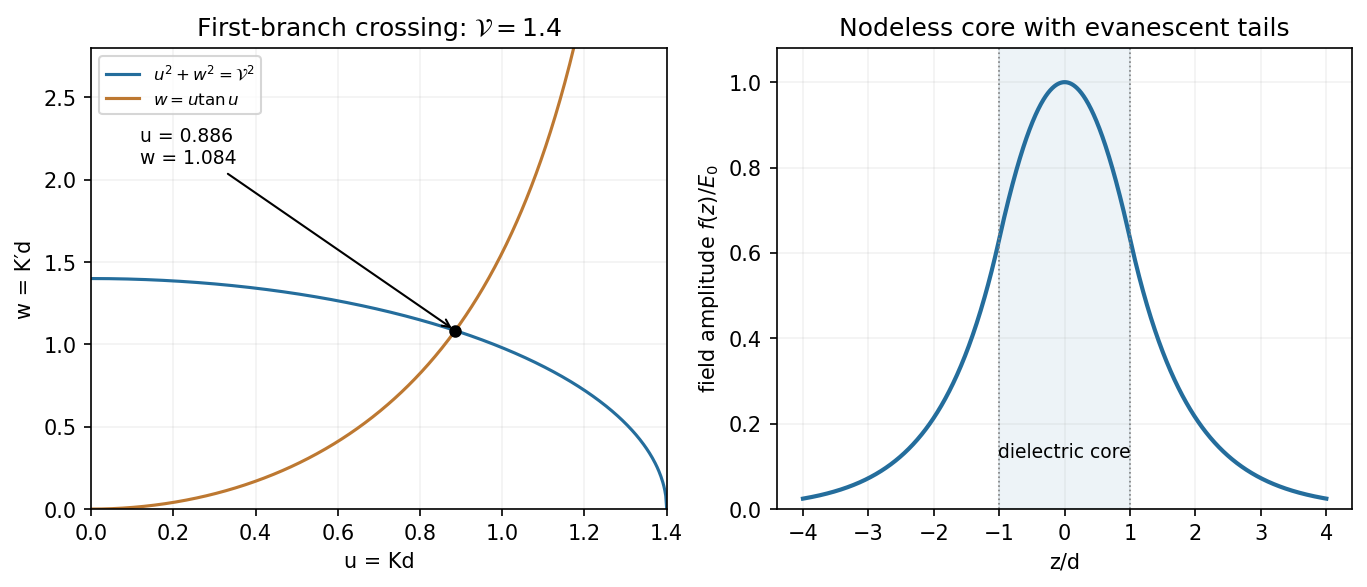
For the planar dielectric waveguide the core is dielectric but the exterior is vacuum. Consequently the exterior decay constant has , while the interior oscillation has . Adding gives the relation labelled (c):For an even bound mode the complete profile can be writtenContinuity of tangential fixes the exterior amplitude; continuity of tangential makes continuous because both media have magnetic permeability . At ,which is the relation labelled (d). The same even profile also matches at ; continuity of follows from that of .
In the requested plot, (c) is a first-quadrant circle and (d) rises from the origin to its first pole at . Equivalently put , , and . At the circle has whereas . At the other end of , the rising tangent curve exceeds the falling circle. Monotonicity therefore gives one intersection on this first branch for every .
The fundamental even mode of a symmetric dielectric slab has no positive cutoff in index contrast or thickness. Its electric profile is a nodeless cosine maximum at the mid-plane, smoothly joined to decaying exterior tails. The qualifier is essential: for the printed limiting value , the circle collapses to and there is no transversely confined bound mode. A uniform unconstrained wave is not a guided mode. This even-mode argument does not assert that the specified cosine describes every possible odd guide mode.

Articles by others on the same topic
There are currently no matching articles.