Original examination: Physical PDF pages 283–291; Physics B Paper 2, 8 June 2011. All questions and both field forms in B9 are covered. Approximations not fixed by the wording are stated explicitly.
For the entropy balance of a thermostatted resistor, electrical work becomes heat . At fixed temperature the resistor has no net change of thermodynamic state; it exports this heat to its thermostat. Treating the electrical supply as a source of work,Entropy is produced by Joule heating even though it does not accumulate in the resistor. Additional entropy production inside a nonideal power supply is outside the specified model.
For a uniformly magnetized ring with a narrow gap, take the local direction of magnetization as positive around the magnetic circuit. Neglect leakage and fringing in the narrow gap, and take the cross section as uniform. Continuity of magnetic flux gives . With no free current, Ampère's law gives . HenceThe rod's field is a demagnetizing field opposite its magnetization; its magnitude is . The gap field points with the magnetization and .
Put the positive plate at and the negative plate at . Reflection through , combined with reversal of the two plate charges, makes the tangential fields cancel at every point of the mid-plane. Thus at the corner as well as inside the capacitor.
For the uniform-charge estimate at a capacitor corner, assemble four identical square pairs around their common corner. Their normal fields there are equal by rotation symmetry and add to the central field of the larger plate pair. With the bulk parallel-plate relation , the conventional corner estimate isThis quarter-field result uses prescribed uniform surface charge, not symmetry alone for finite equipotential conductors. Real conducting plates redistribute charge near their edges; justifies the bulk relation away from the edges but does not remove the local corner fringe. For that exact conductor problem only the zero tangential components follow from the stated reflection symmetry; its normal coefficient requires a fringing-field boundary-value solution. The standard parallel-plate formula explicitly neglects edge effects.[ref]
University Physics Volume 2 by Samuel J. Ling and others. Section 8.1, parallel-plate field and the approximation of negligible edge effects
For a monatomic ideal gas, . If the expansion is reversible adiabatic, is constant, soAdiabatic isolation alone does not imply this temperature law. For example, free expansion into vacuum has , so an ideal gas remains at . Thus is the usual intended answer with the additional isentropic assumption; the literal adjective “adiabatic” does not uniquely select it.[ref]
Thermodynamics and Statistical Mechanics by Richard Fitzpatrick. “Isothermal and Adiabatic Expansion”, Eqs. (6.53) and (6.61); “Free Expansion of Gas”, Eqs. (6.144)–(6.148)
Choose normal to the sheet and along the in-plane projection of the rotation axis. A uniform square has and . Since , the two nonzero angular-momentum components are and . ThereforeAngular momentum is not parallel to the prescribed rotation axis. Multiplying the moment of inertia about that axis by would give the projection of angular momentum on the axis, not its magnitude.
Apply Faraday's law to a shrinking rectangular loop crossing the interface. For bounded fields the magnetic-flux term vanishes with its area, giving . A shrinking Gaussian pillbox similarly gives . Thus normal is continuous when no free surface charge is present, even though a bound polarization charge may remain. These are the assumptions needed for the stated dielectric-interface boundary conditions.
Write , and . Use each region's own permittivity in its Coulomb potential:At , continuity of potential and normal displacement givesSolving,This permittivity convention for transmitted image charges matters: if the vacuum Coulomb prefactor is used even for , its combined effective source is instead. The physical potential is the same. The two numbered leaves identify how these sources satisfy the equations in their respective regions.
The real charge feels only the image contribution after removing its own singular self-field. The image at is separated from it by , soFor the bound charge, the outward normal of the dielectric is and . Differentiating at gives . ThereforeIts integral over the plane is , consistent with the external image representation. For both the image force and induced surface charge vanish.
For the dielectric half-space the two formal sources coincide at , outside the region being represented. Their sum is in the dielectric Coulomb kernel, henceThere is no charge singularity inside this half-space. The expression satisfies Laplace's equation there, decays at infinity, and matches the vacuum solution's tangential electric field and normal electric displacement. The coincident image is a mathematical representation, not an extra physical charge in the vacuum region.
For the vacuum half-space keep the actual charge at and put its image at the reflected point . ThenThe reflected singularity lies outside this region. The real singularity has the correct charge strength, and the interface coefficients obey the two matching equations in the parent Solution at every . With decay at infinity, uniqueness of an electrostatic dielectric boundary-value problem establishes the construction throughout both half-spaces.
Self-inductance relates current to its own magnetic flux linkage: , so the induced electromotive force is for fixed geometry. A long solenoid has and area . Its turns giveThe homopolar generator uses a disc rotating through this axial field; integrate the motional Lorentz force from shaft to rim:For a homopolar disc dynamo, choose the wiring and rotation sense giving positive magnetic feedback. Kirchhoff's voltage law isfor prescribed constant . ThusA nonzero seed grows when , decays when , and is marginal at equality. This explains the printed as the threshold including its boundary; equality does not itself give exponential growth. An exactly zero initial current remains zero in the ideal homogeneous equation, and reversing the feedback sense prevents the instability.
In the torque-controlled homopolar dynamo equilibrium, a radial current element exerts a braking torque , so . For steady rotation and nonzero steady current, and . Hence the field intensity magnitude isThe two current signs give opposite magnetic polarities. Finally,The steady magnetic and rotational energies do not change. This is a steady-state balance, not an assertion that every dynamical trajectory must approach that state.
Insert and into the given identity. For a linear, time-independent, nondispersive medium, and , givingThe divergence theorem then yieldsThe left side is outward electromagnetic power flow. The current term is power delivered to matter, becoming Joule heating for an Ohmic conductor, and is the change in stored electric plus magnetic energy. The minus sign says outward flux reduces stored energy unless supplied locally.
Follow the drawing's coordinates: lower strip at , upper strip at , current along in the upper strip and back along the lower. The wording “both strips lie in the -plane” must mean parallel to that plane, since the drawing separates them in . Neglect the side and end fringes using . Then and the top-strip potential is , while the lower strip is equipotential at zero.
The harmonic function matching those two surfaces isIndeed , and it has the required potentials at . ThusThe two current sheets reinforce their magnetic field between the strips; its direction follows the right-hand rule. The Poynting flow in resistive parallel strips follows from their cross product:Power flows along the gap towards the load and upwards into the resistive strip. Across a transverse area , falls from to . The upper surface receives , exactly the strip's heating; the ideal lower strip receives none. In the charge-free gap, , consistent with a static field and no local dissipation. The small longitudinal electric field cannot be discarded if this upward energy transfer is to be represented.
In a homogeneous, source-free, nonmagnetic dielectric the electric wave equation isSet and . Substitution gives . For the labelled field form (a), , so . For form (b), with , so . These give the two stated inequalities, with equality a zero-transverse-wavenumber limiting case.
Faraday's law gives the associated wave magnetic field, without an added static field,Thus in case (a), and . In case (b), and . In both cases .
For the planar dielectric waveguide the core is dielectric but the exterior is vacuum. Consequently the exterior decay constant has , while the interior oscillation has . Adding gives the relation labelled (c):For an even bound mode the complete profile can be writtenContinuity of tangential fixes the exterior amplitude; continuity of tangential makes continuous because both media have magnetic permeability . At ,which is the relation labelled (d). The same even profile also matches at ; continuity of follows from that of .
In the requested plot, (c) is a first-quadrant circle and (d) rises from the origin to its first pole at . Equivalently put , , and . At the circle has whereas . At the other end of , the rising tangent curve exceeds the falling circle. Monotonicity therefore gives one intersection on this first branch for every .
The fundamental even mode of a symmetric dielectric slab has no positive cutoff in index contrast or thickness. Its electric profile is a nodeless cosine maximum at the mid-plane, smoothly joined to decaying exterior tails. The qualifier is essential: for the printed limiting value , the circle collapses to and there is no transversely confined bound mode. A uniform unconstrained wave is not a guided mode. This even-mode argument does not assert that the specified cosine describes every possible odd guide mode.
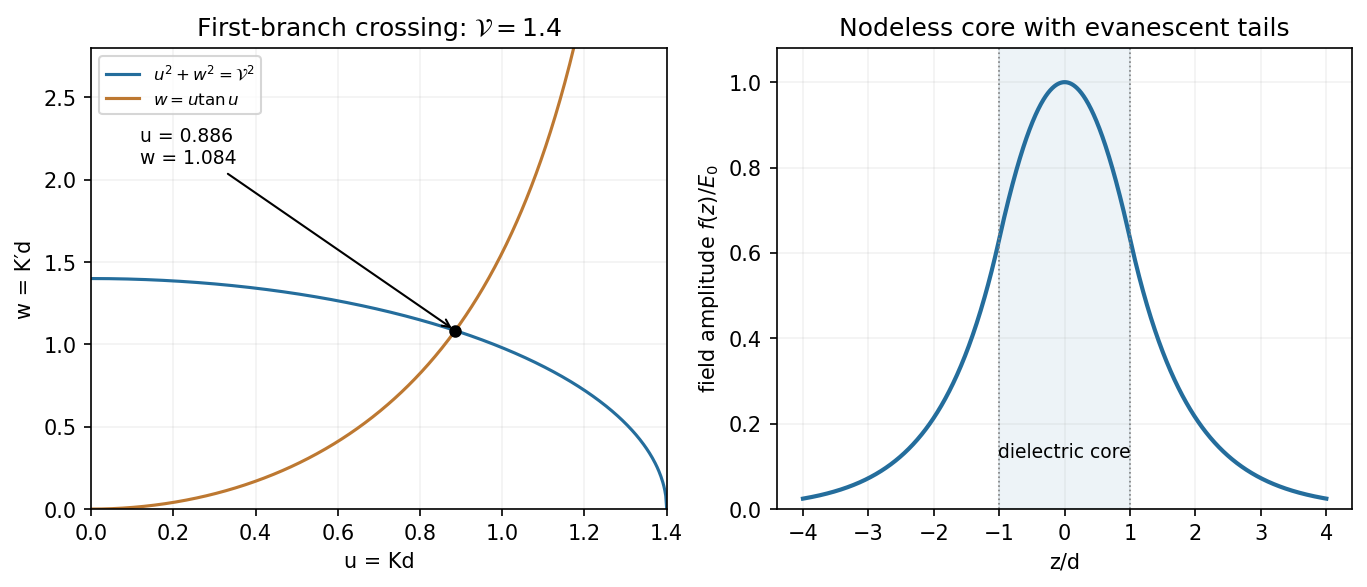
The original diagram uses the illustrative normalized radius ; it is a scaled plot with , followed by the corresponding field profile.
Relative to an origin, the inertia tensor is , with . Its orthogonal eigenvectors are principal axes, with eigenvalues the principal moments of inertia. Different components of are multiplied by different eigenvalues, so angular momentum need not point along angular velocity.
For a uniform thin disc, radial integration gives . The perpendicular axis theorem and symmetry then give , henceFor the elastic eccentric impact of a thin disc, neglect gravity's impulse and take the pole's impulse as vertical. Let point up and let the contact position relative to the centre be . An upward impulse givesFor an elastic impact with a fixed pole, the contact point reverses its normal velocity, so . ThereforeHere denotes upward motion; the centre can still move down if . Substitution givesThis also follows by combining conserved angular momentum about the fixed contact with conserved kinetic energy and selecting the separating, nonzero-impulse solution. At the disc simply rebounds without rotation; at its centre is instantaneously stationary. The rebound result concerns the contacting material point immediately after this ideal impact, not its subsequent contact history.
Let denote distance from the neutral axis within a cross section. Bending to radius gives longitudinal strain , so Hooke's law gives stress . Its moment isHere is Young's modulus and is the second moment of area, not a mass moment of inertia. For the stated square orientation, .
For self-weight deflection of a square cantilever, the downward load per unit length is . A free-end segment from to has shear-force magnitude and bending-moment magnitude . Thus, with the given sign conventions,Using the small-slope curvature for downward deflection,The clamp fixes position and slope, and the unloaded free end has zero moment and shear:Four integrations yieldThe linear beam model requires small slopes and strains; the strong dependence eventually invalidates that approximation if other dimensions and material properties are fixed.
Write and . For a circular orbit of radius , centripetal balance gives . Thus and . Since , , these agree with the general expressions.
For an outward coplanar Hohmann transfer, burn prograde at the inner circle to put its radius at the ellipse's pericentre, then burn prograde at apocentre to circularize at the station's radius. The station must be phased to meet the spacecraft there. With , ,Energy at the first burn, with , givesAngular momentum is conserved along the transfer ellipse, so , while the outer circular speed is . For ,The correct second impulse adds . The reversed circularization burn in a Hohmann transfer, using the same impulse magnitude, instead leavesIts magnitude is below the circular speed at , so that point is the new apocentre. Define . For an ellipse at apocentre, , givingThe lunar radius is . Since , the osculating orbit intersects the Moon: the spacecraft crashes before reaching its formal pericentre. The calculation uses impulsive tangential burns and a spherical central gravitational field; it does not assume that a trajectory continues through the solid body.
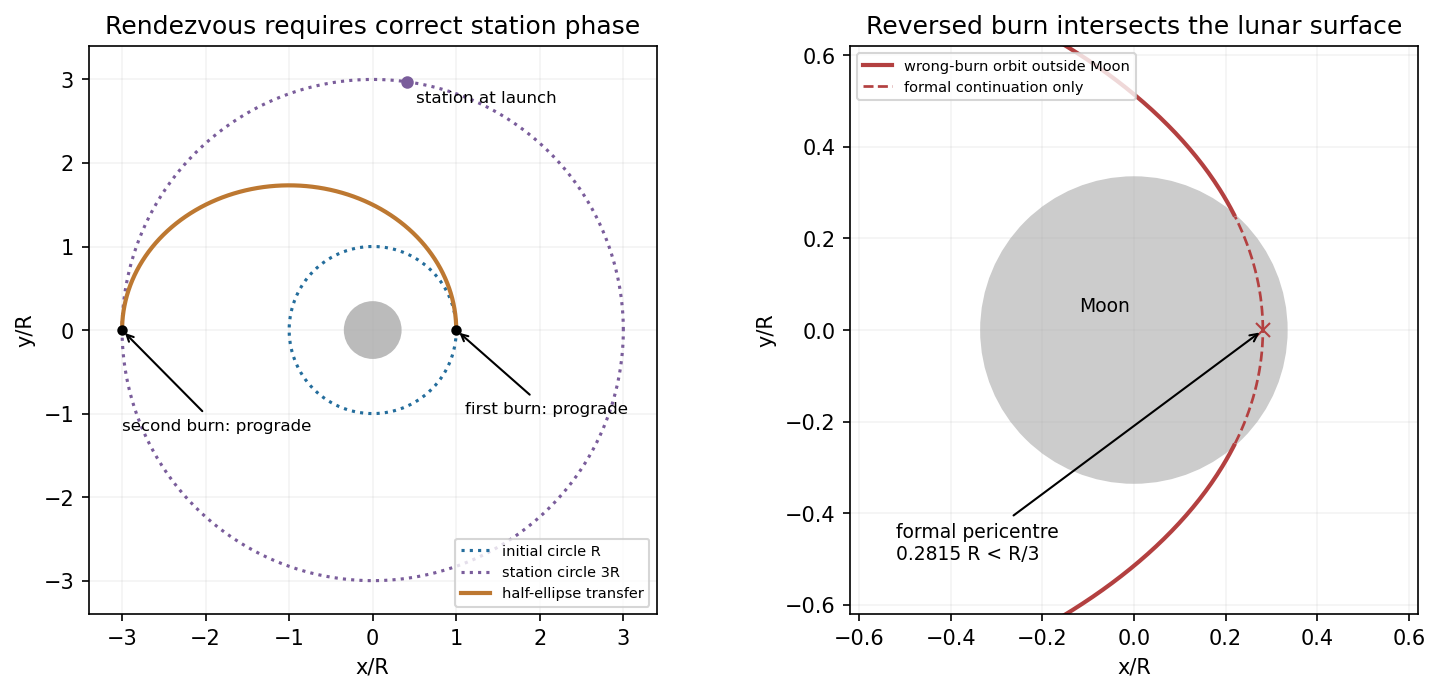
The original plot uses as the length unit and as the lunar radius. The initial station position shown is phased for rendezvous: its initial angular lead is , modulo .
A normal mode is a small-oscillation motion with every coordinate proportional to one common sinusoid, at a fixed amplitude ratio and relative phase. Expanding an arbitrary small motion in normal mode coordinates decouples its linear equations into independent oscillators. With mechanical mass matrix and mechanical stiffness matrix , the generalized eigenvalue equation is .
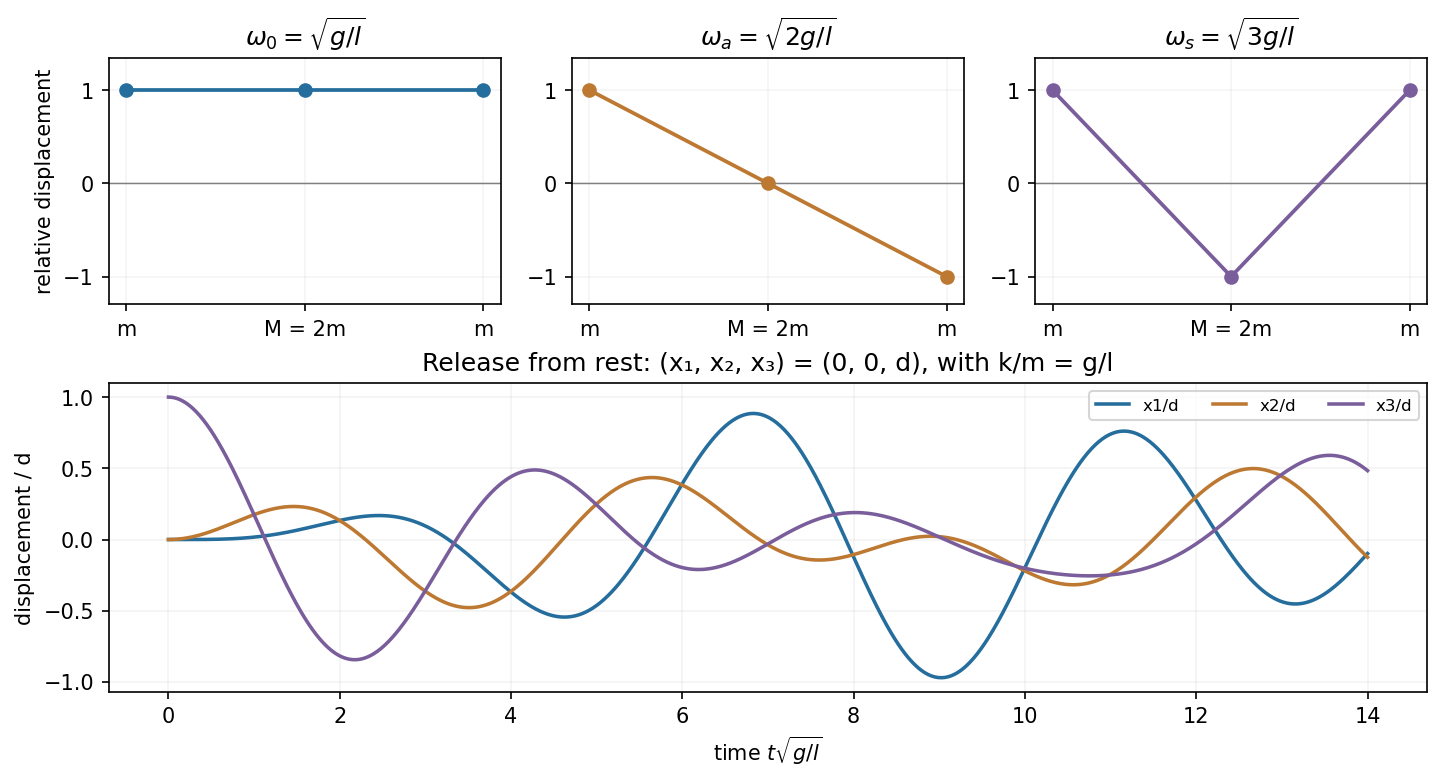
Horizontal gravitational restoring force on each bob is . The two springs add on the first bob, on the middle bob, and on the last. Dividing by the bob masses gives the stated equations withReflection symmetry separates an antisymmetric end motion from two symmetric motions. The three coupled pendulums with equal end masses have independent modesCall their positive frequencies respectively. The middle amplitude in the last mode ensures . The modes are orthogonal in the mass-weighted inner product, rather than generally in the unweighted coordinate dot product.
The initially stationary displacement decomposes asThere are no sine terms because every initial velocity is zero. ThereforeThese give at and solve all three coupled equations. The spring constant is assumed positive; for the frequencies become degenerate and the same superposition reduces to uncoupled pendulum motion.


Articles by others on the same topic
There are currently no matching articles.