For an attractive inverse-square force, write with , and take nonzero conserved angular momentum . The conic section orbit hasThe physically allowed cases are ellipse for , parabola for , and hyperbola for . The minimum allowed energy gives the circular special case . Here is measured relative to infinity. Zero angular momentum instead gives radial collision or escape trajectories, interpreted as degenerate limits rather than regular closed ellipses.
For a repulsive inverse-square force, . The effective potential is positive and decreases from infinity to zero, so a trajectory reaching a finite radius has . For nonzero angular momentum, it is the accessible branch of a hyperbola, with . There are no bound ellipses or finite-distance zero-energy parabolas. At zero angular momentum, the motion is straight inward followed by straight outward after reflection at a radial turning point.
For the scattering calculation, take the heavy target as fixed and define . The incoming kinetic energy and angular momentum are and . In the original sketch, the horizontal dashed incoming asymptote has perpendicular distance from the nucleus, while is the radius from the nucleus to the point where .
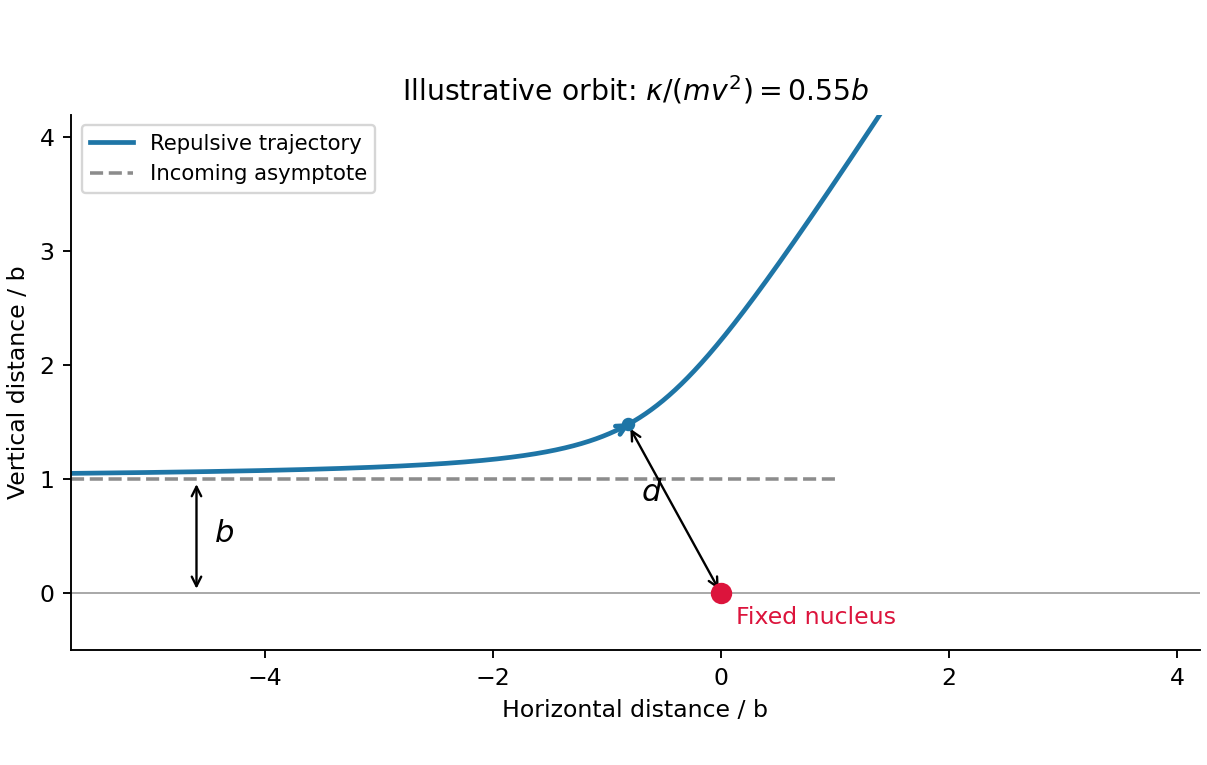

At closest approach, the velocity is tangential and . conservation of energy givesChoose the positive root and put :Head-on incidence gives , and repulsion always gives . With an attractive Coulomb force, change the sign of the potential term:For , the attractive and repulsive inverse-square closest approaches obey . For attraction causes a collision with the point centre, so is a singular endpoint, not a regular scattering turning point. Finite nuclear size is excluded by the stated point-force model.
For the repulsive inverse-cube central force , the torque vanishes, , and angular momentum is still conserved. Its potential energy is , since . ThusThe new coefficient is denoted because its units are , unlike the units of the inverse-square coefficient. Conserving angular momentum depends on centrality, not on a particular radial power law.
Articles by others on the same topic
There are currently no matching articles.