A normal mode is a motion in which all displacement coordinates oscillate at one angular frequency with fixed amplitude ratios. For small conservative oscillations, the symmetric stiffness and mass matrices give the generalized eigenvalue problem for small oscillations, . For positive mass and a stable equilibrium, its mass-orthogonal eigenvectors span the motion. A superposition of these modes, with phases and amplitudes fixed by initial displacements and velocities, gives the general solution; different modes need not share a phase.
Use upward end displacements. The spring compressions are and , while the beam's centre rises by . The potential energy isStatic force balance gives , cancelling the linear terms and leavingFor a uniform beam, its central moment of inertia in the vertical plane is . To first order in the tilt, . Its translational and rotational kinetic energies areThus and . The normal modes of a rigid beam on two end springs have eigenvectorsThe first translates without tilt; the second rocks about a stationary centre. Ordinary frequencies are and .
Assume the system had settled before the end load leaves, and put that load at end 1. Its extra static spring load is at that end and zero at the other. Therefore , , and both initial velocities vanish because no impulse is imparted. Decomposing into the two normal modes givesOnly the symmetric mode contributes to the centre position:The datum is the unloaded beam's equilibrium height; no absolute height is supplied. The rocking mode is present even though it cancels out of this coordinate. These results use small tilt, , ideal light vertical springs and negligible damping.
For an attractive inverse-square force, write with , and take nonzero conserved angular momentum . The conic section orbit hasThe physically allowed cases are ellipse for , parabola for , and hyperbola for . The minimum allowed energy gives the circular special case . Here is measured relative to infinity. Zero angular momentum instead gives radial collision or escape trajectories, interpreted as degenerate limits rather than regular closed ellipses.
For a repulsive inverse-square force, . The effective potential is positive and decreases from infinity to zero, so a trajectory reaching a finite radius has . For nonzero angular momentum, it is the accessible branch of a hyperbola, with . There are no bound ellipses or finite-distance zero-energy parabolas. At zero angular momentum, the motion is straight inward followed by straight outward after reflection at a radial turning point.
For the scattering calculation, take the heavy target as fixed and define . The incoming kinetic energy and angular momentum are and . In the original sketch, the horizontal dashed incoming asymptote has perpendicular distance from the nucleus, while is the radius from the nucleus to the point where .
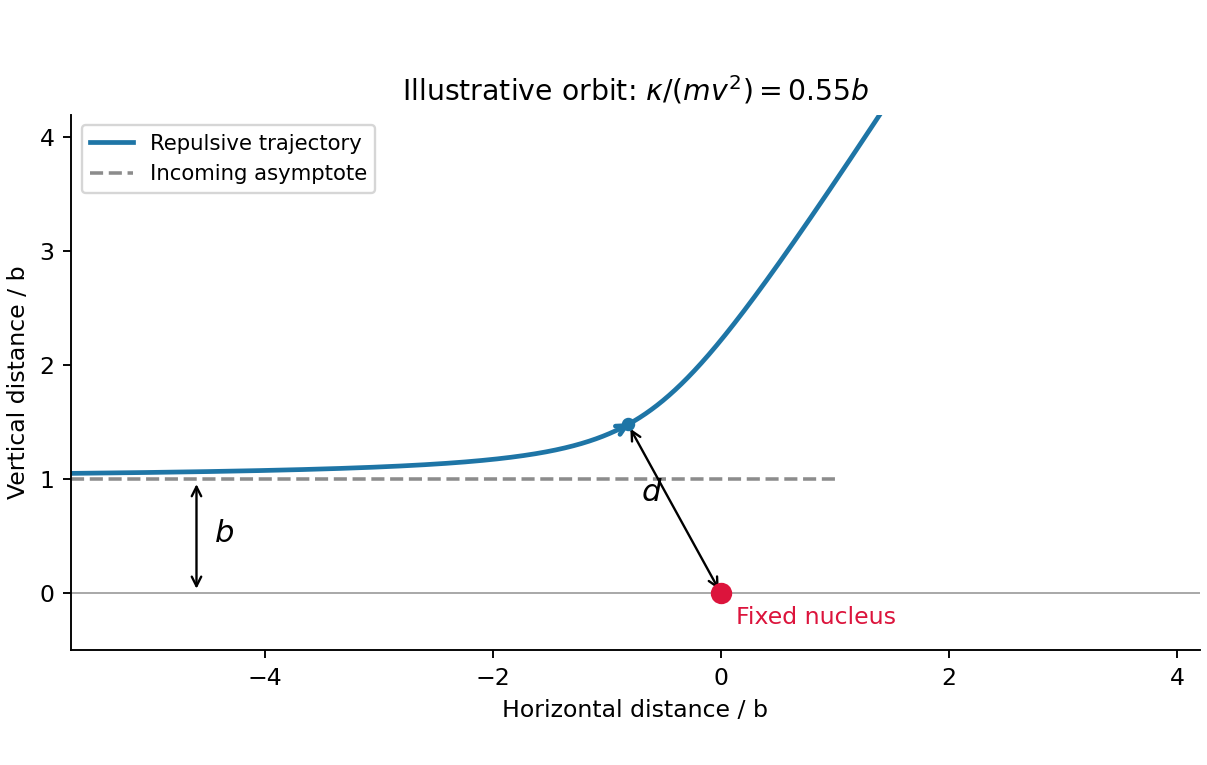
At closest approach, the velocity is tangential and . conservation of energy givesChoose the positive root and put :Head-on incidence gives , and repulsion always gives . With an attractive Coulomb force, change the sign of the potential term:For , the attractive and repulsive inverse-square closest approaches obey . For attraction causes a collision with the point centre, so is a singular endpoint, not a regular scattering turning point. Finite nuclear size is excluded by the stated point-force model.
For the repulsive inverse-cube central force , the torque vanishes, , and angular momentum is still conserved. Its potential energy is , since . ThusThe new coefficient is denoted because its units are , unlike the units of the inverse-square coefficient. Conserving angular momentum depends on centrality, not on a particular radial power law.
Measure from the upward vertical, let point from the support along the symmetry axis, and use the support as the reference point for all moments of inertia. Choose and . These form an instantaneous principal-axis frame; its transverse axes need not spin with marks painted on the body. The three infinitesimal Euler angles rotations add as vectors:Resolving the vertical direction givesA convention matters here: in genuinely material-fixed transverse axes, the first two components are rotated by the spin angle . For one conventional choice they are and . Since , that rotation changes neither kinetic energy nor the axial and vertical conserved momenta. The simplified displayed components use the instantaneous transverse frame just defined.[ref]
The Motion of Rigid Bodies. §3.5.2, angular-velocity decomposition and body-frame components; §3.6, symmetric-top conserved momenta
For a frictionless fixed support, the support does no work and gravity is conservative, so the total energy is constant. The heavy symmetric top Lagrangian isThe two cyclic coordinates giveEquivalently, gravitational torque has no component along the vertical or symmetry axis. Eliminate and the axial spin from :This is the heavy symmetric top reduction at fixed . A constant inclination must satisfy the reduced equation of motion , not merely have zero instantaneous velocity. Differentiation at fixed conserved momenta gives, for and ,Therefore uniform precession of a heavy symmetric top requiresFor a prescribed upward inclination , real precession rates exist only if the quadratic discriminant is nonnegative:For positive spin the absolute-value sign can be dropped. The two roots are the slow and fast branches and coalesce at the threshold. The familiar upright-limit critical magnitude is ; strict inequality gives gyroscopic stabilization of an inverted symmetric top. This limiting stability condition should not be confused with a positive minimum over every possible inclination. As approaches from below, the fixed-inclination threshold approaches zero. At the horizontal angle for ; below the horizontal the quadratic admits real solutions even at . The stated minimum therefore needs the inclination convention made explicit.
Use the Euler-Bernoulli beam equation for a uniform slender elastic beam, small deflection and small slope, neglecting axial tension, shear deformation, rotational inertia of a cross-section and damping. Let be Young's modulus, the second moment of area about the neutral axis, and the mass per unit length. If density instead denotes mass per volume, replace this by . The bending stiffness is ; the small-slope curvature is . The bending and kinetic energies areTwice integrating the variation of by parts gives the restoring load per unit length. Newton's second law therefore givesAt a pivot, displacement is fixed but slope is free; zero end bending moment gives . This also follows from the natural boundary term in the variation.
With separation of variables, givesChoose the time normalization . Initial rest removes the sine time term, so . The spatial characteristic roots are , givingThe two conditions at give and , hence . At , addition and subtraction of give and . Nontrivial positive-frequency modes therefore have and . Thus the simply supported beam normal modes areThe zero-frequency cubic solution also vanishes under these four endpoint conditions, so is not an additional mode.
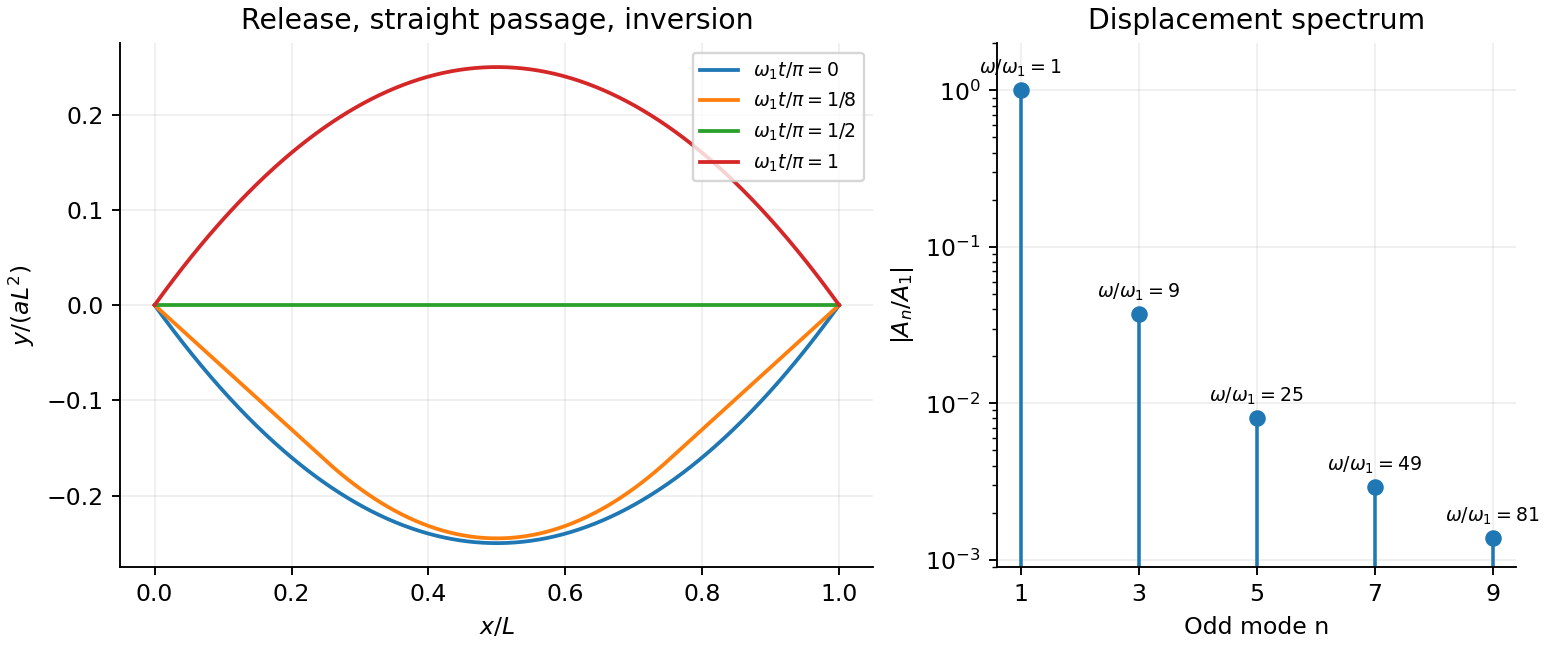
For the specified release, small slope requires . Expand the initial deflection in the Fourier sine series. Its coefficients areWriting , the resulting motion isOnly odd normal modes occur because the initial profile is symmetric about the midpoint, and their amplitudes decrease as . The frequencies grow as , so the motion is dispersive and is not a single shape multiplied by one cosine. Nevertheless the ideal undamped solution is exactly periodic with period . At all odd-mode cosines vanish, so the bar is instantaneously straight; at it has the opposite initial deflection. The first mode dominates displacement, with third-mode amplitude only of the first.
There is initial curvature incompatibility at a moment-free beam end: the prescribed parabola has , whereas a moment-free pivot requires zero curvature at an endpoint. Therefore the data do not define a classical solution with curvature continuous through the two end-time corners. They do define a finite-energy weak solution after release of the forces or end moments that prepared the initial shape. The sine expansion represents that solution: its displacement reproduces the initial parabola, each mode satisfies the released endpoint conditions, and gives finite bending energy. One must not differentiate the initial series twice at its endpoints and assign the interior parabola's curvature there. This qualification leaves the modal displacement prediction intact.


Articles by others on the same topic
There are currently no matching articles.