A normal mode is a motion in which all coordinates have a fixed relative pattern and oscillate at one frequency. Near a stable equilibrium, let the quadratic kinetic and potential energies be and . With positive-definite mass matrix , the equations and harmonic ansatz giveThe stiffness and mass matrices are symmetric. For distinct frequencies, their symmetry gives , so the mode vectors are orthogonal in the mass inner product. A basis can also be chosen in a degenerate eigenspace. Expanding decouples the equations into ; initial displacements and velocities determine the coefficients. Positive stiffness gives real frequencies, a zero eigenvalue can describe a free symmetry motion, and a negative one signals instability rather than an oscillatory mode.[ref]
Classical Dynamics by David Tong. Section 2.6: small oscillations and generalized normal-mode eigenvalue equations
For two equal masses between fixed walls with three equal springs, the stiffness matrix is and the mass matrix is . The patterns and have frequencies and . An initial displacement of one mass excites both modes and can produce beats.
For a uniform taut string fixed at both ends, the wave equation , with , has patterns and angular frequenciesThe boundary conditions select the spectrum. Fourier expansion of arbitrary admissible initial data provides the mode amplitudes, illustrating the extension from a finite set of coordinates to a field.
For the normal modes of inductively coupled LC circuits, take two identical circuits with self-inductance , capacitance and mutual inductance , where . The capacitor charges obey and the exchanged equation. In-phase and opposite-phase charge patterns haveThe positive inductance matrix for two identical coils is the physical counterpart of positive mass. Here inductance plays the role of the mass matrix. Mechanical, wave and electrical examples therefore share the same eigenvalue structure. Weak forcing excites modes according to its spatial overlap with each pattern; damping broadens the resonances, while strong nonlinearity can invalidate a fixed linear-mode decomposition.
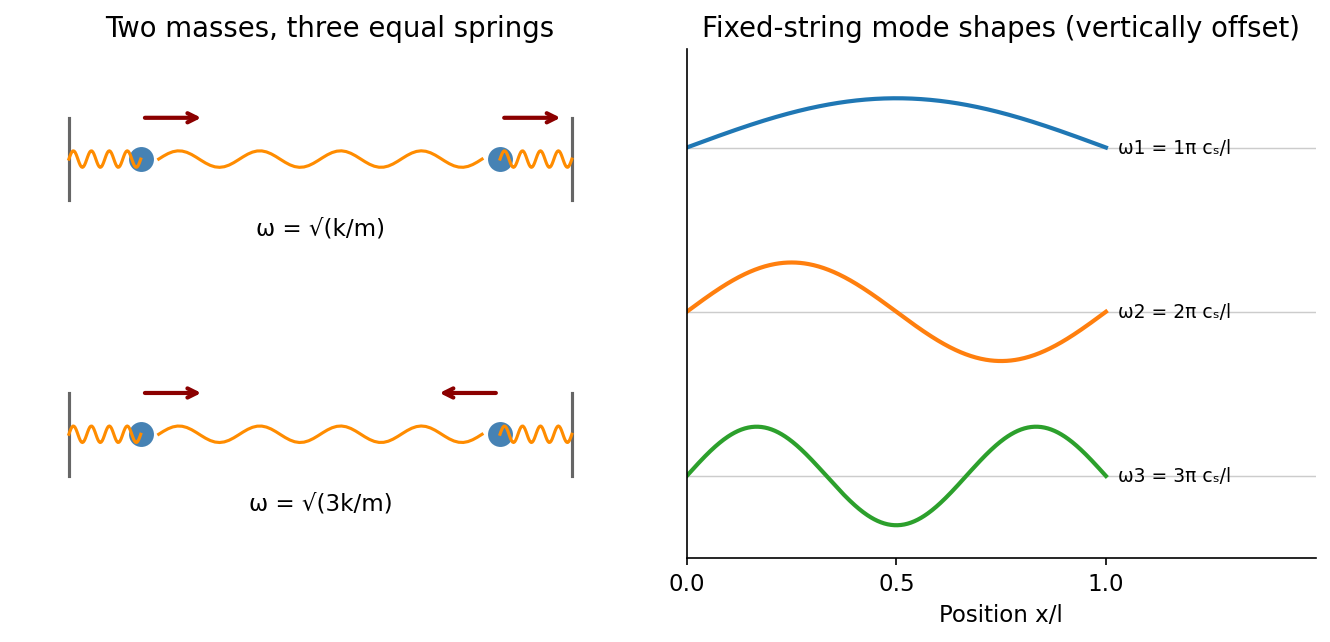
Normal modes range from two-mass displacement patterns to the standing-wave harmonics of a fixed string
. Source. Details. 
Articles by others on the same topic
There are currently no matching articles.