Normal-mode idea. Near a stable equilibrium, expand the potential energy to quadratic order and the kinetic energy as a quadratic form in generalized velocities. The Euler-Lagrange equations then take the linear form . A normal mode has fixed displacement ratios, , with . Real systems admit this description for sufficiently small motion, before higher-order nonlinearities or strong damping matter. Superposition permits a general motion to be assembled from the modes. A free symmetry direction may instead be a zero mode, with constant or linearly changing coordinate.
Lagrangian and bead equations. Take each as an arc-length displacement positive in the same sense around the fixed circular wire. Spring length changes are , and . Equal equilibrium spring tensions give no net tangential force; their linear energy terms sum to zero. Dropping an irrelevant constant, the Lagrangian isFor example, differentiating the potential with respect to gives . The three Euler-Lagrange equations therefore areThe wire supplies normal constraint forces but does no tangential work. These are the equal-mass case of the normal modes of three beads connected by springs on a circular hoop.
Frequencies. The stiffness matrix divided by isIt annihilates . On the two-dimensional subspace , its action is multiplication by three. Thus the angular frequencies of the normal modes areThe repeated frequency is a degeneracy of normal modes, while the zero frequency expresses free rigid rotation of all beads along the wire.
General solution. Two independent vectors spanning the vibrating subspace are and . Each amplitude satisfies , with . The uniform coordinate satisfies . HenceThe six freely specifiable real constants give the six initial data; is fixed by and is not an additional independent integration constant. The linear zero-mode term must be included to allow nonzero total tangential momentum.
Shapes and uniqueness. In the first term beads 1 and 2 have opposite equal displacements and bead 3 remains at its equilibrium position. In the second term beads 1 and 3 do this while bead 2 stays fixed. The last term moves all three identically, leaving spring extensions unchanged: is a rigid phase shift and a uniform drift around the wire. The sketches show positive modal amplitudes; all arrows reverse half a vibration period later.
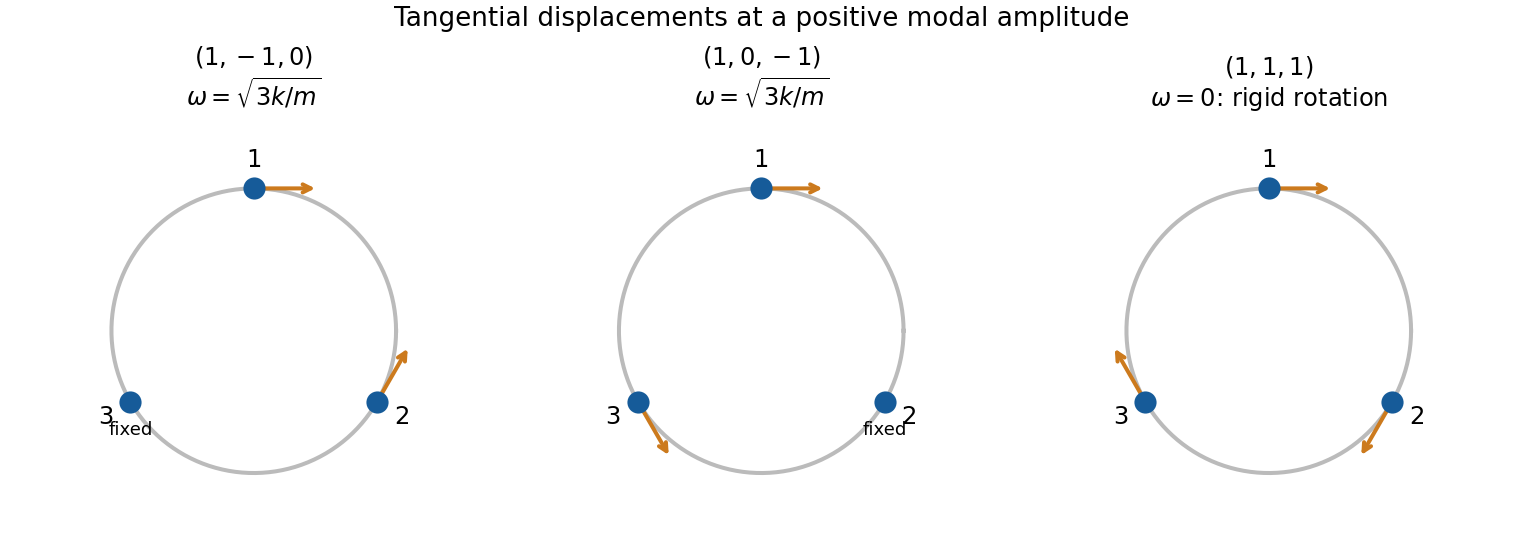
Original displacement sketches for two independent equal-frequency bead modes and the rigid-rotation zero mode; arrows indicate displacement along the ring rather than its radius
. Details. 
The two nonzero-frequency eigenvectors are not unique, because any independent linear combinations in their degenerate two-dimensional eigenspace form an equally valid basis. In particular the displayed pair is independent but not orthogonal; one could use and instead. The zero eigenspace is one-dimensional, so its vector is fixed up to scale and sign.
Specified release. Zero initial velocities permit and require . At , the three displacement conditions become , , . Therefore one convenient set of constants isEquivalently,Their sum remains , as required by zero initial total tangential momentum. Alternative amplitude signs with compensating phase shifts represent the same motion.
Articles by others on the same topic
There are currently no matching articles.