A Carnot cycle consists of four reversible stages: isothermal expansion at the hot-reservoir temperature , adiabatic expansion to , isothermal compression at , and adiabatic compression back to the starting state. The adiabatic stages exchange no heat. For one mole of an ideal gas, the two isothermal stages have heats and in magnitude. The reversible adiabatic relations ensure .
More generally, the total entropy change over any reversible cycle is zero. The two heat exchanges therefore satisfyWith work output , its thermal efficiency isThe temperatures must be absolute. The second law makes this the maximum efficiency for an engine exchanging heat only with those two reservoirs; irreversible entropy production lowers the efficiency.
Label the initial state 1, the end of compression 2, the end of constant-pressure heating 3, and the end of adiabatic expansion 4. The volume sequence is , with . The Diesel cycle has a compression adiabat , a horizontal constant-pressure heat-input segment , an expansion adiabat , and a vertical constant-volume cooling segment .
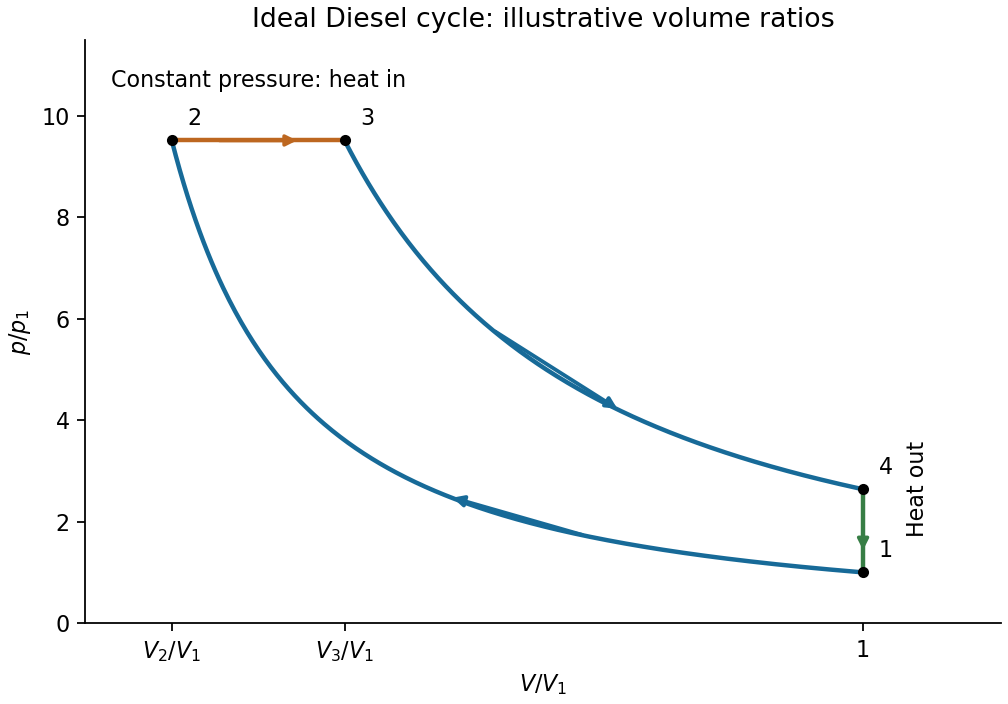

For an ideal gas, a reversible adiabat obeys , so it falls more steeply than an isotherm. The expansion adiabat lies above the compression adiabat at equal volume between and , giving a clockwise cycle with positive work output.
For one mole, , and constant heat capacities satisfy . The specified diatomic-gas model hasA reversible adiabatic process satisfies . Constant-pressure expansion satisfies . Applying these in order givesEvery volume ratio is dimensionless, so the expressions have units of temperature. For the intended volume ordering, the minimum temperature is and the maximum is .
Use heat into the gas as positive. The two adiabatic stages have . During constant-pressure heating and constant-volume cooling,The first law over a complete cycle gives , since the internal energy returns to its initial value. ThereforeSubstitute the temperatures:HenceEquivalently, define compression ratio and cutoff ratio :These formulas use the ideal constant-heat-capacity model and reversible adiabatic strokes. The heat-addition and heat-rejection strokes occur over changing gas temperatures, unlike the isothermal heat exchanges of a Carnot engine.
For , Taylor expansion gives . The vanishing-cutoff limit of the Diesel cycle isThe maximum temperature tends to , while the minimum stays at . A Carnot engine between those limiting extrema hasso the limiting efficiencies coincide. At exactly , however, both heat input and net work vanish, and the cycle retraces its compression adiabat. The efficiency there is an undefined ; the boxed value is the continuous limit for neighbouring nonzero cycles, not finite work at zero heat input.
Articles by others on the same topic
There are currently no matching articles.