Use a stationary wavefunction solving the Time-independent Schrödinger equation. For energy above the positive step potential, the positive wavenumbers areIncidence only from the left permits a right-moving incident plane wave and a left-moving reflected plane wave for , but only a right-moving transmitted plane wave for :The omitted right-incident component would describe a different scattering experiment. Wavefunction matching at a finite potential step requires continuity of both and for a finite jump and the same mass on either side:Eliminate from the second condition:The first ratio is a transmission amplitude; a transmitted probability current also depends on its different propagation velocity.
The probability current of the incident wave is , and that of the reflected wave is . The quantum reflection probability is the positive ratio of reflected to incident flux magnitudes:For comparison, the transmitted probability current is , so the transmission probability isThese satisfy , as required by conservation of probability current for a real, nonabsorbing potential energy. In particular, alone is not the transmitted flux fraction when .
For , the two wavenumbers nearly coincide:Consequently and . To leading order the complete wavefunction isThe small fractional change in kinetic energy scarcely changes the propagation wavenumber, so reflection vanishes and the particle behaves approximately as a free right-moving plane wave. A more accurate phase at large positive retains on the transmitted side; even a small wavenumber difference accumulates over a sufficiently long distance.
Take the threshold from the above-step side used in the preceding parts, . Then while remains finite. The reflected probability amplitude approaches , and the transmitted amplitude approaches . At each fixed position, the potential-step threshold wavefunction is thereforeIts probability density is
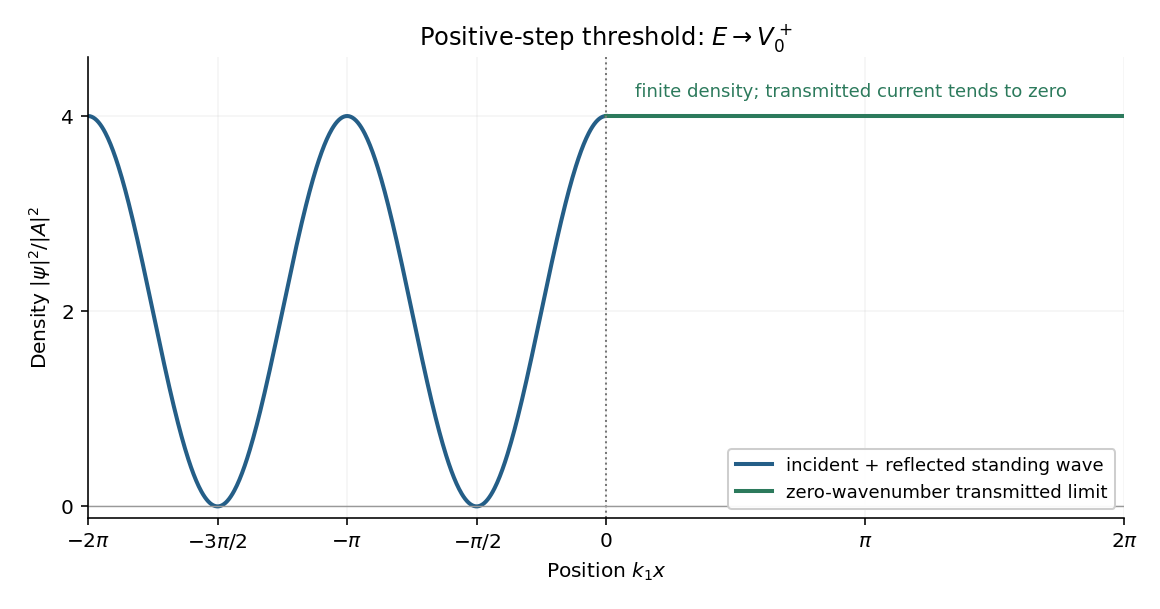
Probability density at the positive-step threshold, normalized to the incident amplitude squared
. Details. 
The left-hand standing wave has zero-density nodes at and maxima of height . Its density period is , half the incident de Broglie wavelength. At the origin the density is a maximum, continuous with the constant value on the right; its first derivative is also zero on either side there.
The nonzero right-hand density does not imply transmitted flux: , so and . The exact threshold solution with no incoming component from the right is the limiting constant solution of in the raised region. These stationary scattering states are not normalized over the whole real line; finite-interval density ratios are nevertheless well defined.
Use adjacent segments and , with . Integrate the threshold probability density from part (d). The left segment contains two complete density periods, so its average is :The right-hand density is constant:The common stationary-state normalization cancels, yieldingThe larger local probability weight on the right is compatible with zero transmitted probability current at threshold: density and flux measure different quantities.
For a downward step potential, , the region on the right is classically allowed at every positive incident energy. The same matching calculation applies withAs , and . Henceand the flux coefficients satisfyThis quantum reflection at a downward step occurs even though a classical particle would simply accelerate into the lower-potential region. The abrupt change in wavenumber causes strong reflected-wave interference.
Both this limit and part (d) give total reflection, but their probability amplitudes and spatial densities differ. At the upward-step threshold, and : an antinode meets the origin and the right-hand density stays finite while its propagation velocity vanishes. Here and : the incident and reflected waves nearly cancel at the origin, and the transmitted density vanishes while the right-hand propagation velocity remains finite. In both descriptions the incident probability amplitude is held fixed for comparison.
The coefficients above are limiting flux ratios for . At exactly the incident probability current vanishes, so directly dividing zero-energy fluxes would not define a scattering probability.
Articles by others on the same topic
There are currently no matching articles.