The mass and surface area of the spherical droplet are and . Constant surface mass accretion rate meansTherefore , and the initial radius givesHere , , and . This surface-fed growth of an accreting sphere law assumes constant droplet mass density.
Choose downward velocity positive, and assume the collected material is initially at rest in the cloud's inertial frame. This assumption is required for the equation in the question. During , momentum conservation for the droplet plus the material it collects givesup to second-order increments. Thus the variable-mass system satisfiesSince , , givingThe notation is appropriate because here depends only on time. The extra term accounts for the momentum needed to accelerate newly collected mass; using would omit it. For incoming material with downward velocity , the more general equation is .
Set . The proposed velocity and its derivative areThe remaining term in the linear ordinary differential equation isso the sum is exactly . Also , establishing both the equation and its initial condition:The integrating factor explains where the expression comes from:The result has units of velocity. Its continuous limit is , despite the apparent in the written expression.
Introduce the dimensionless quantities and . ThenThe Taylor series at givesThus the initial slope is , as for free fall. At late times,The oblique asymptote is , approached from below. Direct differentiation givesThe speed increases monotonically with decreasing slope, from towards . It does not reach a terminal velocity in this drag-free model. Without mass accumulation, and still without drag, a drop released from rest has : its acceleration remains , whereas the growing drop continually shares its momentum with newly acquired material.
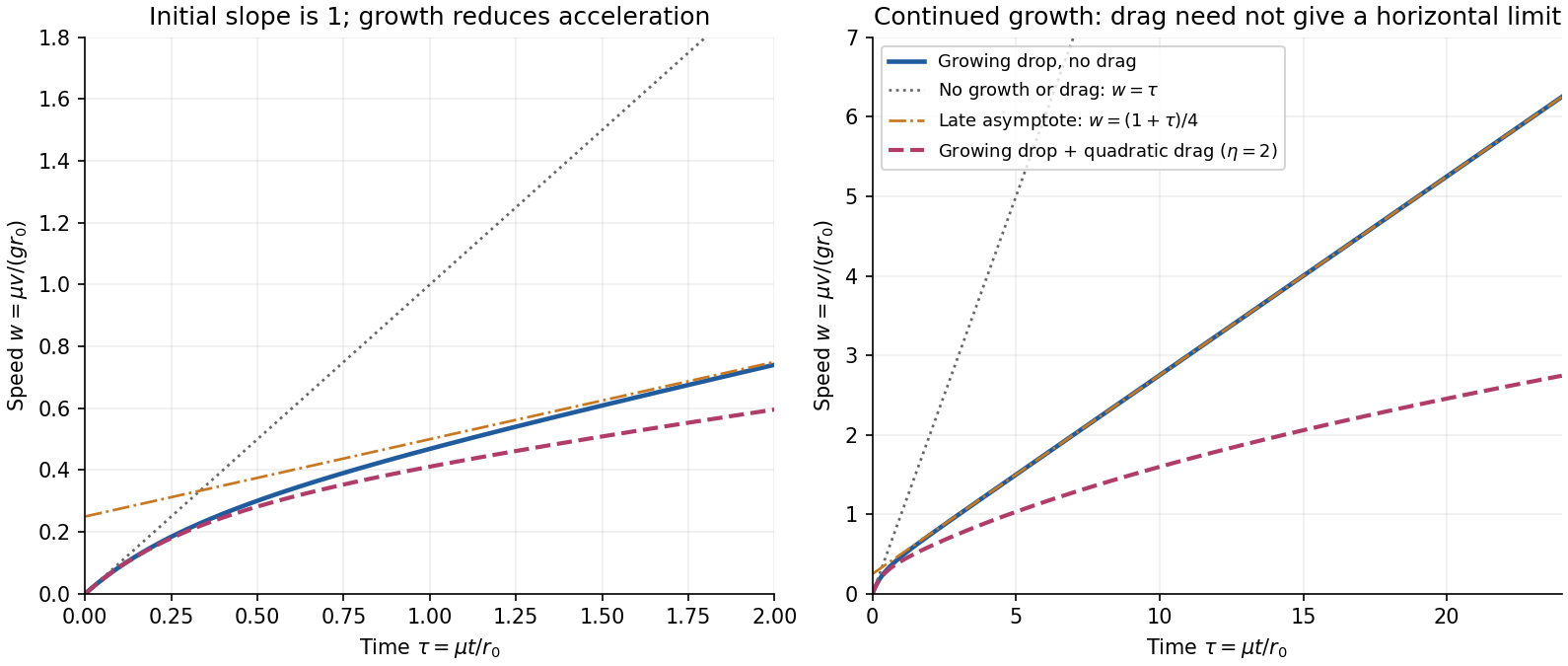
Growing-droplet speed, its early and late limits, and an explicitly assumed quadratic drag example
. Details. 
An upward drag force changes the variable-mass system equation toFor an ordinary drag force increasing with positive speed, the new curve lies below the no-drag curve. It still starts with slope if at rest. The dashed curve illustrates quadratic drag on a sphere with constant radial growth, using with constant drag coefficient and air mass density . The equation for these dimensionless quantities isThe figure uses solely to show the shape; it is not an additional datum of the paper.
There is a limitation to the usual terminal velocity sketch here. The examiner's commentary describes a curve approaching terminal velocity, but the paper maintains unbounded radius growth and specifies no drag law. A horizontal limit is justified if one additionally treats the radius as approximately fixed, or otherwise assumes a drag-to-mass ratio with a fixed limiting balance. With the growing radius and constant- quadratic drag just written, the late balance instead givesThis curve flattens in the sense that its slope tends to zero, but its speed remains unbounded. Thus a lower, more strongly flattening curve is warranted; a finite terminal speed requires an additional assumption. The no-growth approximation gives the familiar finite value for a specified fixed radius.[ref]
https://www.whatdotheyknow.com/request/natural_science_tripos_physics_e/response/2127325/attach/3/FOI%202022%20639%20Sullivan%20materials.pdf?cookie_passthrough=1#page=62. Examiner commentary, B7, released PDF page 62: the stated terminal-velocity expectation
Articles by others on the same topic
There are currently no matching articles.