A Michelson interferometer uses a beam splitter to divide collimated input light between a fixed mirror and a moving mirror. Returning beams recombine at the beam splitter; one output reaches a photodetector. A compensator plate can equalize the glass traversed in the two arms. Moving one mirror by changes the optical path difference by .
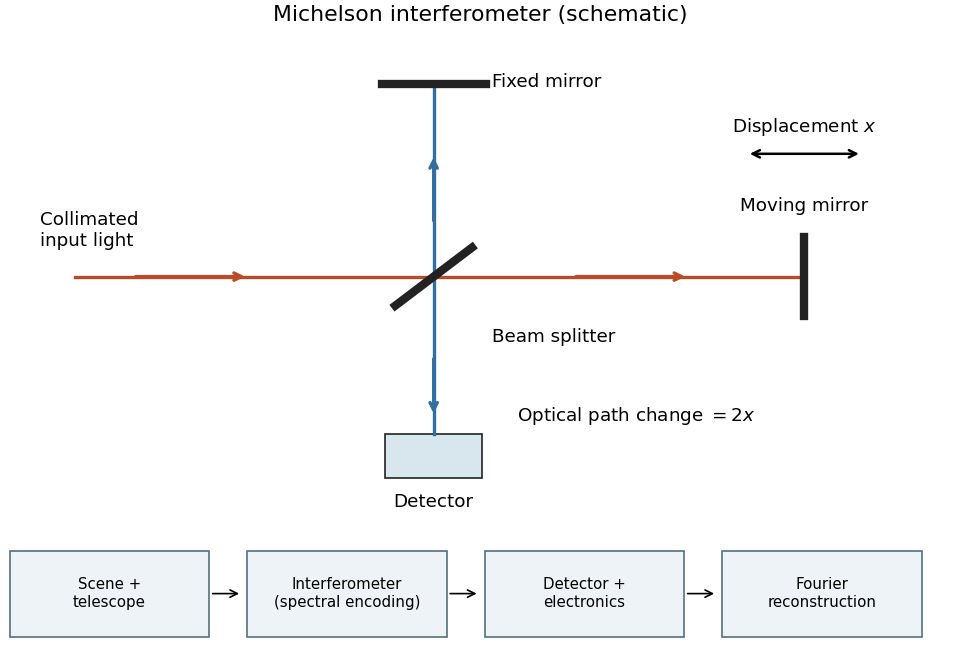
Michelson interferometer and the corresponding measurement chain
. Details. 
The usual nominal Fourier transform spectroscopy specification is , where is the maximum optical path difference measured from equal arms. It givesThis is a nominal spectral resolution element convention.[ref]
FTIR Moving Mirror Travel Distance Calculation by Thermo Fisher Scientific. optical path difference equals reciprocal resolution; mirror travel is half the optical path difference
A symmetric rectangular scan from to instead has a sinc instrumental line shape with first-zero offset . Quoting that first-zero criterion would give cm; interferogram apodization and other linewidth criteria change the numerical factor. An exact mathematical minimum requires such a criterion.In the measurement chain, the Michelson interferometer is the spectral analyzer or modulator, between the collection optics and the photodetector. It encodes the incoming radiation spectrum into an interferogram; detector electronics digitize that signal and a Fourier transform reconstructs the radiation spectrum. It does not itself turn radiant power into an electrical signal.
Let the two returning monochromatic fields at the chosen detector port beHere is wavenumber, rather than temporal frequency. An optical-cycle average uses and . In units absorbing the detector's field-to-power conversion,The choice of output port can reverse the cosine sign. For mutually incoherent components of the radiation spectrum, add powers rather than instantaneous fields, givingSubtracting the constant term leaves the Fourier cosine transform of the detected spectral weighting , including throughput and detector response.
The printed prefactor requires a normalization convention. In the derivation, is the amplitude of each returning field at the detector, not an entrance amplitude with input power . For a lossless balanced beam splitter and literal input power , conservation of energy instead gives , so the source formula identifies . Taking both and the printed formula literally would give at zero optical path difference, a concrete normalization contradiction.
Ignoring refraction, the line of sight is perpendicular to the radius at its tangent point. For a surface tangent, Pythagorean theorem gives the satellite-to-tangent distanceFor tangent altitude , replace by ; lower atmospheric scale heights change the estimate little. The required angular resolution isUsing the Rayleigh criterion for a circular telescope aperture, . The longest wavelength imposes the strongest condition, soThe corresponding requirement at is mm. This is a diffraction limit, without allowance for scan sampling, aberrations or instrumental field of view.
Use one spectral resolution element, , and assume comparable angular resolution horizontally and vertically, so the pixel solid angle is . The question specifies only the vertical angle; without an assumption about horizontal field of view the diameter is not unique. Interpret throughput as dimensionless transmission. With primary collecting area , the power in that element iswhen is in square metres. There is no extra factor of multiplying the supplied spectral radiance.
For an integration time s, the order-of-magnitude effective noise bandwidth is Hz. The root-mean-square noise-equivalent power is then W.[ref]
NEP – Noise Equivalent Power by Thorlabs. p. 1, NEP Definition; p. 2, equations (2)–(3): minimum power and averaging time
A signal-to-noise ratio of 10 requires W, and thereforeAn ideal rectangular average of a one-sided white noise spectral density has , giving cm instead. A circular field with diameter changes the diameter by another order-unity factor. These convention choices all require an aperture substantially larger than the mm diffraction estimate, so signal collection is the stronger constraint. The estimate treats the quoted NEP as applicable to the reconstructed channel; a detailed Fourier transform spectroscopy design would also specify scan weighting, background and how interferogram noise propagates into that channel. Articles by others on the same topic
There are currently no matching articles.