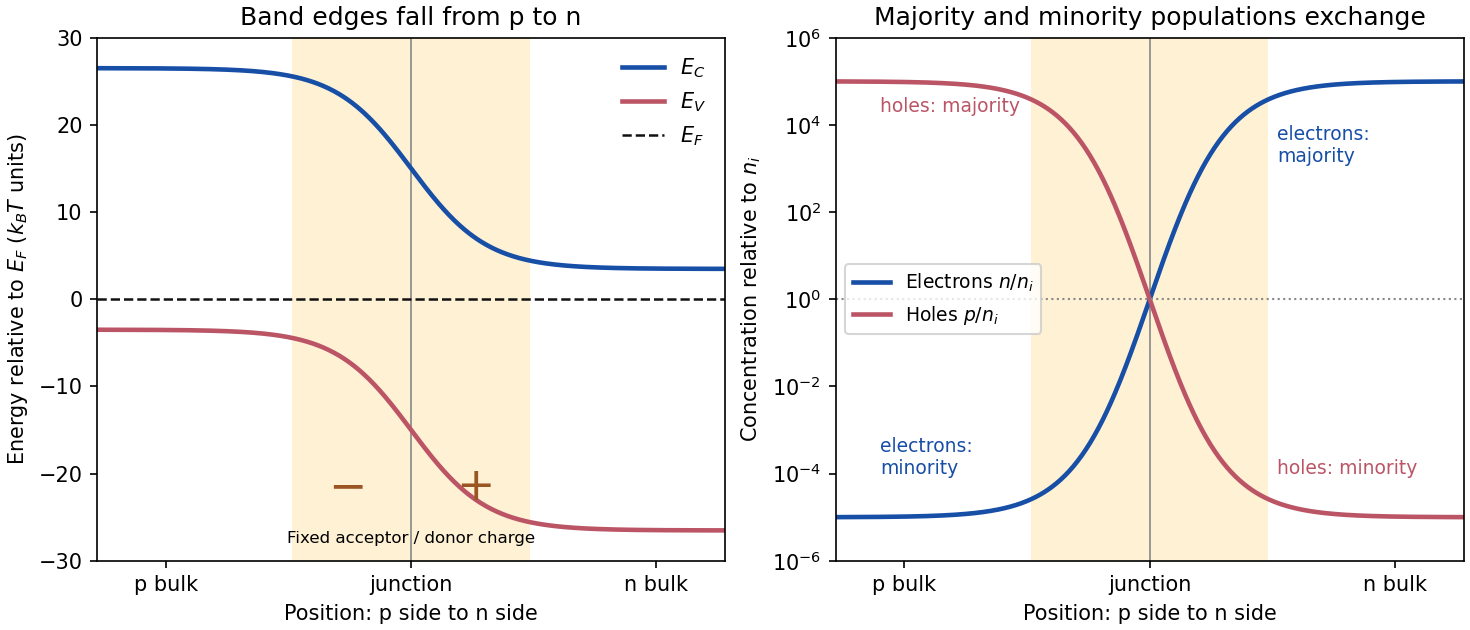
Equilibrium junction. Put the p-type side on the left and n-type side on the right. When they are joined, Electrons diffuse from n to p and electron holes diffuse from p to n. This leaves negative ionized acceptors on the p-side and positive ionized donors on the n-side of the depletion region. The resulting built-in electric field points from n to p, opposing further diffusion. At equilibrium there is one constant Fermi level, and drift and diffusion currents cancel for each carrier species.
In the nondegenerate, fully ionized limit, the neutral-region carrier densities areThe conduction band and valence band lie higher on the p-side and bend down towards the n-side. The gap between them stays fixed for a homojunction. If increases towards the n-side, both edges shift by , whileThus rises and falls continuously across the junction; neither mobile population is an exact step function. Their depletion exposes fixed dopant charge density, rather than an absence of every kind of charge. The built-in voltage is

Light emission. Forward bias lowers the barrier and injects minority carriers across the p-n junction. In a light-emitting diode, electron-hole recombination converts some of their energy into photons. A direct band gap permits efficient radiative transitions with nearly conserved crystal momentum; nonradiative channels compete. Near-edge emission has and . Material composition and confinement select the emission colour. Reverse-bias saturation is not the ordinary LED operating mode.
Reverse current. Take and to mean reverse voltage and reverse current magnitudes. The Shockley diode equation in this convention isThe bias-independent term is the supply of thermally excited minority carriers from the neutral regions, swept across the junction by its electric field. The opposing injection current is reduced by the extra barrier energy and is . Their equality gives zero net current at zero bias; for , the reverse current approaches until leakage or breakdown invalidates this ideal law. The collecting field need not create the minority carriers; their thermal supply limits the diffusion-dominated current.
For an ideal long junction of area , steady diffusion with recombination gives the diode minority-carrier diffusion currentIt depends on doping, geometry, carrier diffusion coefficients and lifetimes, and especially the intrinsic carrier concentration. Depletion-region generation current and surface leakage can add nonideal contributions to the measured reverse current.
Band-gap estimate from the data. Read a nearly flat region well above the small-bias knee and below the high-bias upturn, rather than estimating in the breakdown region. For a diffusion-dominated junction with nearly temperature-independent gap and effective masses,so , where includes transport and doping factors. Extracting a semiconductor band gap from diode saturation current amounts to measuring the slope of against : it is . If the prefactor is taken approximately constant over a short interval,Approximate readings from the original PDF plateaus areUsing the two warmer curves and givesKeeping the factor but taking the residual transport factor constant changes this estimate to approximately . The justified graphical estimate is thereforeThe colder curve is a genuine limitation of the supplied data: the to pair gives only about with a constant prefactor, and the endpoint pair gives about . Thus all three cannot support one precise diffusion-only activation slope. A depletion-region generation current, approximately proportional to rather than , can have a roughly half-gap activation energy; other leakage and temperature-dependent transport can also alter the slope. The PDF alone does not identify their relative contributions. A reliable precision gap measurement would use more temperatures and verify the transport regime instead of forcing one fit through these three readings.
Two atomic orbitals. In the linear combination of atomic orbitals approximation, use , where the two basis functions are localized atomic orbitals. Projecting onto each orbital gives the generalized eigenvalue problemHere the scalar overlap in the matrix is , while . Normalization requires , with now denoting the full overlap matrix. For equivalent real orbitals with diagonal energy , real hopping , and real overlap , the eigenstates and energies areFor the usual negative hopping convention, the symmetric combination is the lower bonding orbital and the antisymmetric combination is the higher antibonding orbital. In an orthonormal approximation, and the result reduces to a two-by-two Hermitian matrix eigenproblem.
Hybridized bands. At each , take the two Bloch basis states to be orthonormal, as implicit in the stated band model, and write . The Hamiltonian isFor , the eigenvalue condition isso . Thus band hybridization givesFor nonzero , a convenient explicit normalized pair of eigenstates isA phase convention can make real, but the eigenvalues depend only on its modulus. These are exact within the truncated two-band model, and approximate as a description of a material.
Dispersions and limits. For , the parabola crosses the flat band atFor the crossing is avoided, with a direct hybridization gap at . The lower and upper branches exchange orbital character through this avoided crossing. At the origin their energies areso for the small- expansions areAt large , where ,The lower branch approaches from below and becomes flat; the upper branch approaches the free-electron parabola from above. At zero coupling the unsorted orbital bands remain exactly flat and parabolic. Sorting them by energy instead gives and , which cross at without mixing.
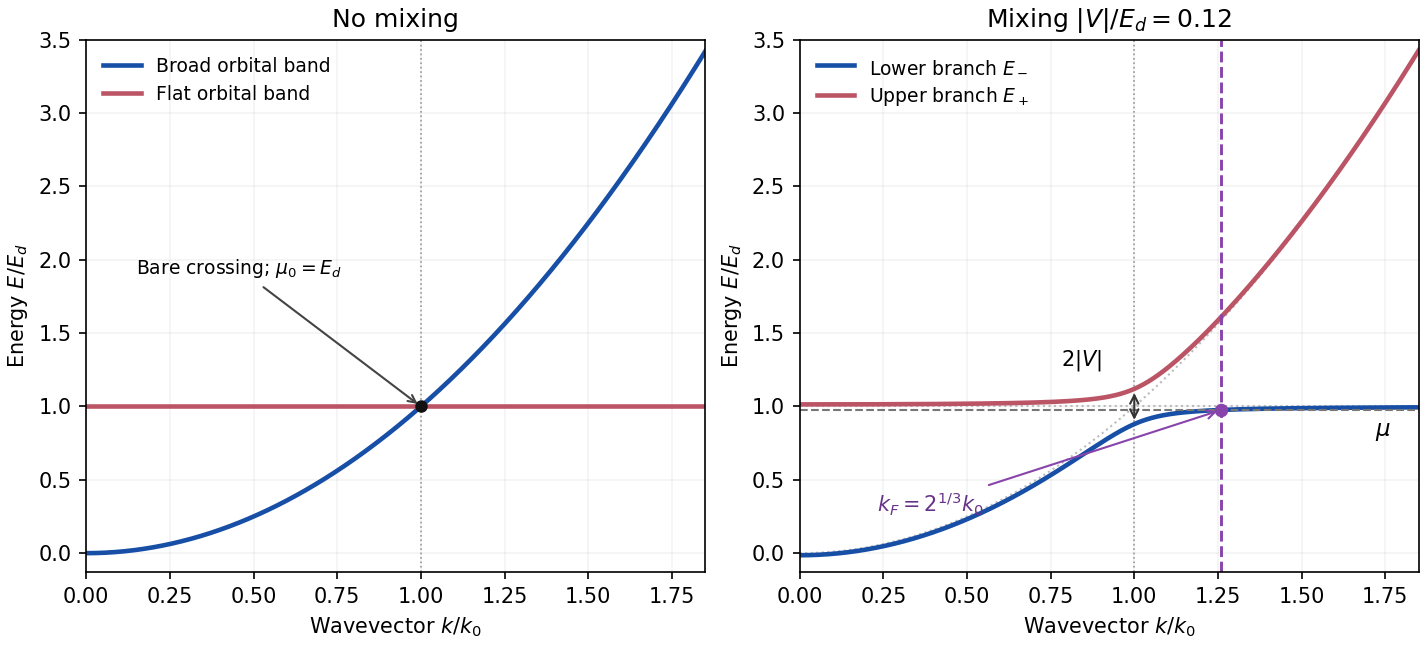

Fermi wavevector and velocity. A partially occupied perfectly flat band has chemical potential . Thus before mixing, the occupied broad band has radius defined above. For spin degeneracy two, its particle density is ; equal population of the flat sector gives total density .
For any nonzero mixing, at finite , while . Moreover increases monotonically. At zero temperature and this fixed density, a single occupied sphere in the lower branch therefore accommodates all particles, and the upper branch is empty. Fermi-volume conservation in two hybridized electron bands givesThe new radius is about larger than the old broad-band radius. The strictly flat uncoupled band has no uniquely determined Fermi radius of its own; its prescribed population is what enters the count.
The radial group velocity is . Differentiating the exact dispersion givesAt , put , so . Relative to the original broad-band Fermi velocity ,Expanding for gives the flat-band hybridization Fermi-velocity suppressionThe coefficient is about . The enlarged occupied volume coexists with a small velocity because the new Fermi surface lies on the almost-flat part of the lower branch. This result assumes fixed particle density, sufficient available states before any Brillouin zone boundary, and temperature low enough to resolve energy differences of order . The limit at a fixed nonzero temperature need not give this sharp redistribution. Giving the narrow band a finite dispersion can also leave both pockets occupied, so the result is specific to the ideal model.
Energy and momentum measurement. In angle-resolved photoemission spectroscopy, monochromatic photons illuminate a clean surface in vacuum, and an electron energy analyzer measures the outgoing kinetic energies and emission directions. Measuring both gives the occupied electronic band structure, rather than only a momentum-integrated distribution of removal energies.
Choose a common energy reference for initial and final states. Let be the initial electron energy, the Fermi energy, and the vacuum level immediately outside the sample. The binding energy is . For a direct emission event without additional losses, conservation of energy givesHere the work function is the energy from the Fermi level to the local vacuum. The initial and final energies are total single-electron energies on the same scale, while is measured above vacuum. The diagram illustrates each interval independently.
Neglecting ultraviolet photon momentum, photoemission momentum conversion giveswhere is measured from the surface normal. Parallel crystal momentum is conserved modulo a surface reciprocal lattice vector; the surface breaks perpendicular translation symmetry. A three-dimensional sample therefore generally needs a final-state model to infer perpendicular momentum. The stated two-dimensional sheet avoids that ambiguity. The kinetic energy used in this formula is the sample-vacuum value; if the analyzer and sample have different work functions, their contact potential must be included when converting the analyzer's reading, as in photoelectron binding energy reference.
Spectral information. Define and the electron spectral function by . In the sudden approximation, the basic photoemission intensity and spectral function relation isbefore instrumental broadening and background are included. Here is the Fermi-Dirac distribution, and is the transition matrix element. The electron removal spectral function contains the occupied part of the spectrum. In a noninteracting band it has a delta peak at the band energy; interactions shift and broaden peaks and can add incoherent weight. Thus peak trajectories reveal dispersion, while line shapes can constrain lifetimes after resolution effects are accounted for. Dividing by known matrix and occupation factors can estimate where those factors are appreciable; intensity alone is not identical to , and a missing peak can reflect a matrix-element suppression. States well above are not accessible to ordinary low-temperature photoemission.
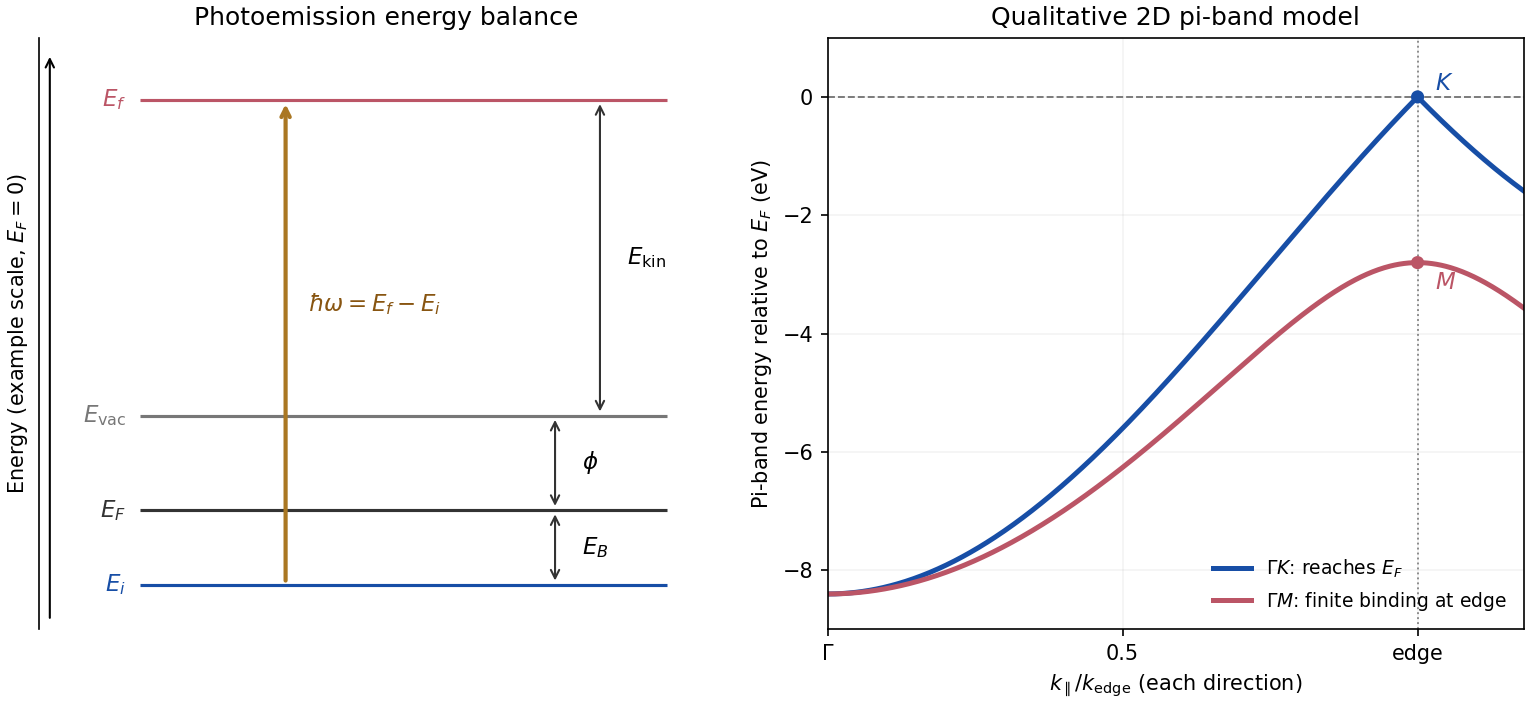
Photoemission energy accounting and qualitative upper valence-band dispersion
. Original schematic energy diagram and illustrative nearest-neighbour graphene pi-band curves. The left panel labels every requested energy and energy interval. The right panel shows an ideal two-dimensional pi band with hopping , not a fit or reproduction of the measured graphite spectra; other occupied orbital bands are omitted. Details.
Two independent band-structure probes. First, the de Haas-van Alphen effect measures oscillatory magnetization as Landau levels cross the Fermi level when a magnetic field changes. The inverse-field frequency iswhere is an extremal Fermi surface cross-sectional area perpendicular to the field. Changing field orientation maps its shape. This reveals the momentum-space geometry of occupied bands; the related Shubnikov-de Haas effect measures oscillatory resistance.
Second, absorption or reflectance spectroscopy detects interband transitions. Photon energies at absorption edges and peaks constrain the band gap and interband energy differences. For a direct band gap, negligible photon momentum selects approximately vertical transitions in the band diagram, weighted by the joint density of states and transition matrix elements. An indirect transition needs a phonon to carry the extra crystal momentum. These measurements provide evidence beyond a free-electron parabola, although an optical spectrum alone does not reconstruct every band's dispersion.
Reading the graphite spectra. For each direction, follow a moving peak through successive angles and convert each peak's own kinetic energy to ; angle is not itself proportional to momentum over this wide range. The prominent dispersing valence feature starts at roughly – binding energy near and moves towards lower binding energy as increases. Along it approaches the Fermi level at the corner, then turns back to larger binding energy on continuing beyond the corner. Along it reaches a finite minimum binding energy of roughly – near the edge midpoint and turns back; it does not reach the Fermi level there. Additional deeper peaks describe other occupied valence branches, with visibility varying across the spectra.
A useful qualitative description is the upper occupied band of the nearest-neighbour model of graphene: . It rises from at to zero at , but only to at . The schematic curve in the figure captures those two different behaviours. It is not a full multi-orbital assignment or a quantitative fit to graphite, whose deeper valence features are also visible in the supplied spectra.
Angle needed to reach the corner. The corner's parallel wavevector isUse the near-zero binding energy of the upper valence band at that point. With the sample work function interpreted as the stated separation below vacuum,HenceThe energy and angle readings in the PDF are approximate. If a peak at the corner were instead assigned a small binding energy , the estimate becomesFor – this gives about –, consistent with the near-Fermi feature in that angular range. Substituting the full photon energy for the kinetic energy would omit the work-function cost and underestimate the required angle.
Articles by others on the same topic
There are currently no matching articles.