For a uniform continuum gas with pair interactions depending on relative positions, a Galilean boost changes every particle momentum by and leaves the interaction energy unchanged. Write . The transformed many-body Hamiltonian operator isThe resting ground state has , so the Galilean boost energy of an interacting gas isThe mass here is the bare particle mass, because this is an exact transformation of the microscopic kinetic energy. Substituting the Fermi-liquid effective mass would omit the change in interaction energy encoded by the Landau quasiparticle energy functional. This conclusion requires the Principle of Galilean relativity; a gas in a lattice or a fixed external potential energy landscape need not obey it.
Let be the real-space area and use , with . There is one state per momentum cell, since the fermions are spinless. An annulus between and contains states. Near the Fermi surface, the quasiparticle dispersion relation has , so the total density of states isThe density of states per unit area and the occupied-state count are, respectively,In particular, . No factor of two for spin degeneracy is present. This counts Landau quasiparticle levels, so it is not multiplied by the quasiparticle residue of the microscopic particle Green's function.
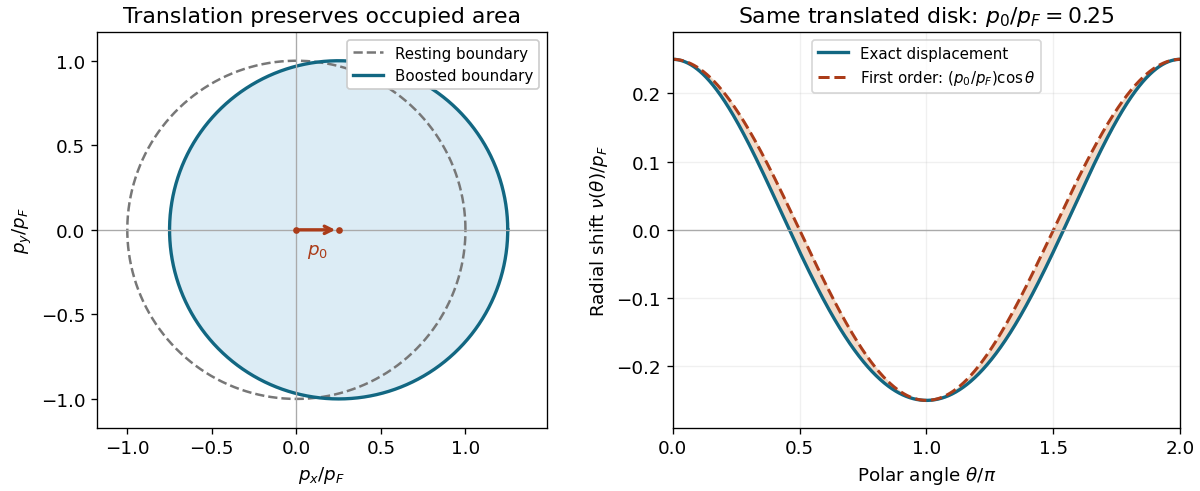
The shifted Fermi circle satisfies . Its radial boundary at polar angle is the positive solution of . Thus, for ,and its leading Taylor expansion isForward-pointing momenta gain occupied states and backward-pointing momenta lose them. With the paper's explicitly reversed Heaviside step function convention, ; consequentlywith a positive leading sign.
For the later quadratic energy calculation it is useful to distinguish the first-order shape from exact particle number conservation. The particle-conserving displacement of a Fermi circle hasThe second-order inward correction cancels the apparent area increase one would obtain by treating as exact.

Within a stable normal Fermi liquid, the low-energy states are described by long-lived Landau quasiparticles and holes in a thin shell about the Fermi surface; the Pauli exclusion principle suppresses their decay. Expanding the energy about the equilibrium occupations gives the one-quasiparticle dispersion relation at first order and the interaction between occupation changes at second order, namely the Landau quasiparticle energy functional. For a smooth interaction, radial deviations in that interaction may be neglected at leading order, leaving its angular dependence; higher occupation terms contribute higher powers of the small shell thickness. Collective occupation deformations are included in the same description. The sufficiency claim is conditional on the normal Fermi liquid regime, and on supplementing this static energy functional with dynamics when required: it is not a description of arbitrary low-energy phases such as a superconductor or non-Fermi liquid.
Use the total density of states and from part (b). In the paper's double-sum convention, has units of energy and scales as . Define its first angular moment byThis convention matters: the Landau quasiparticle energy functional written with an explicit instead uses the intensive kernel .
At zero temperature, the displayed functional is the change in ; a true Galilean boost preserves , so . For a radial displacement , the first term in the Landau quasiparticle energy functional becomesThe oriented radial integral also works for negative : removing occupied levels below the chemical potential costs positive energy. Substituting and using givesThe exact second-order correction to the boundary is unnecessary here because the unperturbed excitation energy vanishes on the Fermi surface; it changes this term only beyond quadratic order. It must nevertheless be understood when identifying with a fixed-particle number energy change.
For the quadratic interaction term, the first-order occupation change alone suffices. The radial Dirac delta function integrals givePut . The remaining angular integral usesso only the first cosine component of the interaction survives. Since ,Adding both contributions and matching the bare-mass result of part (a) yields the two-dimensional Landau effective-mass relation:Equivalently, using the density of states per unit area ,If dimensionless Landau parameters are defined through the Fourier series , then andDefining the cosine expansion with an extra factor of two would instead absorb that factor into ; the angular-integral formula above fixes the convention unambiguously. The physical content is that interaction changes accompanying a moving Fermi sea compensate the renormalized quasiparticle velocity, so the total boost energy is governed by the bare mass. For an interaction independent of angle, and this consistency condition requires .
Articles by others on the same topic
There are currently no matching articles.