For a thin uniform spherical shell, dC=(Rsinθ)2dm and angular averaging gives ⟨sin2θ⟩=2/3. Thus C=2MR2/3. The printed formula requires a negligibly thin outer shell. For a finite-thickness hollow sphere of uniform density between r0 and R,For example r0=R/2 gives C/(MR2)=31/70, not 2/3. The thin-shell limit r0→R restores the printed result. A uniform outer layer of unspecified thickness does not by itself establish it.
C=52MR3−r03R5−r05.
Build a solid uniform sphere from thin shells: dC=(2/3)r2(4πρr2dr). Integration gives C=8πρR5/15, while M=4πρR3/3. Hence C=2MR2/5. This is a spherical uniform-density model; planetary flattening modifies the exact relation.
A point mass at the rotation center has zero perpendicular distance to the axis, so C=∫r⊥2dm=0. More generally, moving a fixed mass inward lowers its moment even if its total gravitational monopole and outer radius remain fixed.
Rotation rate, oblateness and measured external gravitational multipoles provide constraints beyond mass and radius; spin-axis precession/nutation and satellite dynamics can add moment-related information. For a giant planet the deep rotation rate and hydrostatic approximation matter. These measurements require an interior model or supplementary constraints for an accurate moment: a spherically symmetric body's exterior monopole alone cannot reveal its radial density distribution. An exact moment cannot generally be inferred just by labeling a measured J2 as C.
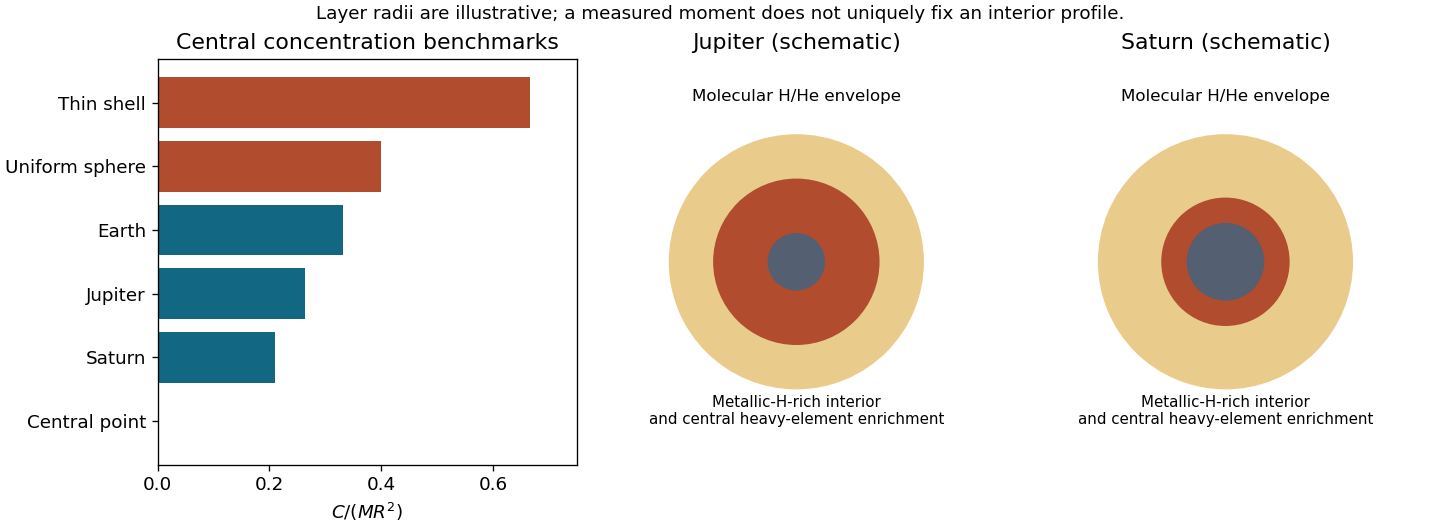
All three measured factors are below the uniform-sphere value 0.4, indicating central concentration. Earth at 0.331 is consistent with a dense core and less dense mantle; Jupiter at 0.264 and Saturn at 0.21 have still more centrally concentrated normalized distributions, with Saturn especially concentrated relative to its outer radius. These numbers do not uniquely determine core masses, chemical boundaries or density profiles.
A qualitative sketch has molecular hydrogen/helium outside, increasing pressure into a conducting metallic-hydrogen-rich interior, and centrally enhanced heavy elements, possibly distributed rather than confined to a sharp solid core. Saturn's lower mass produces different pressure/temperature transitions and a larger relative role for central concentration. Both can have compositional gradients and helium separation; the moment alone does not decide whether any boundary is sharp.

Helium becoming partially immiscible in dense hydrogen can form helium-rich droplets that settle inward. Gravitational energy release and associated thermal evolution can supply extra luminosity, while the upper hydrogen envelope becomes helium depleted. Different interior temperature-pressure histories can make separation stronger in Saturn than in Jupiter.
The source's ratio is reversed for this intended explanation. Depleting helium lowers He/H and raises H/He. For a concrete example, keeping ten hydrogen units while reducing one helium unit to one half changes H/He from ten to twenty, not to a lower value. Thus the literal statement that Saturn has lower H/He cannot simultaneously be used as evidence for the stated upper-envelope helium-depletion mechanism. If the intended comparison is lower He/H, the observations and extra heat are mutually consistent with helium rain. Composition measurements and interior modeling are still needed; excess heat alone does not uniquely prove that process.[ref]
Cassini mission press kit by NASA. Background on Saturn: helium-to-molecular-hydrogen ratio and helium migration as a heat source
Ancestors (10)
- S29
- 2016
- Past exam of the short options paper shared by Prelims and Parts A and B of the physics course of the University of Oxford
- Short options paper shared by Prelims and Parts A and B of the physics course of the University of Oxford
- Physics course of the University of Oxford
- Undergraduate course of the University of Oxford
- Course of the University of Oxford
- University of Oxford
- List of universities
- Home
Discussion (0)
New discussionThere are no discussions about this article yet.
Articles by others on the same topic (0)
There are currently no matching articles.