Radiative equilibrium balances absorbed solar power against emitted thermal power, with no net energy accumulation. A spherical body's projected area absorbs πr2FS(1−A)/RAU2; its full area emits 4πr2ϵσT4. HenceHere A is bolometric Bond albedo, not a geometric albedo measured at one phase or wavelength. The radius cancels because the absorption and emission areas scale together.
Teq=[4ϵσRAU2FS(1−A)]1/4.
The formula assumes spherical geometry, an effective uniform emission temperature, steady balance, specified bolometric emissivity, no important internal heating and appropriate redistribution or averaging. An atmosphere is not mathematically required: for any surface-temperature pattern the same global balance holds with Teq4=⟨T4⟩ if emissivity is uniform. Without redistribution on an ideal airless surface, local dayside equilibrium instead gives T(ζ)=[FS(1−A)cosζ/(ϵσRAU2)]1/4 and the instantaneous night side would approach zero in the no-storage limit. Atmospheric absence alone does not justify replacing the factor four by one for a global temperature.
For FS=1360 W m−2 and emissivity one, the estimates areThese are effective fourth-power averages set by absorbed sunlight, not automatic surface thermometer readings. Uncertainty in actual albedo, emissivity and redistribution changes a more detailed model.
Teq,⊕≃254 K,Teq,Moon≃270 K,Teq,Io≃99 K,Teq,Jupiter≃111 K.
The Moon's mean equatorial temperature near 206 K is well below the approximately 270 K global effective radiative temperature. The surface has a large day-night range and finite thermal inertia; ⟨T4⟩1/4 exceeds ⟨T⟩, so comparing those two differently averaged quantities as though they were equal is invalid. The discrepancy need not imply a missing atmospheric greenhouse effect on an airless Moon.
Jupiter emits at about 130 K rather than the solar-only estimate around 111 K. Intrinsic heat contributes additional outgoing flux, so σTemit4=Fabsorbed+Finternal. The difference of fourth powers is the relevant energy excess, not their direct temperature difference. Cooling and contraction of the interior provide the main physical motivation for including this extra term.
Io's volcanic structures and young resurfaced regions indicate strong ongoing geological activity, despite a low sunlight-set equilibrium temperature. Tidal dissipation forced by its orbital interactions supplies interior energy. Europa's fractured relatively lightly cratered ice indicates resurfacing and a mechanically active ice shell on geological timescales, with tidal heating a plausible contributor; surface appearance alone does not prove every fracture is currently opening. Ganymede has both older cratered regions and grooved younger terrain, indicating a more varied resurfacing history; primordial/radiogenic heat and past tides can matter. Callisto's heavily cratered surface suggests much less extensive recent resurfacing, without proving that all interior activity or subsurface liquid is absent.
The comparison is between surface ages and possible energy sources, not simply “warmer means active.” Surface irradiation is too cold to explain silicate volcanism, while internal heat, tidal work and material-dependent melting temperatures can sustain processes below a cold surface. The NASA images in the source are evidence to interpret; no exam illustration is reproduced.
Impact cratering begins with contact and compression, in which a shock rapidly heats and compresses target and impactor. During excavation, material moves outward and upward, producing a transient cavity and ejecta. Modification then involves gravitational collapse, wall slumping, fallback and, for large structures, rebound and central features. The stages overlap in time; crater size and morphology depend on gravity, impact conditions and target strength, not just the projectile's geometric hole size.
For a locally flat airless surface, constant gravity and equal launch/landing heights, x=vcosθt and z=vsinθt−gt2/2. The positive flight time is 2vsinθ/g. ThusNeglected effects include curvature, varying gravity, rotation and terrain. At ranges comparable to the body's radius a spherical ballistic calculation is necessary.
r=gpvej2sin2θ,rmax=vej2/gp at θ=45∘.
In a gravity-dominated excavation model, displaced mass scales as ρD3 and lifting it through a distance of order D costs order ρgD4. If a comparable fraction of impact energy supplies this work across similar impacts, D∝Eimpact1/4. This is a scaling justification, not a universal crater law: strength-dominated small craters or varying coupling efficiencies can have different exponents.
At fixed projectile mass and the assumed common quarter-power law, changing diameter from 30 to 75 m increases energy by (75/30)4 and speed by (75/30)2=6.25. The corresponding primary impact speed is about 15.6 km s−1. Five percent transferred to secondary-forming ejecta gives vej≃781 m s−1. ThereforeThis assumes a 45-degree launch and similar target properties/coupling, as well as the source's fixed mass and velocity-transfer rules. Such a range is a noticeable fraction of the lunar radius, so curvature would produce a correction; the supplied flat-surface formula is an estimate rather than exact lunar orbit dynamics.
rmax≃1.6227812≃3.76×10⁵ m≈380 km.
Permanently shadowed polar craters can remain cold enough to trap water ice and other volatiles for long periods. LCROSS used an impact plume to expose and spectroscopically sample material from such a cold trap, testing the interpretation of polar hydrogen signatures and the availability/history of lunar volatiles. Shadow was therefore a physical target-selection criterion, not merely an observational inconvenience.[ref]
LCROSS by NASA. Mission objective and the 9 October 2009 Cabeus impacts
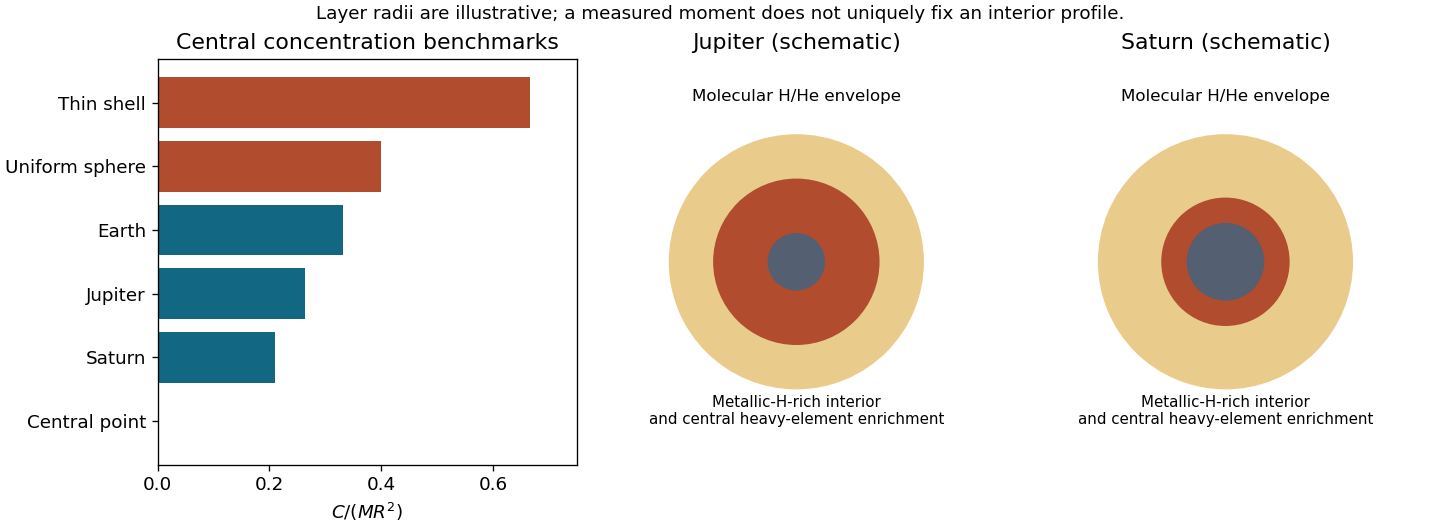
For a thin uniform spherical shell, dC=(Rsinθ)2dm and angular averaging gives ⟨sin2θ⟩=2/3. Thus C=2MR2/3. The printed formula requires a negligibly thin outer shell. For a finite-thickness hollow sphere of uniform density between r0 and R,For example r0=R/2 gives C/(MR2)=31/70, not 2/3. The thin-shell limit r0→R restores the printed result. A uniform outer layer of unspecified thickness does not by itself establish it.
C=52MR3−r03R5−r05.
Build a solid uniform sphere from thin shells: dC=(2/3)r2(4πρr2dr). Integration gives C=8πρR5/15, while M=4πρR3/3. Hence C=2MR2/5. This is a spherical uniform-density model; planetary flattening modifies the exact relation.
A point mass at the rotation center has zero perpendicular distance to the axis, so C=∫r⊥2dm=0. More generally, moving a fixed mass inward lowers its moment even if its total gravitational monopole and outer radius remain fixed.
Rotation rate, oblateness and measured external gravitational multipoles provide constraints beyond mass and radius; spin-axis precession/nutation and satellite dynamics can add moment-related information. For a giant planet the deep rotation rate and hydrostatic approximation matter. These measurements require an interior model or supplementary constraints for an accurate moment: a spherically symmetric body's exterior monopole alone cannot reveal its radial density distribution. An exact moment cannot generally be inferred just by labeling a measured J2 as C.
All three measured factors are below the uniform-sphere value 0.4, indicating central concentration. Earth at 0.331 is consistent with a dense core and less dense mantle; Jupiter at 0.264 and Saturn at 0.21 have still more centrally concentrated normalized distributions, with Saturn especially concentrated relative to its outer radius. These numbers do not uniquely determine core masses, chemical boundaries or density profiles.
A qualitative sketch has molecular hydrogen/helium outside, increasing pressure into a conducting metallic-hydrogen-rich interior, and centrally enhanced heavy elements, possibly distributed rather than confined to a sharp solid core. Saturn's lower mass produces different pressure/temperature transitions and a larger relative role for central concentration. Both can have compositional gradients and helium separation; the moment alone does not decide whether any boundary is sharp.

Helium becoming partially immiscible in dense hydrogen can form helium-rich droplets that settle inward. Gravitational energy release and associated thermal evolution can supply extra luminosity, while the upper hydrogen envelope becomes helium depleted. Different interior temperature-pressure histories can make separation stronger in Saturn than in Jupiter.
The source's ratio is reversed for this intended explanation. Depleting helium lowers He/H and raises H/He. For a concrete example, keeping ten hydrogen units while reducing one helium unit to one half changes H/He from ten to twenty, not to a lower value. Thus the literal statement that Saturn has lower H/He cannot simultaneously be used as evidence for the stated upper-envelope helium-depletion mechanism. If the intended comparison is lower He/H, the observations and extra heat are mutually consistent with helium rain. Composition measurements and interior modeling are still needed; excess heat alone does not uniquely prove that process.[ref]
Cassini mission press kit by NASA. Background on Saturn: helium-to-molecular-hydrogen ratio and helium migration as a heat source
Ancestors (9)
- 2016
- Past exam of the short options paper shared by Prelims and Parts A and B of the physics course of the University of Oxford
- Short options paper shared by Prelims and Parts A and B of the physics course of the University of Oxford
- Physics course of the University of Oxford
- Undergraduate course of the University of Oxford
- Course of the University of Oxford
- University of Oxford
- List of universities
- Home
Discussion (0)
New discussionThere are no discussions about this article yet.
Articles by others on the same topic (0)
There are currently no matching articles.