Hydrostatic equilibrium means that the local pressure gradient balances gravity, with no large acceleration or strength-supported departure from that balance. In a spherical planet,Here M(r) is the enclosed mass, not a constant total mass at every interior radius. If composition is uniform and the radial thermodynamic path is adiabatic, the relevant bulk modulus is Ks=ρ(dP/dρ)s. The chain rule then gives the Adams-Williamson relationA phase transition or composition jump must be treated separately; its density change is not obtained by integrating one smooth homogeneous-adiabatic equation through it.
drdP=−ρ(r)r2GM(r).
drdρ=KsρdrdP=−Ksr2GM(r)ρ2.
The seismic parameter isThe shear modulus μ measures resistance to shear deformation. Solids with μ>0 transmit shear waves; an ideal fluid has zero static shear modulus, so it cannot carry a bulk S wave, while compressional P waves can still propagate through its nonzero bulk modulus.
Φ=VP2−34VS2=ρKs,drdρ=−r2ΦGM(r)ρ.
Limitations include uncertain seismic coverage, temperature and composition tradeoffs, nonadiabatic boundary layers, phase changes, lateral heterogeneity, rotation and finite material strength. Small asteroids and comet nuclei commonly retain irregular shapes because their self-gravity is too weak to overcome strength and impact history; a few larger bodies, such as Ceres, are much closer to global hydrostatic figures. A spherical shape alone is not a complete proof of present hydrostatic equilibrium.
Two complementary remote constraints are precise spacecraft tracking, which measures gravitational harmonics and constrains mass distribution when combined with shape and rotation; and tidal or rotational measurements, such as Love numbers, librations and spin precession, which constrain deformability, moment of inertia and possible fluid layers. Magnetic induction measurements in a time-varying external field can provide an additional conductivity constraint, but are not a unique density inversion.
For the June 2018 lunar picture, start with a regolith and fractured crust, a largely anorthositic crust tens of kilometres thick, a silicate mantle, a deep partially molten region and a small iron-rich core. GRAIL and Apollo-based models gave a global mean crustal thickness around 34-43 km.[ref]
The Crust of the Moon as Seen by GRAIL by Mark A. Wieczorek and colleagues. abstract: mean crustal thickness and gravity/seismic constraints
A representative seismic model has a partial-melt boundary near radius 480 km, a liquid outer-core boundary near 330 km and a solid inner-core radius near 240 km; these are model-dependent radii from the centre, not depths below the surface.[ref]Seismic detection of the layers of the lunar core by Renee C. Weber and colleagues. core-reflection analysis and inferred layer radii
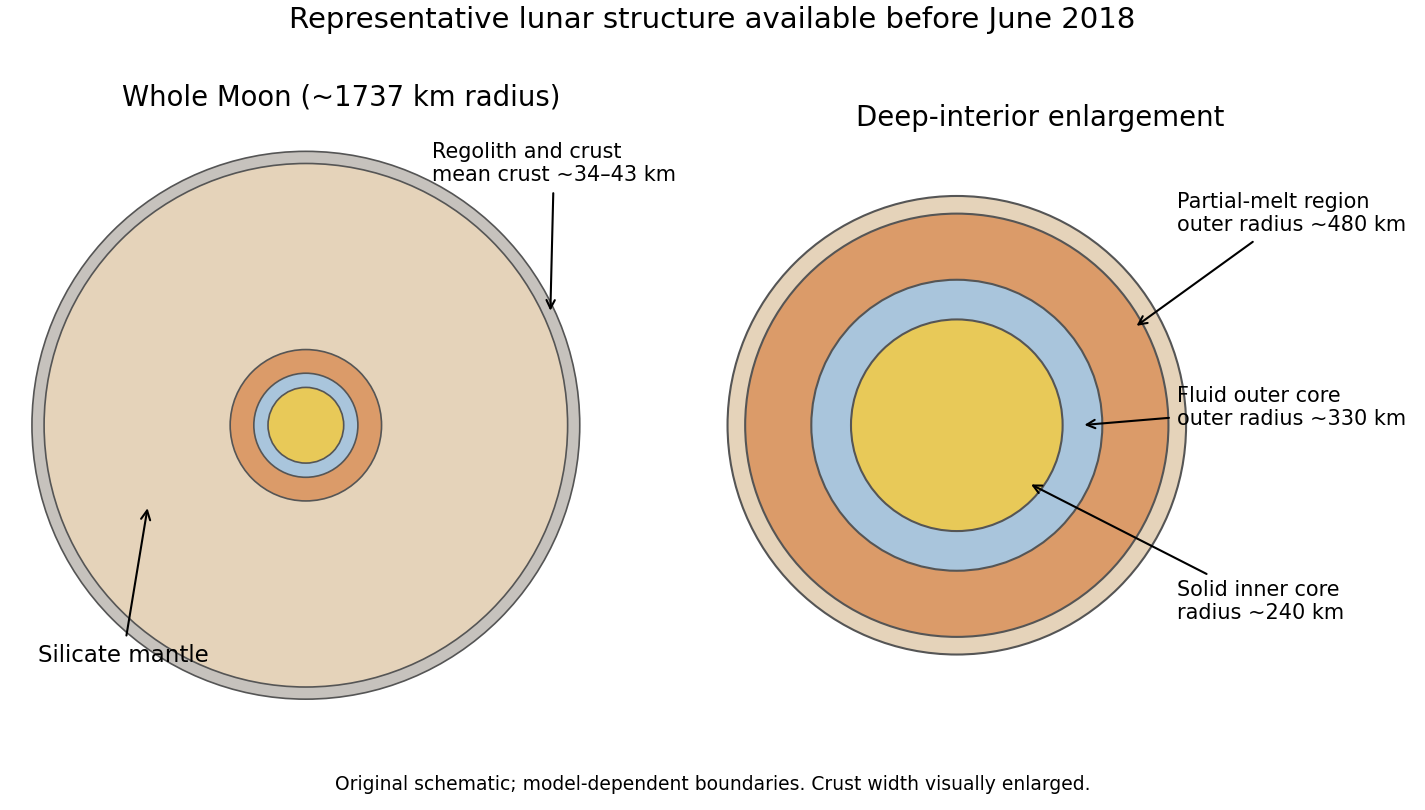

The long-running Apollo network had only four principal stations on the near side, with poor global coverage and strong scattering in the fractured near-surface material. Far-side structure and weak deep reflected phases were therefore difficult to constrain. The historical date matters: the answer does not import later Mars seismology or later lunar-core refinements into the 2018 premise.
Ancient Martian valley networks, lake basins, deltas, rounded or transported sediments and water-altered minerals show that liquid water was once more widespread than the present cold, low-pressure surface permits. Such evidence motivates a denser early atmosphere and different greenhouse conditions. It does not uniquely establish a continuously warm global ocean: episodic warming, local hydrology and several greenhouse compositions are alternatives that must be tested.
Over time, volatile loss to space, declining interior activity and changing surface storage altered the atmosphere. Early intense solar ultraviolet radiation could drive escape of light species; ion pickup, sputtering and photochemical processes removed additional material. Reduced dynamo activity changed solar-wind interaction, while water and carbon-bearing material could also be sequestered in ice, adsorbed material or minerals. Impacts can both remove and deliver volatiles. The balance is not reducible to one process or to the simple assertion that a magnetic field perfectly retains an atmosphere.
Surface ages are estimated mainly by crater size-frequency statistics, calibrated through radiometric ages and an assumed impact history. More heavily cratered ancient highlands and younger, resurfaced volcanic plains demonstrate substantial age differences on Mars. Lunar sample calibration must be transferred cautiously; erosion, burial and secondary craters complicate counting. Martian meteorites and the pre-2018 Curiosity potassium-argon measurement add radiometric constraints, but a mineral age need not equal the age of its final sedimentary deposition.[ref]
Measuring the Age of a Rock on Mars by NASA. 2013 Cumberland measurement and distinction between mineral and depositional ages
Let Σ=Matm denote the printed atmospheric mass per area. An impactor's projected area intercepts a column mcol=πRimp2Σ. The requested model assigns energy mcolVimp2/2 to atmospheric removal, and equates it to GMMarsMEsc/RMars. ThusThis uses a thin atmosphere, a uniform column, surface escape energy, complete useful coupling of that column-energy estimate, and negligible radiative or other losses. It is not a general consequence of the impactor's kinetic energy, which would contain the impactor mass instead of the column mass. A realistic shock/escape calculation needs a coupling model, impact geometry and atmospheric structure. The expression is evaluated as the stipulated approximate model.
MEsc=2GMMarsπRimp2ΣVimp2RMars.
At one bar, g≃3.71ms−2, so Σ=P/g≃2.69×104kgm−2 and the total atmospheric mass is 4πRMars2Σ≃3.89×10¹⁸ kg. With a radius of 150 km for the stated diameter,corresponding to about 1.7×10¹⁶ kg. The pressure cancels from this fractional estimate. Confusing diameter with radius would overestimate it fourfold.
MatmosphereMEsc=8GMMarsRMarsRimp2Vimp2≃4.38×10⁻³≃0.44%,
A single such impact therefore does not remove the bulk of the atmosphere in this model. Repeating an identical fractional loss would require roughly 525 such events for ninety-percent removal, before allowing for volatile delivery or geological evolution. Craters and basins show that bombardment was substantial, but their presence does not establish that the necessary net loss occurred. Heavy-isotope enrichment, including argon and hydrogen isotopes, demonstrates selective escape and constrains competing processes. MAVEN had already supplied evidence for substantial space loss by 2017.[ref]
NASA's MAVEN Reveals Most of Mars' Atmosphere Was Lost to Space by NASA. 2017 argon-isotope result and solar-driven escape interpretation
These signatures are not uniquely diagnostic of impact erosion, which can be relatively bulk-like; they should not be presented as proof of impact dominance.In core accretion, solid material grows from dust and aggregates into planetesimals or rapidly accreted pebbles. A sufficiently large core binds an atmosphere; beyond the snow line, additional condensed volatiles aid solid growth. Cooling allows the envelope to contract and acquire more gas. Once gas self-gravity becomes important, rapid gas accretion can build a giant planet until disk supply, gap formation or disk dispersal limits growth. Migration and interactions with other bodies can alter its final orbit.
Heavy-element enrichment in giant planets, evidence for substantial interior heavy material, the prevalence of smaller solid planets and the correlation of giant-planet occurrence with host-star metallicity all support an important role for solid accumulation. They do not uniquely establish one growth pathway. A classic difficulty is forming cores and cooling envelopes before a gas disk disperses, especially far from the star; migration, envelope opacity, solid-delivery rates and fragmentation complicate the calculation. Pebble-assisted growth can change the timescale, and disk gravitational instability remains a distinct possible route in some environments.
Planetary luminosity is the total emitted power. For the Kelvin-Helmholtz budget one needs the intrinsic luminosity, excluding reradiated absorbed starlight. With orbital distance rp, Bond albedo AB, solar luminosity L⊙ and present-like radius RJ,The given ratio of emitted to absorbed power is 1.67, so Lint=0.67Pabs. Using the supplied radius, rp=5.2 AU and a solar luminosity around 3.8×1026 W givesconsistent with the quoted 3.42×10¹⁷ W. Taking 1.67Pabs as intrinsic power would incorrectly include reradiated sunlight.
Pabs=(1−AB)4rp2L⊙RJ2.
Pabs≃5.1×10¹⁷W,Lint≃3.4×10¹⁷W,
The Hill radius is the scale at which stellar tidal acceleration competes with the planet's attraction. It bounds the approximate region in which gas can remain gravitationally associated with the planet and helps set feeding and envelope boundary scales. With a Jupiter mass,Using this as the stipulated extended proto-planet radius and the present-like intrinsic luminosity givesUsing the compact present radius instead would give an even longer value, of order 3×10¹¹ years at that same luminosity. Neither number is a complete formation time: mass, radius, luminosity and envelope structure evolve together. The Hill radius is not automatically the radius holding most of the binding energy.
RH≃5.2AU(3M⊙MJ)1/3≃0.355AU≃5.3×1010m.
tKH∼RHLintGMJ2≃4.2×10⁸yr.
A constant present-like luminosity with this simple energy budget is too slow compared with a gas-disk lifetime of a few million years. At the Hill-radius energy scale, radiating in 3 Myr would require an average intrinsic luminosity of order 5×10¹⁹ W, much brighter than the adopted value. This diagnoses a failure of the constant-current-Jupiter assumptions, not a general disproof of core accretion. Formation models must compute a much more luminous, evolving accretion and contraction history.
Ancestors (9)
- 2018
- Past exam of the short options paper shared by Prelims and Parts A and B of the physics course of the University of Oxford
- Short options paper shared by Prelims and Parts A and B of the physics course of the University of Oxford
- Physics course of the University of Oxford
- Undergraduate course of the University of Oxford
- Course of the University of Oxford
- University of Oxford
- List of universities
- Home
Discussion (0)
New discussionThere are no discussions about this article yet.
Articles by others on the same topic (0)
There are currently no matching articles.