Take vertically upward and the porous skeleton stationary. Darcy's law and incompressibility areHere is the Darcy velocity, a volume flux per unit total cross-sectional area, including solid and void. If is the liquid pore velocity and all the pore space is saturated and connected, thenThe porosity therefore enters storage and the conversion to pore velocity; it does not multiply the Darcy velocity again when calculating discharge.
Let be the characteristic saturated thickness and let . Scale pressure by . The horizontal part of Darcy's law gives the scaleBy incompressibility, . The vertical part of Darcy's law isIts left side is smaller than the scale by . Therefore , and the leading pressure is hydrostatic pressure:Here the water table has pressure . This is the Dupuit approximation, valid away from the small region near an outlet where the surface slope need not remain small.
The hydrostatic pressure gives , independent of depth. Thus Darcy's law gives and the horizontal volume flux per unit width isThe coefficient is the hydraulic conductivity, with units of velocity. For a column of unit horizontal area, the stored water volume is , and rainfall supplies volume flux . The local mass conservation equation is . Therefore the Boussinesq equation for an unconfined aquifer isThis assumes rainfall is entirely converted into recharge and neglects unsaturated storage and losses before the water reaches the water table.
Set , , and . The Boussinesq equation for an unconfined aquifer becomesBalance rainfall recharge with lateral drainage, and then with storage:Dropping tildes, the dimensionless equation isThe horizontal Darcy velocity, vertical Darcy velocity, and discharge scales are respectively , , and . Thus the vertical thickness scale is set by rainfall balanced against hydraulic conductivity over the finite drainage length , rather than by porosity. The latter determines the storage time . The Dupuit approximation requires for these scales. The initially dry initial condition is .
Use the dimensionless equation from part (a). For the similarity ansatz , , its three terms have time factorsA nontrivial similarity solution retaining storage, lateral drainage and nonzero rainfall requires the exponents to agree:Unlike a source-free diffusion equation, the nonzero prescribed rainfall fixes an amplitude-versus-time scale directly, so no additional conserved quantity or boundary condition is required to determine these exponents. Degenerate spatially uniform solutions are an exception to this all-terms balance. The rain-fed aquifer similarity solution satisfiesIf the dimensional equation is used directly without scaling out coefficients, its similarity profile instead obeys . The normalization above is the one in which the subsequent condition applies.
The condition means the river maintains the water table at the impermeable base level: . The liquid is exposed to atmospheric pressure there. It does not imply zero drainage, because may be singular at the outlet.
Far from the river, lateral drainage has not significantly affected storage. Rainfall simply fills pore volume, so the dimensional height is . In the dimensionless variables this is , giving .
Although the physical aquifer is finite, these boundary conditions describe its early similarity solution before the drainage-affected region reaches . In dimensional variables its horizontal extent is of order , so the semi-infinite approximation requires .
Introduce the positive outlet constantFor a draining similarity profile, is finite and positive. A regular linear profile would have and at the origin, incompatible with the rain-fed aquifer similarity solution . Instead there is a square-root drainage boundary. At leading order, , givingMore explicitly, the rain-fed aquifer similarity solution implies , hence and . The height vanishes but its derivative diverges; their product remains finite.
Use temporarily for dimensional quantities. The nondimensionalization in part (a) givesTaking the drainage flux to be positive out of the left-hand end, , givesThe printed expression in terms of and must be understood as this limit; a literal product of their separate endpoint values is undefined. This is discharge per unit transverse width. Very close to the river, the divergent slope marks the limit of the Dupuit approximation, while the outer solution still supplies the leading discharge.
Return to dimensional variables. The river at base level imposes the drained boundary condition, while the right-hand end is impermeable:As long as the right-hand end remains wet, the latter is . The initial condition for the drought is the height profile inherited at ; stopping rainfall changes the forcing but does not instantaneously remove stored water.
With , substitute into the dimensional Boussinesq equation for an unconfined aquifer:For a positive draining profile, take . Normalize , so has the dimensions of height. The temporal ordinary differential equation integrates toThe spatial ordinary differential equation and boundary conditions areHere has units of inverse length with this normalization. The scale freedom between and is fixed by the chosen value ; the amplitude of , and hence , must be matched to the available water.
This separable aquifer drawdown is exact if the inherited height profile has the separated spatial shape. For a general rainfall-generated initial condition, it describes the late drought regime; it cannot reproduce an arbitrary profile at the instant rainfall stops merely by choosing one temporal constant.
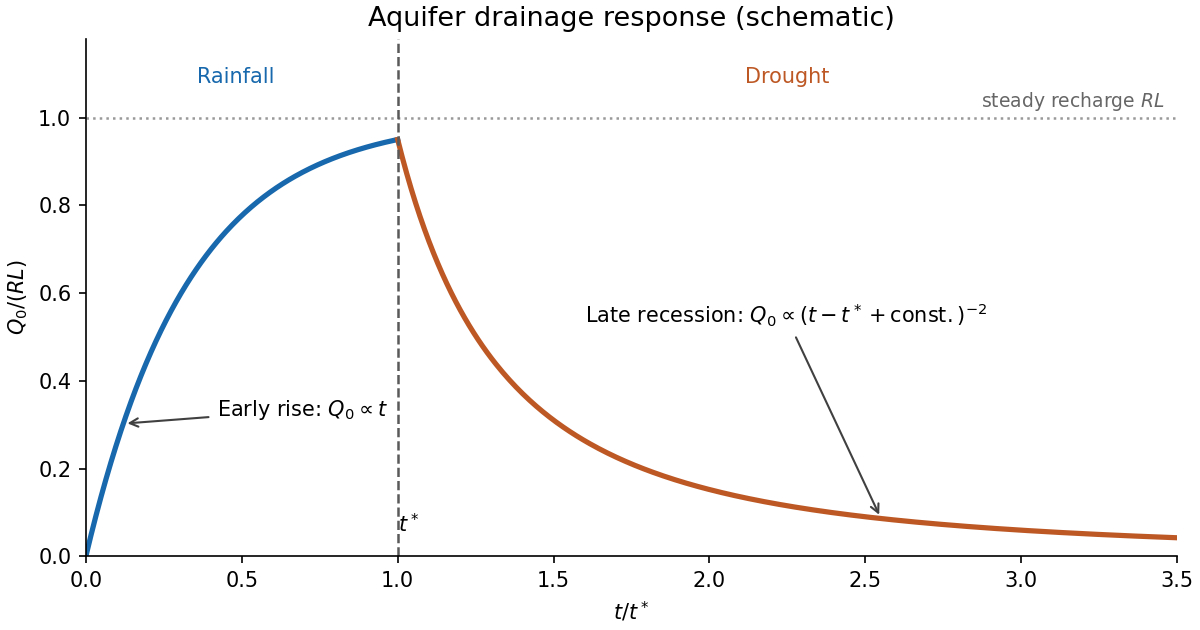
Let . The spatial ordinary differential equation gives , so its leading outlet behavior isAgain this is a square-root drainage boundary. For the separable aquifer drawdown, the dimensional drainage flux isEquivalently, with , it is for an exact separated profile. Integrating the spatial ordinary differential equation gives . This verifies the global mass conservation checkThus the late drainage flux follows an inverse-square power law, while stored water decays inversely with time.
The aquifer drainage hydrograph starts at zero, rises linearly in the early rainfall similarity solution, and approaches the total recharge if rainfall lasts long enough for a finite-length steady state. Indeed, steady mass conservation gives and , hence . At , the outlet flux stays continuous for a regular inherited flux profile, then recedes as water drains; the eventual decay is proportional to . An arbitrary transition requires the full time-dependent partial differential equation, so matching an early rainfall formula directly to a separated drought formula is only a schematic approximation.

Articles by others on the same topic
There are currently no matching articles.